

Industries · Government partners
Governments & Public Institutions
The evidence layer a finance ministry, debt office or investment promotion agency needs to be read accurately by the market — and sovereign AI built to be owned locally.
- 200–400bp
- the spread African issuers have paid above similarly rated emerging-market peers
- $15.5bn
- financing a one-notch continental improvement has been estimated to unlock
- $75bn
- estimated cost of subjective assessment to African sovereigns (UNDP, 2023)
- 85
- languages in the Kilwa source registry
African sovereigns borrow at a premium their fundamentals do not fully explain. Before the pandemic, African eurobond spreads ran 200 to 400 basis points wider than similarly rated emerging markets elsewhere — a gap that persists after the rating itself is controlled for. Part of that is an evidence gap, and an evidence gap is addressable.
The problem
What makes this hard
The premium survives the rating
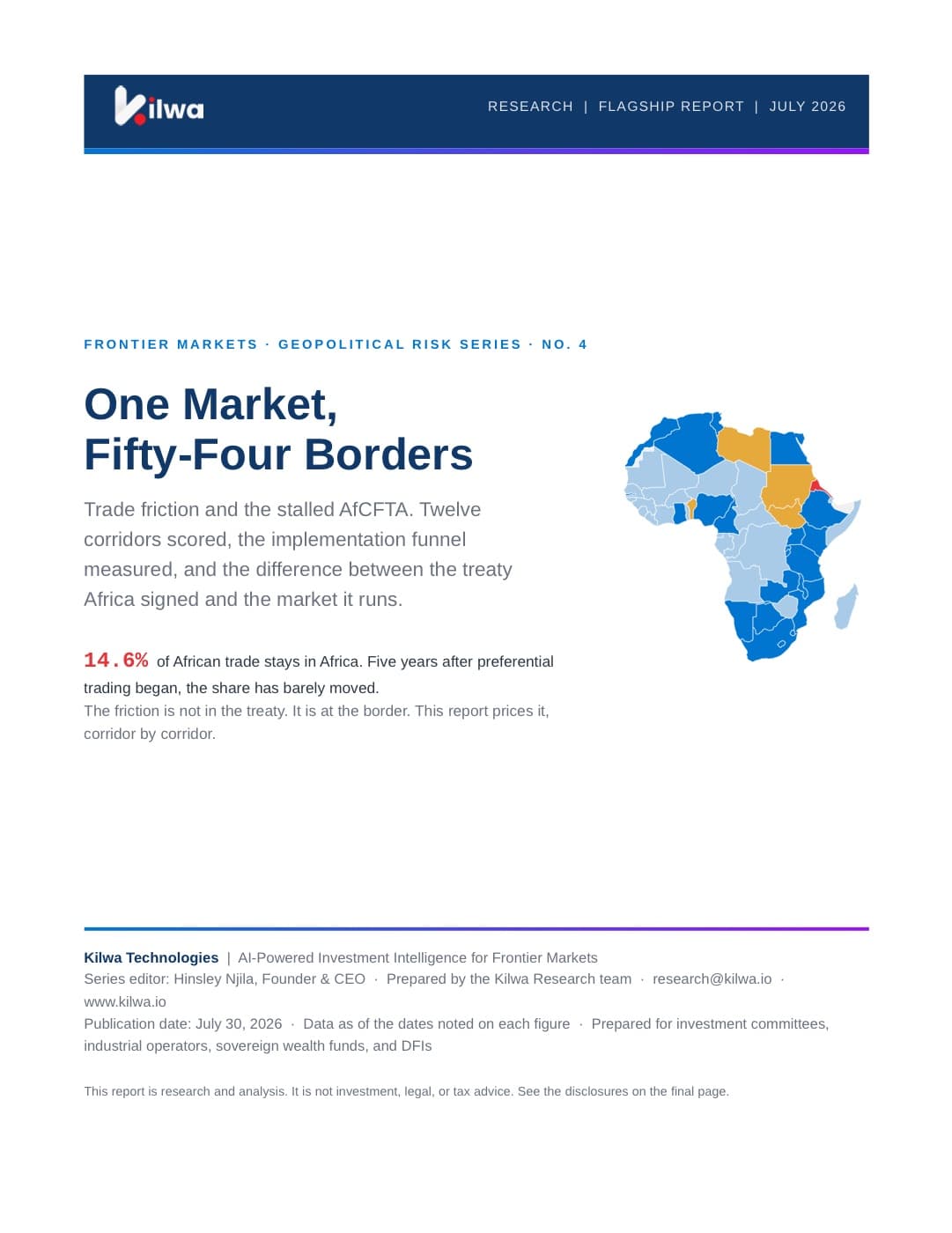
Two sovereigns rated the same do not borrow at the same price. African issuers have paid 200–400bp above identically rated peers, which is a gap the rating does not account for and the market has never had to justify.
One notch is real money
A single-notch downgrade can add more than 100 basis points — roughly $100m a year on a $10bn book — and a fall to sub-investment grade has raised treasury bill rates by 138bp on average. The asymmetry runs the other way too: a one-notch improvement across the continent has been estimated to unlock $15.5bn in financing.
The data that would answer it is not published in a form the market reads
The IMF withholds projections for sovereigns in restructuring — exactly when a government most needs to be understood. Investment promotion agencies compete for capital using indicators that describe the market as it was a year ago.
Capability arrives imported, and expires
AI systems delivered without local capacity become dependencies. The models that work at scale were not trained on the languages most public services are actually delivered in.
With Kilwa
What changes
An evidence base you can put in front of the market
Scored, sourced and provenance-flagged, published on a fixed calendar. Kilwa does not rate sovereigns and cannot move a rating — what it provides is the reliable-data layer that critics and defenders of the rating agencies both name as the remedy.
Scored when the standard sources go quiet
Kilwa scores markets the IMF omits during restructuring, flags every estimate as an estimate, and publishes what would change the number. A government in a restructuring is not absent from the record.
Investment promotion on current signals
The same ISI and METI signals institutional investors use, in the hands of the agency courting them — so a pitch rests on this quarter's evidence rather than last year's yearbook.
Sovereign AI, owned locally
National-scale systems built with the government that will own and operate them, with small language model work in national languages and local teams trained to maintain it.
Services for this mandate
How we work with government partners.
Risk & regulatory intelligence
Risk, Resilience & Regulatory Intelligence
What changed this week, whether it touches your exposure, and which action deserves attention.
Read moreSovereign capital & investment promotion
Sovereign Capital & Investment Promotion
How global capital reads your country, where the evidence is weak, and how to close the gap.
Read moreSovereign AI
Sovereign AI & Public Data Systems
National AI and data capability built with the institutions that will own and operate it.
Read moreResearch for this mandate
All insights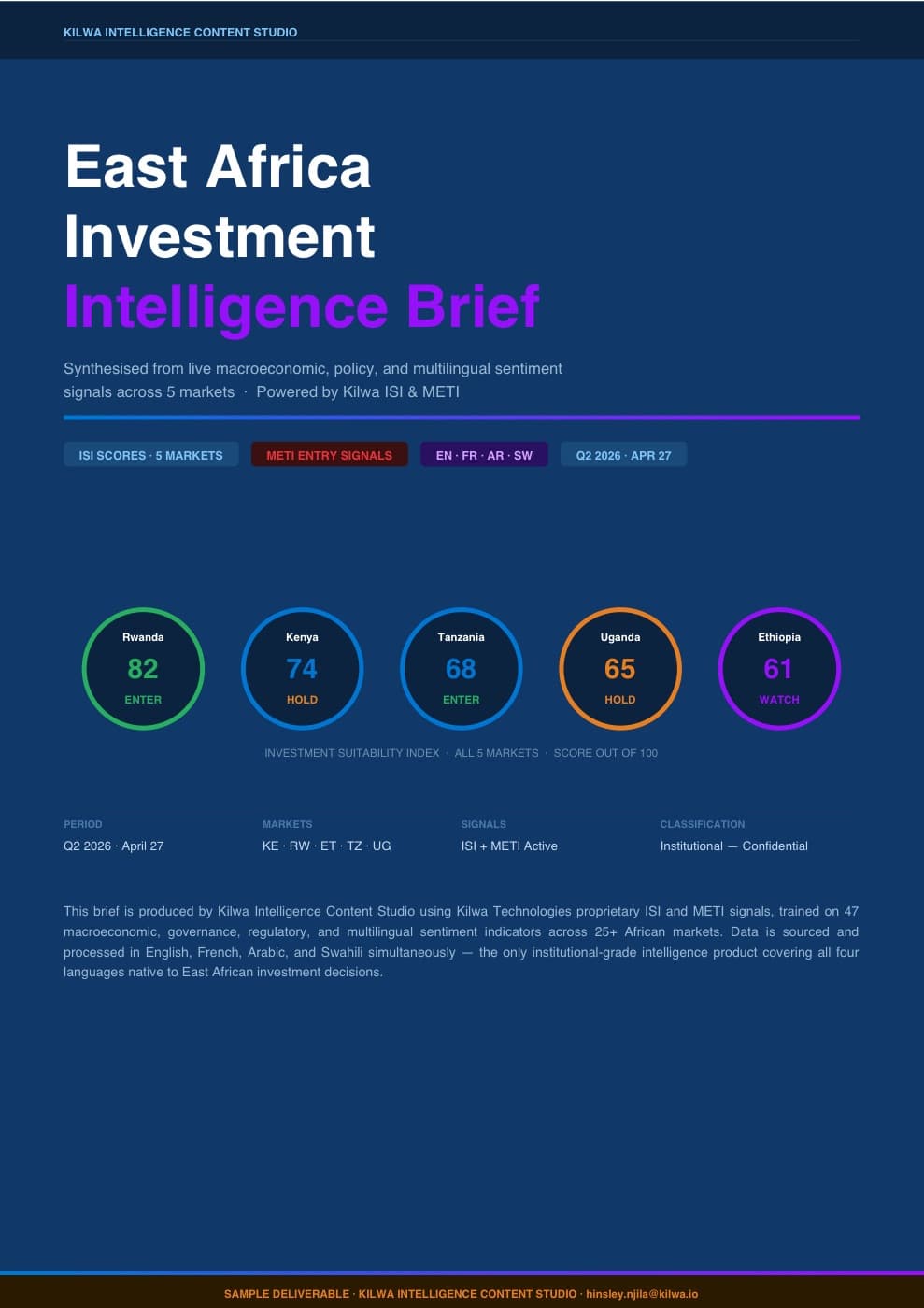

Get started
Built for government partners.
A working session on the markets you follow, with the decomposition behind every score.