Geopolitical Risk · No. 4
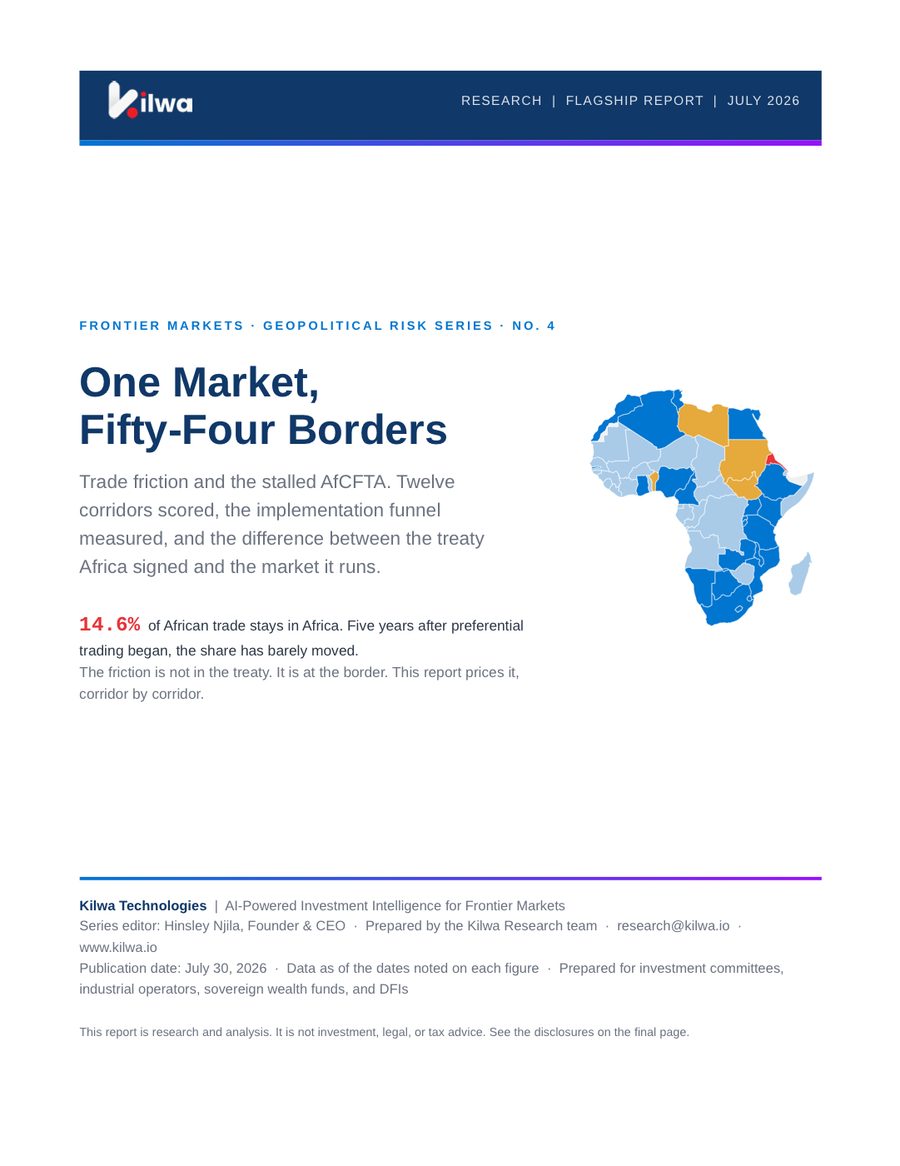
One Market, Fifty-Four Borders
Trade friction and the stalled AfCFTA
Twelve corridors scored, the implementation funnel measured, and the difference between the treaty Africa signed and the market it runs.
Series editor Hinsley Njila, Founder & CEO · Prepared by the Kilwa Research team
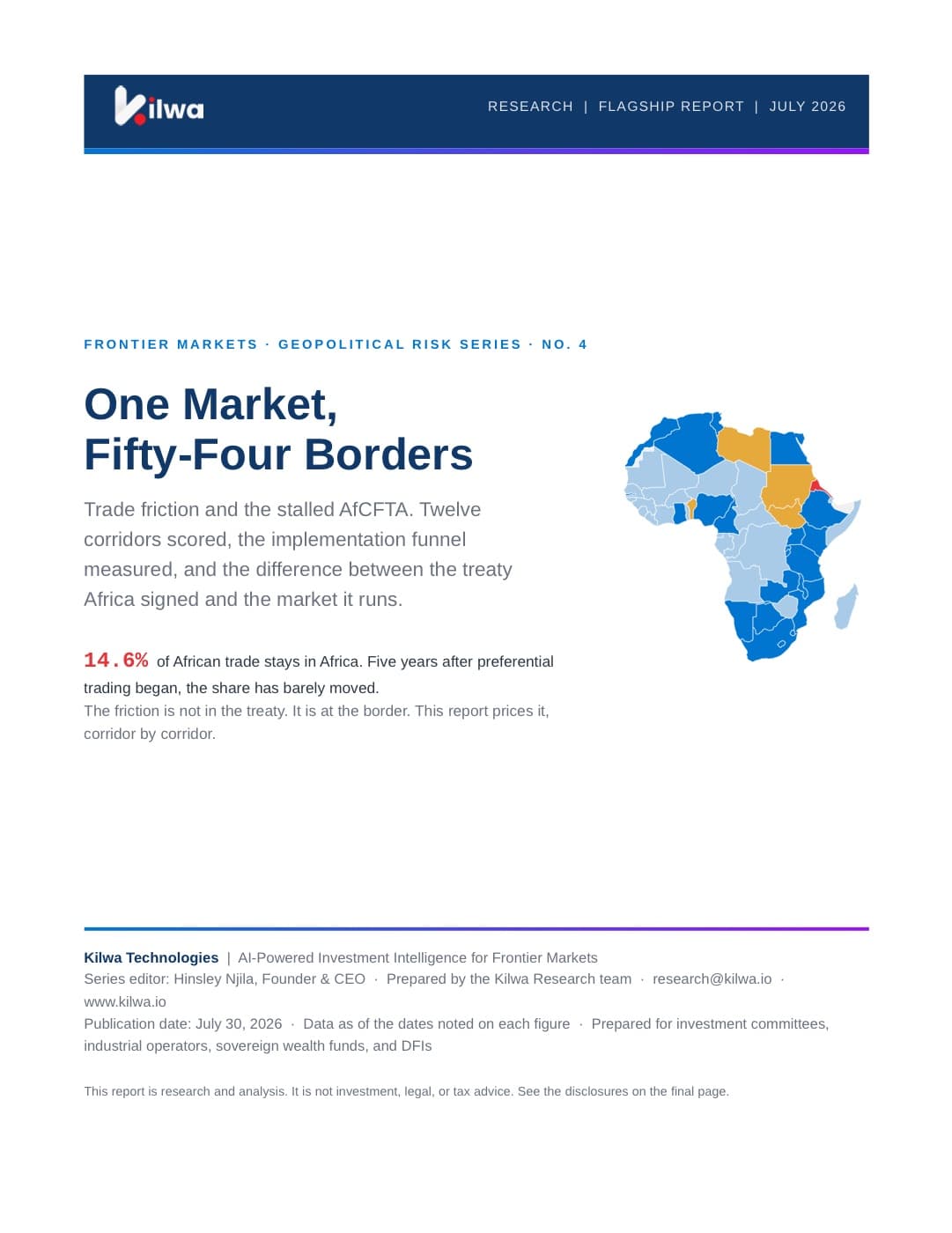
of African trade stays in Africa. Five years after preferential trading began, the share has barely moved
The report, in brief
What it is, who it is for, and what you get.
Trade friction under the AfCFTA, measured at the border: twelve corridors scored.
Written for
Logistics, consumer-goods and manufacturing strategy teams
Which corridors actually move goods, and what friction costs on each.
Trade-finance providers and DFIs
Where implementation is real enough to finance.
Investors in regional platforms
The four ways friction taxes capital.
Trade ministries and promotion agencies
How the border scores against the treaty.
What you get
- Twelve corridors scored
- The implementation funnel, measured
- Four ways friction taxes capital
- 26 pages as a PDF, delivered the moment payment clears
The call
The African Continental Free Trade Area is the largest free trade area in the world by membership and the least implemented by volume. The market keeps scoring the treaty. It should be scoring the border.
The friction is not in the treaty. It is at the border.
Europe runs 68% intra-regional trade. Asia runs 59%. Africa runs 14.6% — and the border is where the continent's industrial scaling either happens or doesn't.
UNCTAD puts the annual gain from removing non-tariff barriers at $20bn against $3.6bn from tariff cuts. The tariff conversation is roughly one-sixth of the prize and absorbs most of the political attention.
“The market keeps scoring the treaty. It should be scoring the border.”
Four ways friction taxes capital
We separate the margin tax, the scale ceiling, the policy whiplash and the payments toll — because an industrial operator and a private equity underwriter feel these in different line items.
- 01The margin tax97 hours of border compliance is working capital sitting still, priced into every unit.
- 02The scale ceilingRules of origin that exclude autos and textiles cap exactly the sectors that industrialise.
- 03The policy whiplashA trade war that lasted five weeks still repriced a corridor for two quarters.
- 04The payments tollCurrency conversion through a third currency is a tax collected in basis points.
The numbers
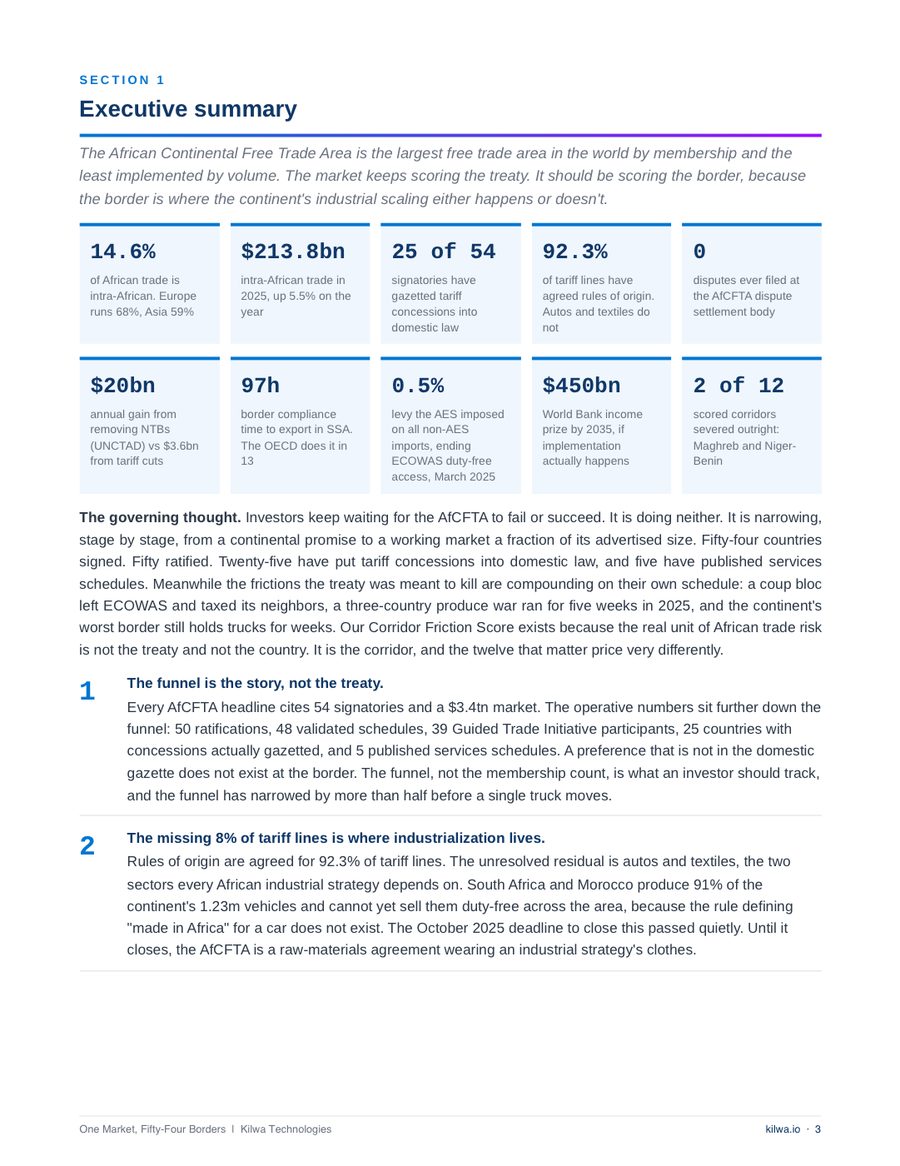
- $213.8bn
- intra-African trade in 2025, up 5.5% on the year
- 25 / 54
- signatories have gazetted tariff concessions into domestic law
- 92.3%
- of tariff lines have agreed rules of origin. Autos and textiles do not
- 0
- disputes ever filed at the AfCFTA dispute settlement body
- $20bn
- annual gain from removing non-tariff barriers, vs $3.6bn from tariff cuts
- 97h
- border compliance time to export in Sub-Saharan Africa. The OECD does it in 13
Series editor: Hinsley Njila, Founder & CEO. Prepared by the Kilwa Research team. research@kilwa.io
This report is research and analysis. It is not investment, legal or tax advice. Kilwa scores are structured risk rankings, not validated predictive models, except where explicitly stated otherwise. It is prepared for general circulation on a published schedule and is not tailored to any recipient.
Conflicts of interest. Kilwa does not hold, trade or take positions in the securities, currencies or instruments of the markets it scores, and receives no compensation from any government, issuer or institution in exchange for a score, a rating or favourable coverage. Where a research programme is funded by a named partner, that funding is disclosed in the report.