

Platform · METI
When should it move?
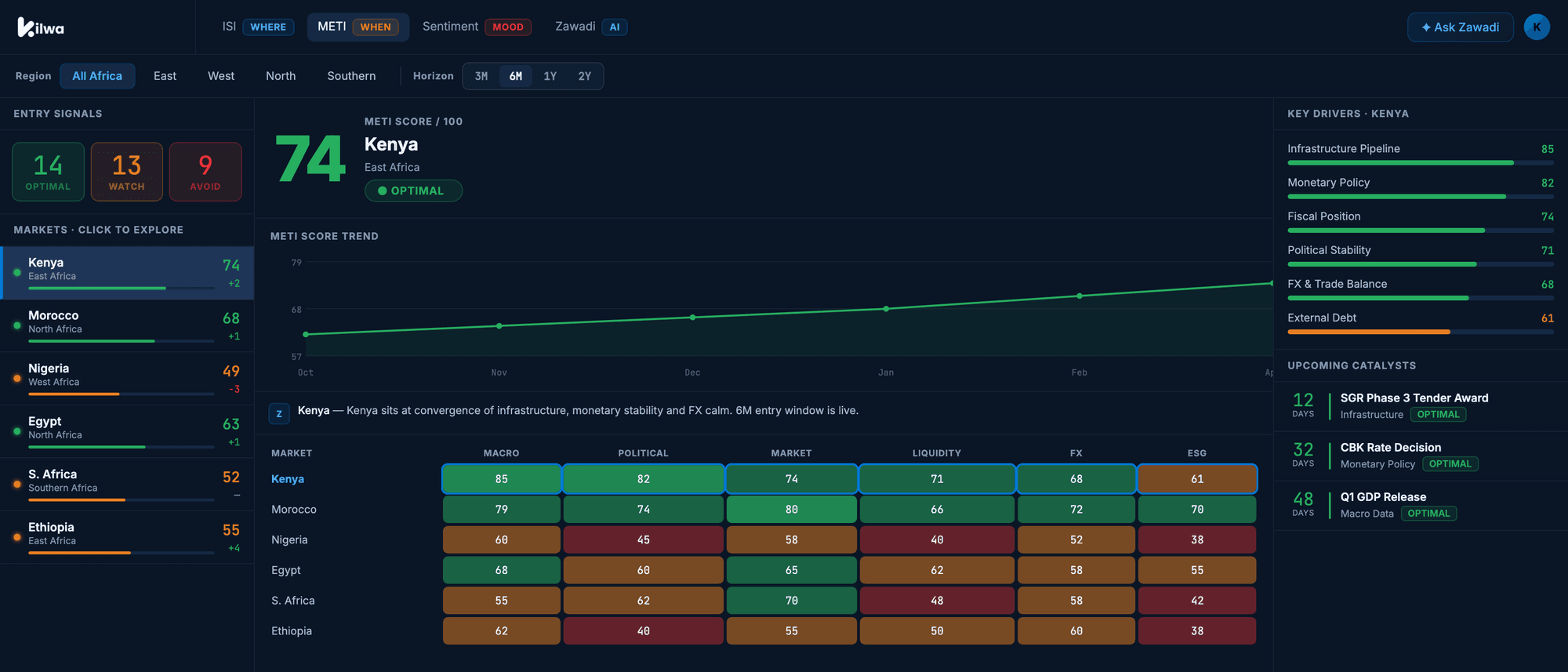
A predictive forecasting engine that fuses time-series analysis with NLP-driven sentiment tracking from news and policy statements to identify optimal entry windows.
- 1–6
- month forecast windows
- 68
- day window identified in Rwanda, Q2 2026
- 3
- postures: optimal, watch, avoid
Predictive timing intelligence
What METI is
The Market Entry Timing Index (METI) is Kilwa's timing model for frontier markets. It fuses time-series analysis with multilingual news and policy sentiment to forecast 1 to 6 month entry windows, returning an OPTIMAL, WATCH or AVOID posture with a confidence indicator for each market covered.
Suitability without timing is half an answer. METI forecasts 1–6 month entry windows by combining structured time-series signals with multilingual sentiment drawn from local news and policy sources.
The output is an explicit posture — OPTIMAL, WATCH or AVOID — attached to a window and a confidence indicator, rather than a directional opinion the reader has to translate into a decision.
METI is the reason our East Africa brief could put a 68-day window on Rwandan digital infrastructure rather than describing the market as 'attractive'. The posture is a property of the market under a published methodology, not a recommendation to any reader.
Capabilities
Hybrid forecast
The Sentiment Pulse delta enters a time-series forecast as an exogenous variable, so a high-frequency signal informs a low-frequency one instead of competing with it.
Learned weighting
A Bayesian optimisation process tunes how hard the sentiment signal is weighted, rather than fixing it by assumption.
1–6 month windows
Forecast horizons matched to how institutional deployment decisions are actually scheduled.
OPTIMAL / WATCH / AVOID
An explicit posture per market, with a confidence indicator attached.
Sentiment fusion
Structured time-series and unstructured multilingual sentiment enter the same model.
Evaluated against outcomes
Windows are evaluated against realised outcomes, and the evaluation method is published with the model card.
Seen in the research
Kilwa Atlas No. 6: Five Gates — Private Credit in Africa
Capital for African private credit tripled in five years, and more than half of the money raised between 2021 and 2024 was still waiting to be lent. This Atlas explains why with one idea: a private loan has to pass five gates before the lender is repaid, and in most markets at least one is shut. The Private Credit Conditions Index scores each gate from 0 to 100 in twenty markets, a screen puts all 54 into four lanes on court speed and the proceeds gate, and five enforcement precedents show what lenders actually got back and how long it took.
Read the analysis
Get started
See METI running across our covered markets.
We'll walk your team through the module on the markets you follow.