Kilwa Atlas · No. 2
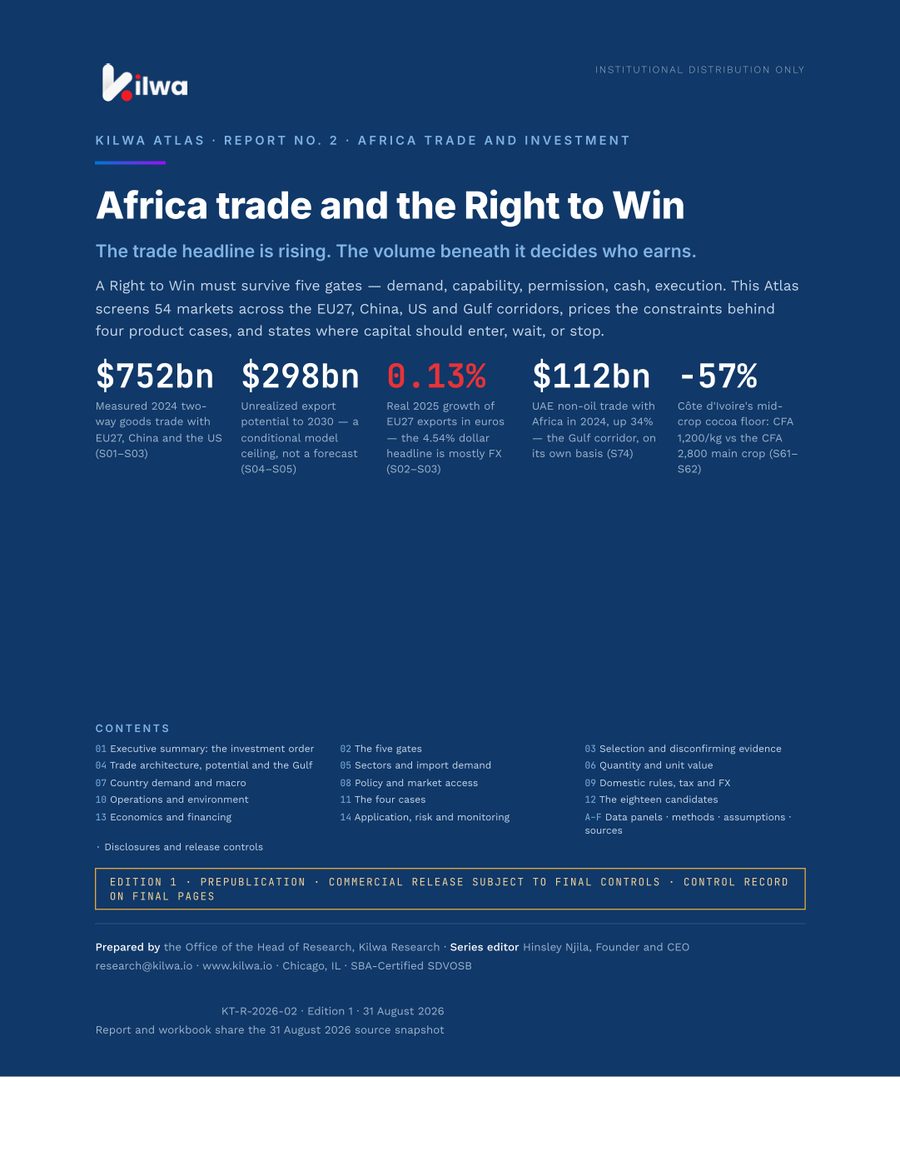
Kilwa Atlas No. 2: Africa Trade and Investment
The trade headline is rising. The volume beneath it decides who earns.
A Right to Win must survive five gates — demand, capability, permission, cash and execution. This Atlas screens 54 markets across the EU27, China, US and Gulf corridors, prices the constraints behind four product cases — Moroccan wiring, Ugandan coffee, Kenyan roses and Ivorian cocoa — and states where capital should enter, wait or stop.
Series editor Hinsley Njila, Founder & CEO · Prepared by the Kilwa Research team
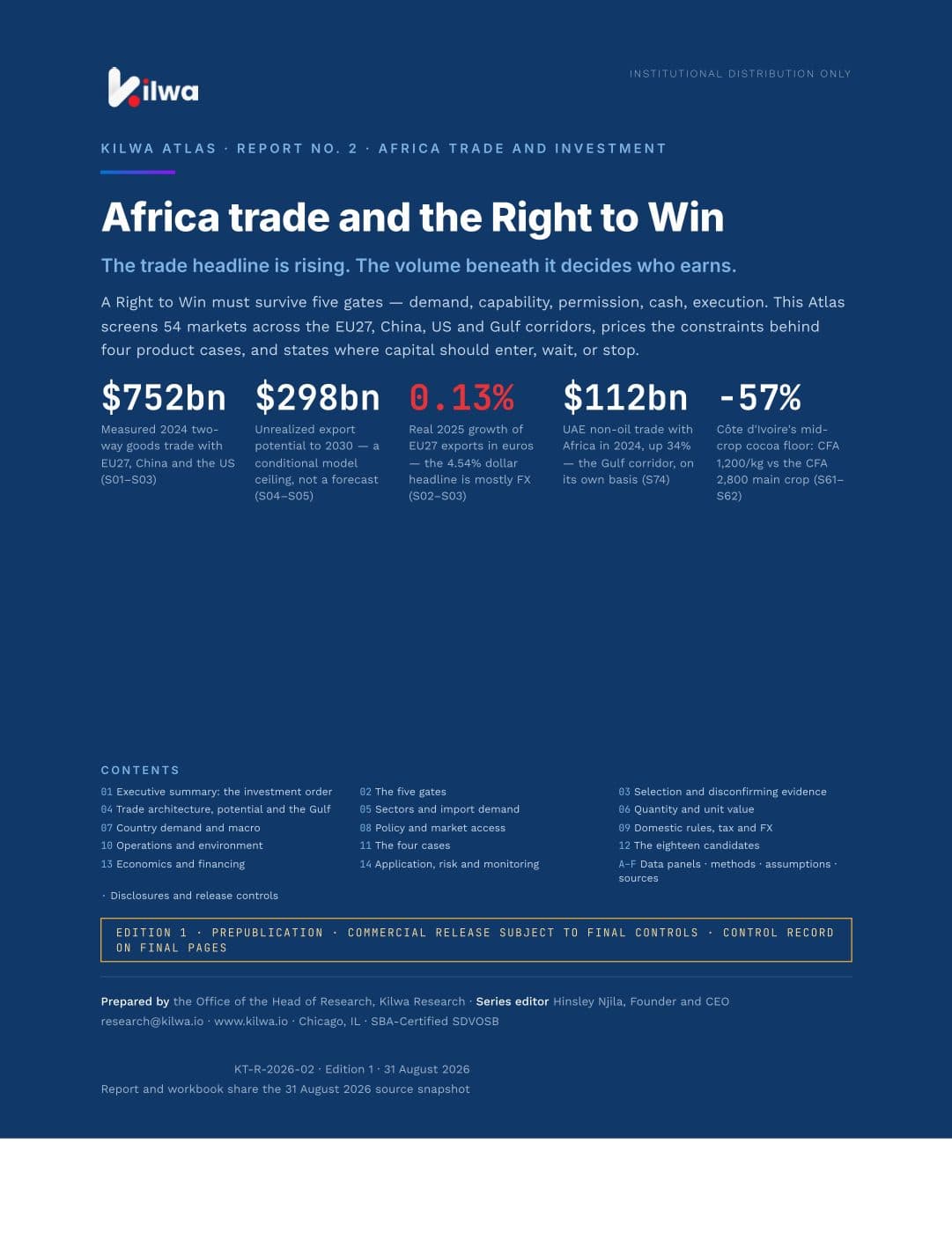
real 2025 growth of Africa's exports to the EU27 in euros, against a 4.54% dollar headline. The FX factor contributes 4.40 points; volume, not revenue, decides each case
Key takeaways
- 01
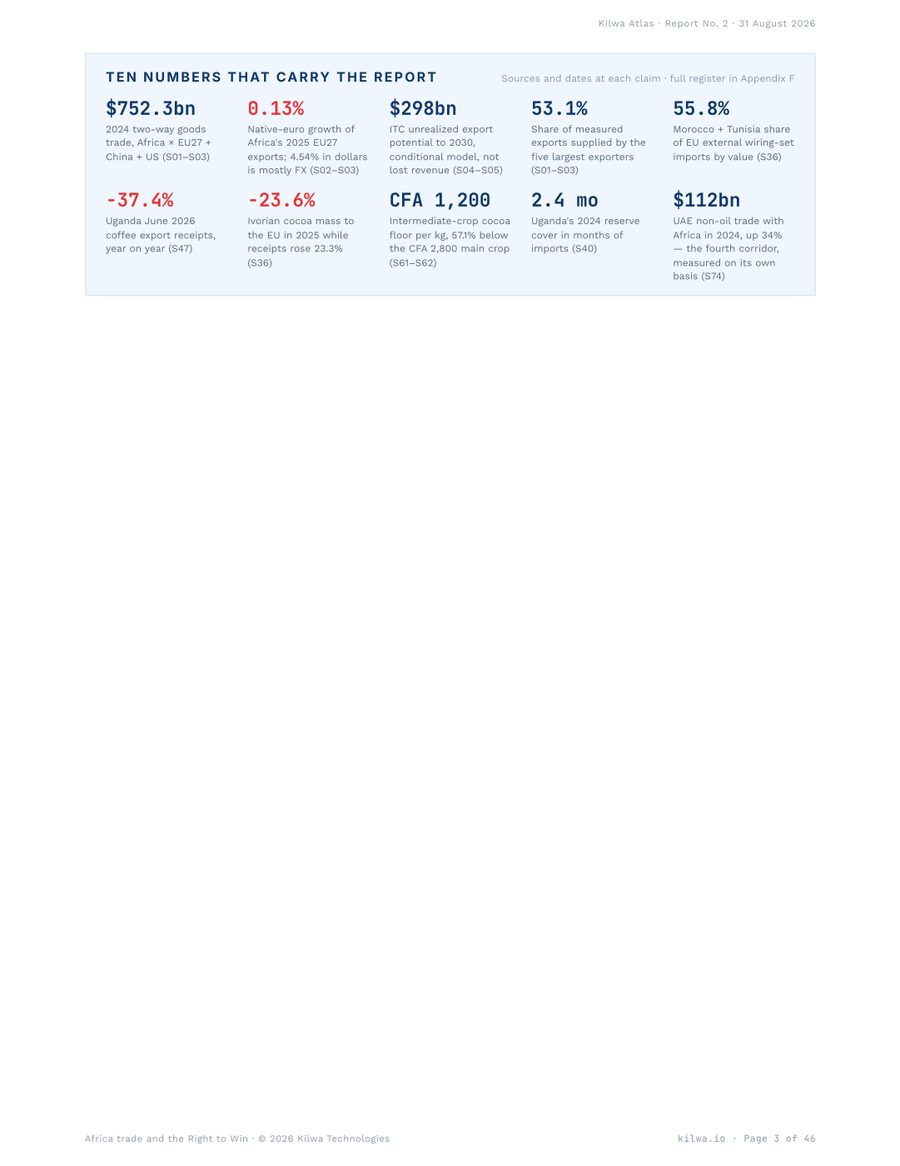
The 2025 growth headline is translation, not volume. Africa's EU27 exports grew 4.54% in dollars but 0.13% in euros; the FX factor contributes 4.40 points.
- 02
Volume divergence is the buy/stop signal. Ivorian cocoa receipts rose 23.3% on 23.6% less mass, and Uganda's June 2026 coffee receipts fell 37.4%. Procurement, inventory values and credit terms move before the annual data do.
- 03
A fourth corridor is forming on capital, not customs. UAE non-oil trade with Africa reached $112bn in 2024, up 34%, with Gulf FDI commitments near $113bn over 2022 to 2023, logistics- and minerals-led and measured on a different basis from the EU–China–US matrix.
- 04
The policy calendar is the underwriting clock: EUDR traceability from 30 December 2026, AGOA's authorisation ending 31 December 2026, CBAM's first certificate sales in February 2027, China's non-LDC zero-tariff window closing 30 April 2028.
- 05
Country scores cannot clear asset gates. The five-gate method stops a case on one hard failure — demand, capability, permission, cash or execution — regardless of the composite.
- 06
The product is a screen, not underwriting: reproducible evidence, researched constraints and ranked diligence priorities. No project return is asserted and none should be inferred.
The report, in brief
What it is, who it is for, and what you get.
Where African trade actually earns: 54 markets, four corridors and four product cases priced through five gates.
Written for
Corporate strategy and supply-chain leads
Which of four corridors your product can win in, and which gate stops it.
Trade-finance and working-capital lenders
Where order-linked working capital works, and where inventory risk does not.
Agribusiness and manufacturing investors
Enter, wait or stop verdicts on Moroccan wiring, Ugandan coffee, Kenyan roses and Ivorian cocoa.
Investment promotion agencies
How a Right to Win is tested: demand, capability, permission, cash and execution.
What you get
- A 54-market screen across four corridors
- Four product cases, with the constraint priced at each gate
- The investment order: the action now, and the main reason to stop
- The Gulf corridor read: capital, ports and food security
- What would change the view
- 46 pages as a PDF, delivered the moment payment clears
The call
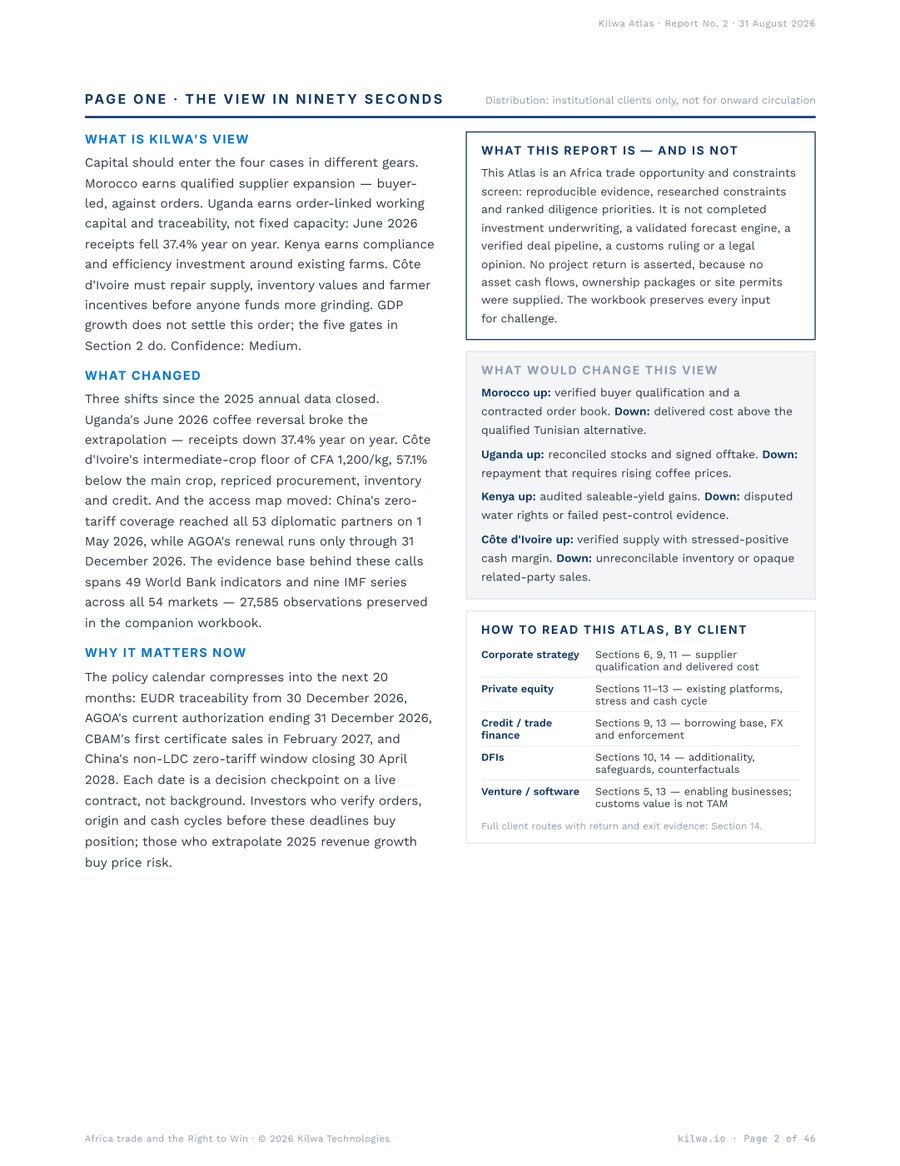
Capital should enter the four cases in different gears. Morocco earns qualified supplier expansion, buyer-led and against orders. Uganda earns order-linked working capital and traceability, not fixed capacity. Kenya earns compliance and efficiency investment around existing farms. Côte d'Ivoire must repair supply, inventory values and farmer incentives before anyone funds more grinding. GDP growth does not settle this order; the five gates do. Confidence: medium.
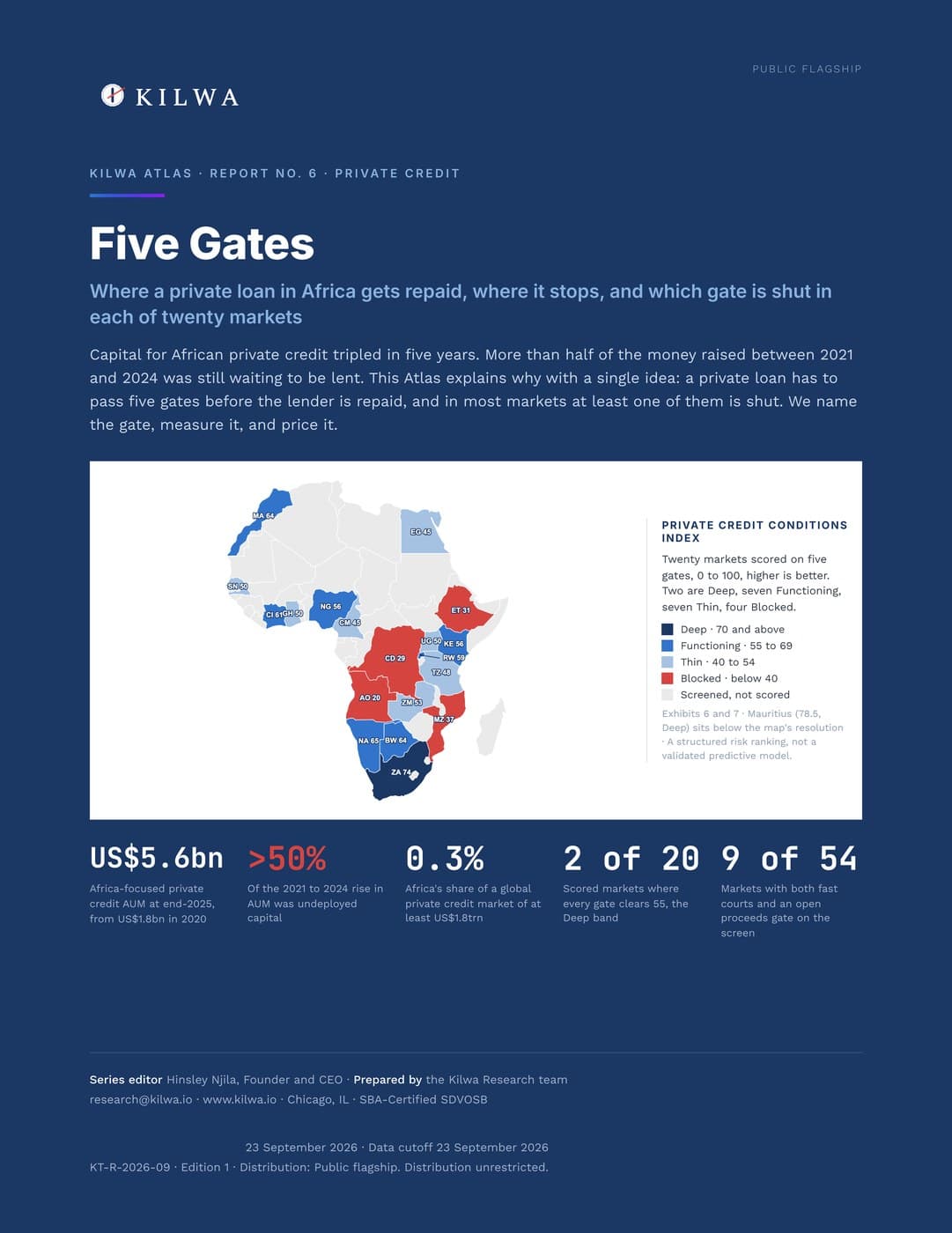
A Right to Win must survive five gates
Demand: verified product demand, buyer access and an achievable sales forecast — never GDP or import growth as a proxy. Capability: qualified supply, competitive cost, reliable inputs and workforce, with the missing capability costed before expansion. Permission: origin, product rules, ownership, site, water and environmental approvals, with the affected activity paused until cleared. Cash and financing: positive contribution, a funded cash cycle, FX exposure and repayable debt, or the case is resized, restructured or rejected. Execution and impact: an accountable operator, a feasible timetable, safeguards and measurable results, with funding staged against evidence.
A fatal constraint cannot be averaged away. A country can score highly on trade capability and still fail a gate; the cocoa case shows why. The gates therefore run in sequence, and one hard failure stops the case regardless of the composite picture. No validated ISI or METI forecast appears in this edition — both remain in independent validation — and no composite score turns unknown project costs into a precise investment ranking.
“A fatal constraint cannot be averaged away.”
Four corridors, four gears for capital
The evidence base spans 49 World Bank indicators and nine IMF series across all 54 markets, 27,585 observations preserved in the companion workbook, and four product cases chosen because they offer unusually clear evidence on value, physical shipments and supplier share. That clarity is also a selection bias, so the search space stays open and the disconfirming evidence stays on the page.
- 01Morocco wiring · fund the qualified order, then the lineMorocco holds 35.1% of the EU's external wiring-set market against Tunisia's 20.8% and Serbia's 12.5%, with a verified Kenitra cluster. The binding tests: a named platform with approved-supplier status, delivered cost proven by a bill of materials and twelve months of yield data, and incremental orders that cover tooling and working capital. Preferred route: supplier development or investment in an existing qualified business.
- 02Uganda coffee · finance the crop without uncontrolled price riskA record 2025 of roughly 8.7 million 60-kg bags and US$2.5bn met a hard reversal in June 2026: 744,540 bags against 979,702 a year earlier, receipts down 37.4%. The top ten exporters moved 66.2% of June volume. Preferred route: trade finance, logistics, drying and traceability services linked to verified flows, with stocks tested at stressed realisable prices.
- 03Kenya roses · protect market access, improve saleable yieldCompliance and efficiency investment around existing farms, with EU audit scrutiny of false codling moth controls active since October 2025. Stop if water rights, pest-control evidence or export logistics fail.
- 04Côte d'Ivoire cocoa · repair supply before funding more grindingThe intermediate-crop floor of CFA 1,200/kg sits 57.1% below the main-crop CFA 2,800, repricing procurement, inventory values and credit. Upgrade only on verified supply with a stressed-positive cash margin; stop on unreconcilable inventory or opaque related-party sales.
The Gulf: a corridor built on capital, ports and food security
UAE non-oil trade with Africa reached $112bn in 2024, up 34%, and Gulf FDI commitments ran near $113bn over 2022 to 2023 — logistics- and minerals-led, and measured on its own basis rather than the EU–China–US goods matrix. Gulf engagement runs infrastructure-first: ports and logistics, minerals, food-security procurement and sovereign capital that moves faster than DFI processes. The indicator that matters is announcement-to-close conversion on African ports and minerals, not the headline commitment.
Political and counterparty risk must be transaction-specific. Five channels, each with an observable trigger: trade-preference changes, conflict and route disruption, policy and tax reversal, counterparty failure, and sanctions and ownership — where OFAC's 50% rule can block an unlisted entity through aggregate ownership. Uganda's June coffee exposure to Sudan, 12.9% of monthly volume, shows why a destination share is a weak diversification measure.
What would change our view
Morocco up on verified buyer qualification and a contracted order book; down on delivered cost above the qualified Tunisian alternative. Uganda up on reconciled stocks and signed offtake; down on repayment that requires rising coffee prices. Kenya up on audited saleable-yield gains; down on disputed water rights or failed pest-control evidence. Côte d'Ivoire up on verified supply with a stressed-positive cash margin; down on unreconcilable inventory or opaque related-party sales.
The monitoring board tracks eight indicators in the order they would move: Uganda's monthly coffee volumes and unit values, Côte d'Ivoire's 2026/27 main-crop floor, AGOA's post-2026 legislative action, EUDR importer readiness in cocoa and coffee, EU wiring-set import mass and the Morocco and Tunisia shares, China's preference utilisation, Gulf announcement-to-close conversion, and Kenyan rose consignment rejections. The next trade edition grades every dated reading against what happened, in public, with misses stated as plainly as hits.
The numbers
- $752bn
- Africa's measured 2024 two-way goods trade with the EU27, China and the US
- $298bn
- unrealised export potential to 2030 on the ITC's conditional model — a ceiling, not a forecast
- −37.4%
- Uganda's June 2026 coffee export receipts year on year, the reversal that broke the extrapolation from a record 2025
- $112bn
- UAE non-oil trade with Africa in 2024, up 34% — a fourth corridor forming on capital, not customs
The model, in one table
The investment order
| Case | Action now | Main reason to stop |
|---|---|---|
| Morocco wiring | Buyer-led supplier expansion | No buyer qualification, weak utilisation, or an uncompetitive delivered cost. Stop if the project needs unapproved tax relief or utilisation unsupported by orders. |
| Uganda coffee | Selective working capital and traceability | June 2026 receipts fell 37.4% year on year; unhedged inventory or unverified orders. A fall in headline export value is manageable for service models and dangerous for an unhedged inventory position. |
| Kenya roses | Compliance and efficiency investment | Water rights, pest-control evidence or export logistics fail. |
| Côte d'Ivoire cocoa | Supply and balance-sheet repair | Inventory exposure, grower incentives and traceability remain unresolved. |
Kilwa judgment as of 31 August 2026 is a diligence priority, not a capital commitment or a security recommendation. The IMF projects 2026 growth of 4.9% in Morocco, 7.5% in Uganda, 4.5% in Kenya and 6.2% in Côte d'Ivoire, yet the fastest grower earns the most conditional treatment: a country average cannot establish the return on a specific business, which is why the gates run on asset-level evidence.
By market
Markets this report tiers.
Discussed by name, without a tier:
Each market page gathers every tier the published reports print for that market, dated and linked to its source.
Series editor: Hinsley Njila, Founder & CEO. Prepared by the Kilwa Research team. research@kilwa.io
This report is research and analysis. It is not investment, legal or tax advice. Kilwa scores are structured risk rankings, not validated predictive models, except where explicitly stated otherwise. It is prepared for general circulation on a published schedule and is not tailored to any recipient.
Conflicts of interest. Kilwa does not hold, trade or take positions in the securities, currencies or instruments of the markets it scores, and receives no compensation from any government, issuer or institution in exchange for a score, a rating or favourable coverage. Where a research programme is funded by a named partner, that funding is disclosed in the report.