Kilwa Atlas · No. 4
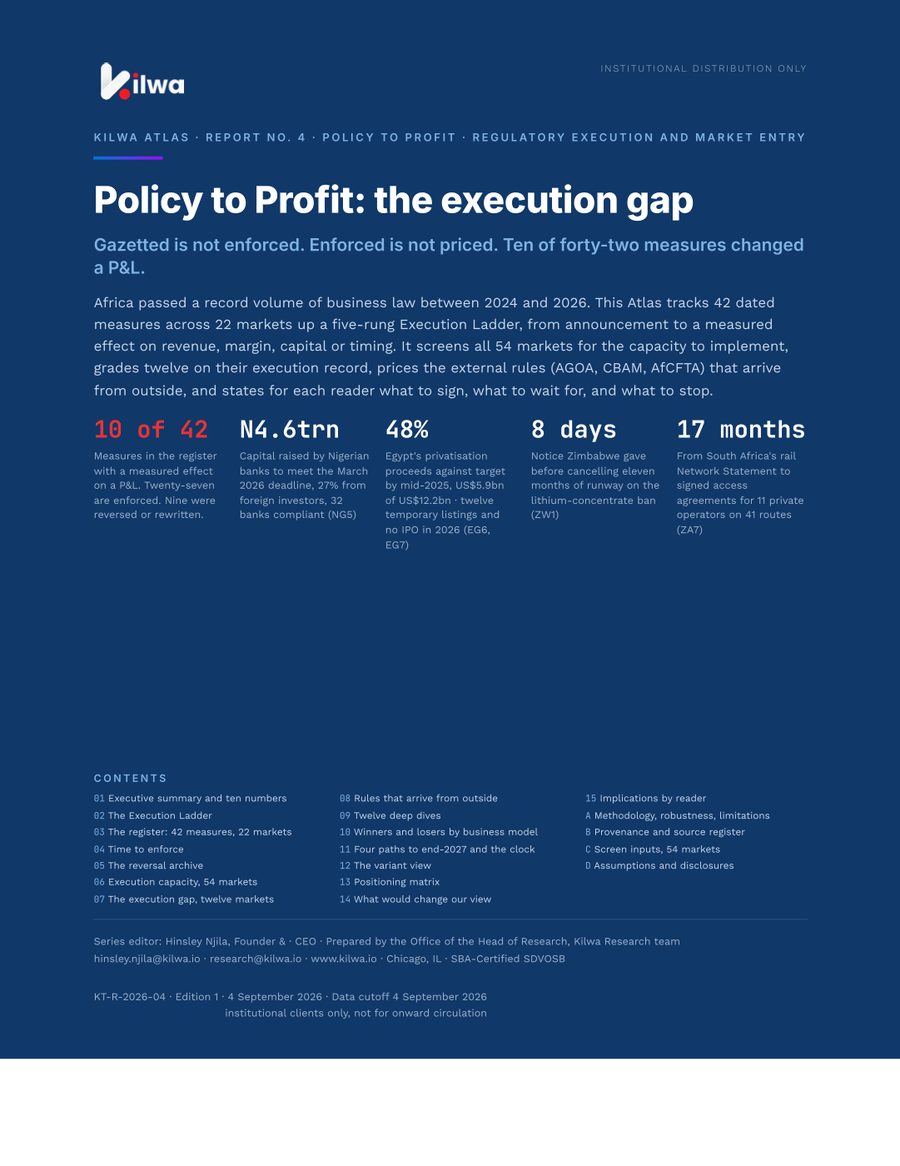
Kilwa Atlas No. 4: Policy to Profit — Regulatory Execution and Market Entry
Gazetted is not enforced. Enforced is not priced.
Africa passed a record volume of business law between 2024 and 2026, and ten of forty-two measures changed a P&L. This Atlas tracks 42 dated measures across 22 markets up a five-rung Execution Ladder, from announcement to a measured effect on revenue, margin, capital or timing; screens all 54 markets for the capacity to implement; grades twelve on their execution record; and prices the external rules — AGOA, CBAM, AfCFTA — that arrive from outside.
Series editor Hinsley Njila, Founder & CEO · Prepared by the Kilwa Research team
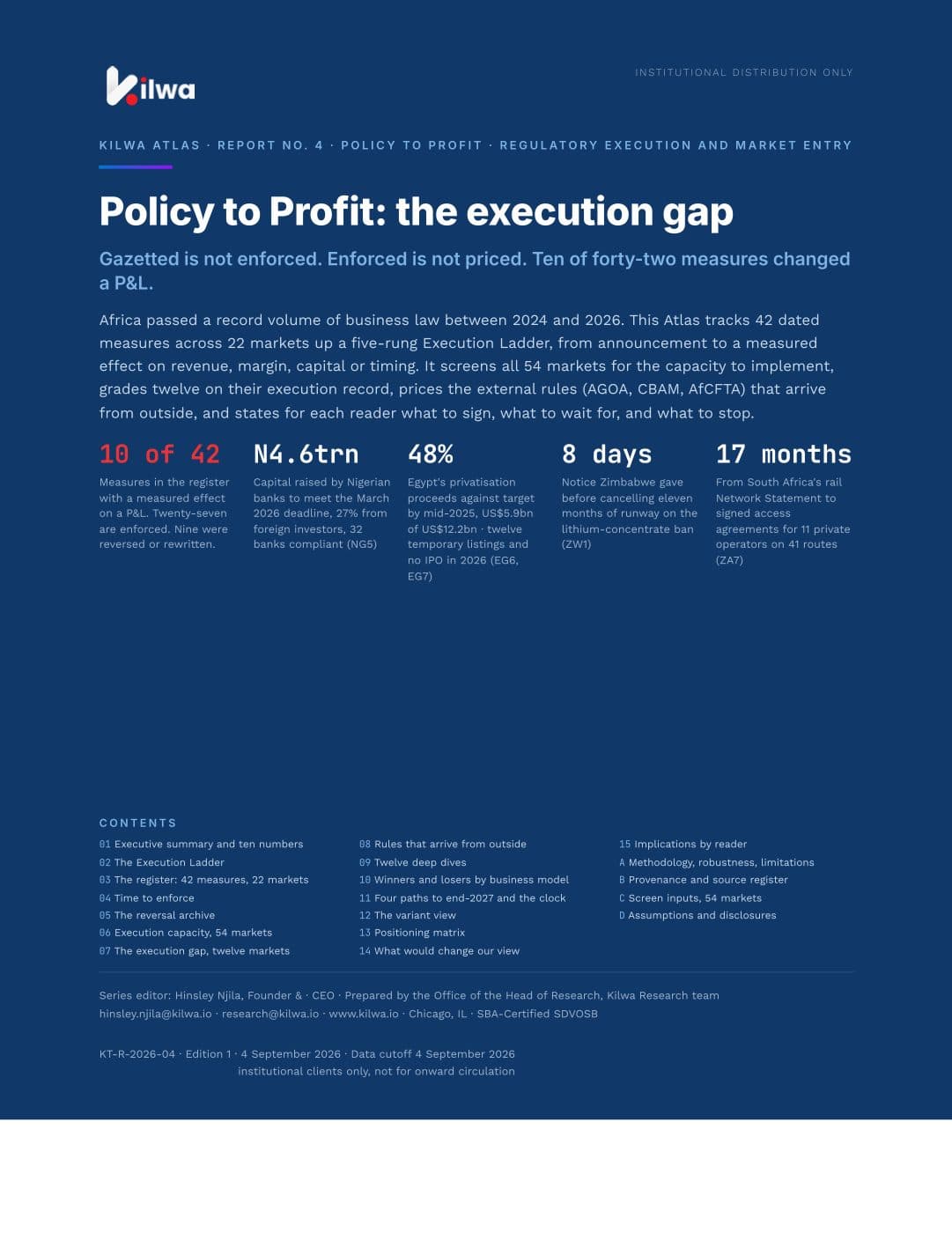
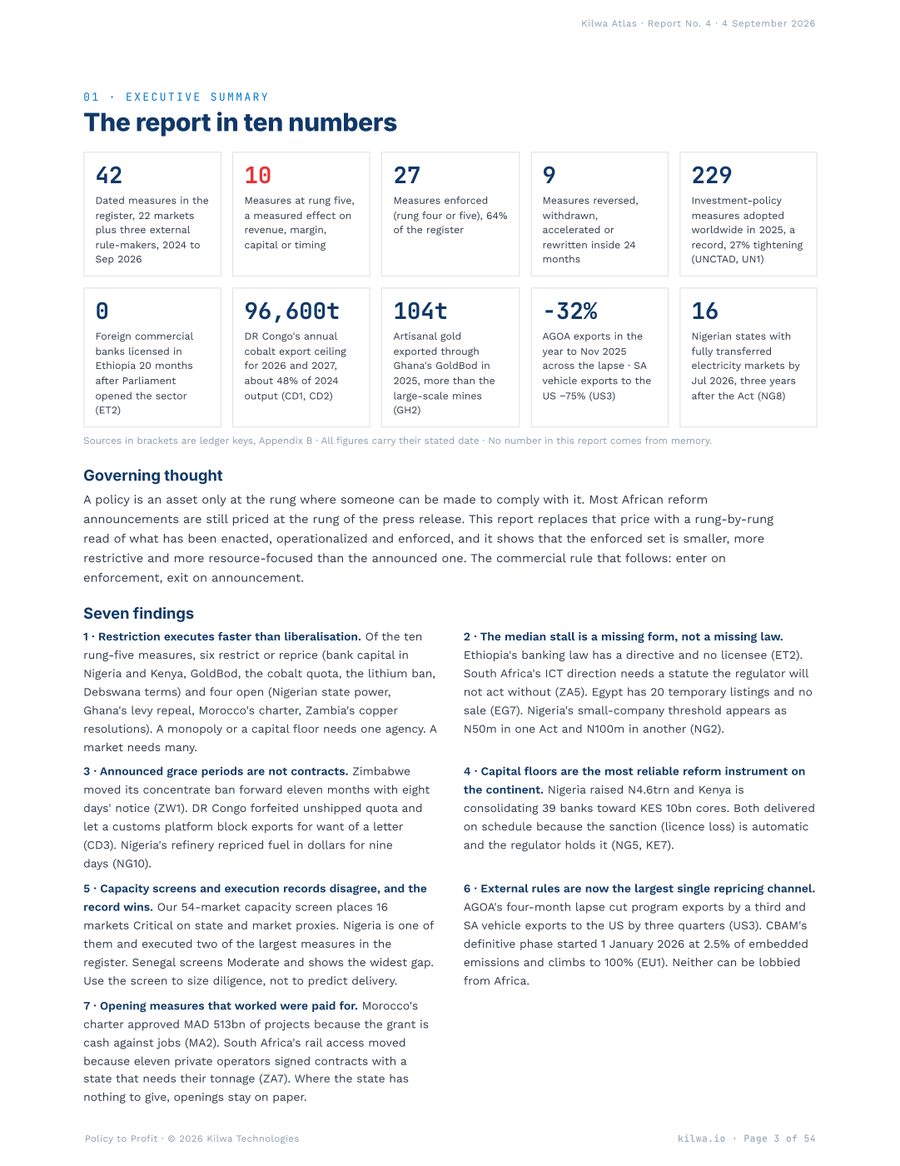
dated business measures tracked from 2024 to September 2026 that reached a measured effect on revenue, margin, capital or timing. Twenty-seven are enforced; nine were reversed or rewritten
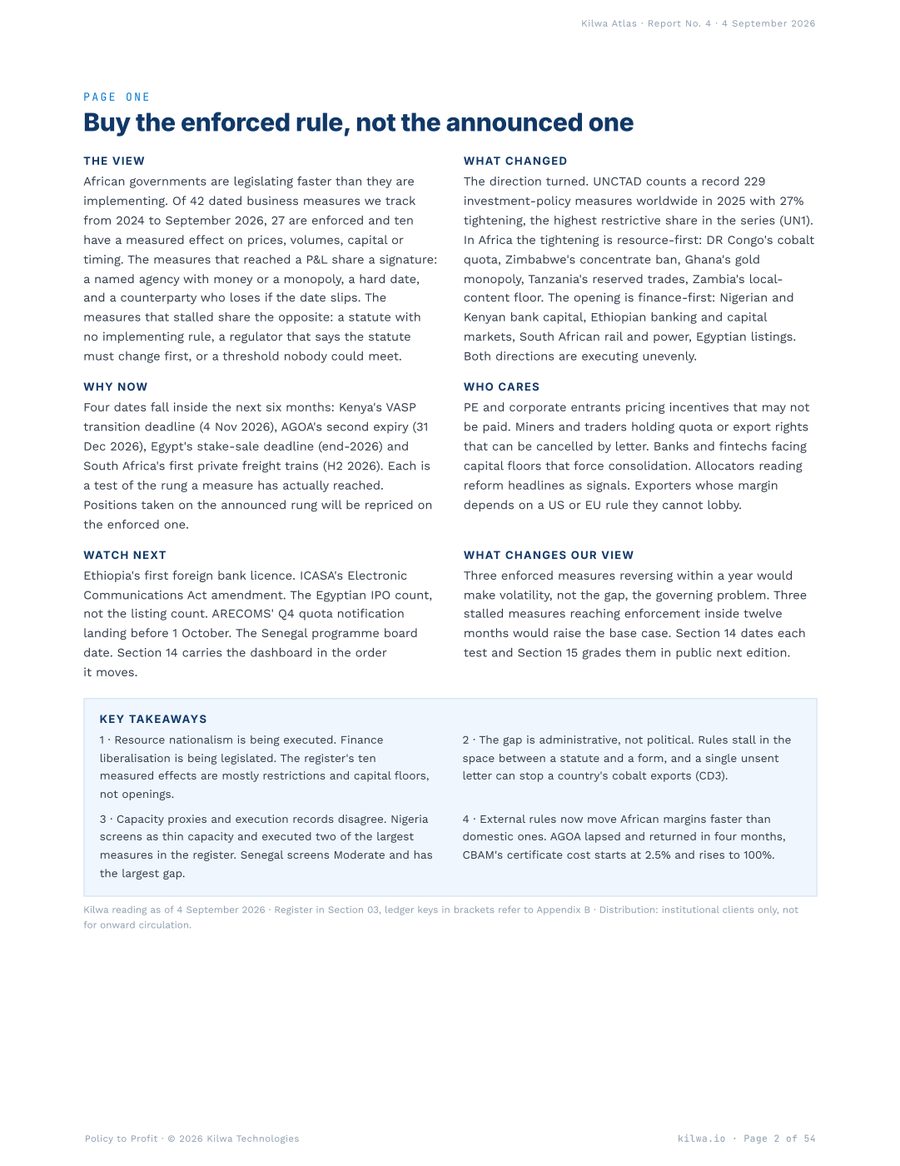
Key takeaways
- 01
Restriction executes faster than liberalisation. Of the ten measures with a measured effect, six restrict or reprice — bank capital floors in Nigeria and Kenya, Ghana's GoldBod, DR Congo's cobalt quota, Zimbabwe's lithium ban, Debswana's terms — and four open.
- 02
The median stall is a missing form, not a missing law. Ethiopia's banking law has a directive and no licensee; Egypt has 20 temporary listings and no sale; South Africa's ICT direction waits on a statute the regulator will not act without.
- 03
Announced grace periods are not contracts. Zimbabwe moved its concentrate ban forward eleven months with eight days' notice, and DR Congo let a customs platform block exports for want of a letter.
- 04
Capital floors are the most reliable reform instrument on the continent. Nigeria raised N4.6trn and Kenya is consolidating 39 banks toward KES 10bn cores, both on schedule, because the sanction is automatic and the regulator holds it.
- 05
Capacity screens and execution records disagree, and the record wins. Nigeria screens as thin capacity and executed two of the largest measures in the register; Senegal screens Moderate and shows the widest gap. Use the screen to size diligence, not to predict delivery.
- 06
External rules are now the largest single repricing channel. AGOA's four-month lapse cut programme exports by a third, and CBAM's definitive phase started on 1 January 2026 at 2.5% of embedded emissions and climbs to 100%. Neither can be lobbied from Africa.
The report, in brief
What it is, who it is for, and what you get.
Which African business laws reach a P&L: 42 measures across 22 markets, tracked from announcement to effect.
Written for
Market-entry and strategy teams
Enter on enforcement, exit on announcement: the rung each measure has really reached.
General counsel and regulatory affairs
A dated register of 42 measures, with the agency, the date and the counterparty behind each.
Investors pricing policy risk
Which markets enforce what they enact, and where the gap is volatility rather than delay.
Trade and supply-chain leads
What AGOA, CBAM and AfCFTA rules cost, priced as external rules.
What you get
- The 42-measure register across 22 markets
- The five-rung Execution Ladder, from announcement to a measured P&L effect
- Execution-gap grades for twelve markets, with the sample size printed beside each
- A 54-market screen of the capacity to implement
- Four paths to end-2027 and what would change the view
- 54 pages as a PDF, delivered the moment payment clears
The call
Enter on enforcement, exit on announcement. A policy is an asset only at the rung where someone can be made to comply with it, and the enforced set is smaller, more restrictive and more resource-focused than the announced one. The measures that reached a P&L share a signature: a named agency with money or a monopoly, a hard date, and a counterparty who loses if the date slips. The measures that stalled share the opposite.
Five rungs separate a headline from a cash flow
Atlas No. 1 refused to count announced megawatts as operating capacity. This edition applies the same discipline to rules: a measure sits on one of five rungs, from announcement through enactment and operationalisation to enforcement and a measured economic effect, and it earns a price only at the rung it has reached. Three tests decide the rung — is there a document, is there a counter, has anyone complied or been punished — and the answers are dated and sourced for every one of the 42 measures in the register.
The direction of travel has turned. UNCTAD counts a record 229 investment-policy measures worldwide in 2025 with 27% tightening. In Africa the tightening is resource-first: DR Congo's cobalt quota, Zimbabwe's concentrate ban, Ghana's gold monopoly, Tanzania's reserved trades, Zambia's local-content floor. The opening is finance-first: Nigerian and Kenyan bank capital, Ethiopian banking and capital markets, South African rail and power, Egyptian listings. Both directions are executing unevenly.
“A policy is an asset only at the rung where someone can be made to comply with it.”
Who enforces what they enact
Our 54-market capacity screen places 16 markets Critical on state and market proxies, and the proxies do not predict which enacted rules get enforced. Nigeria is one of the sixteen and executed two of the largest measures in the register. Senegal screens Moderate and shows the widest execution gap: a frozen programme and a debt restatement that has sat at rung one for nineteen months. South Africa's gap is a portfolio of statutes each waiting for something else — a market code, an Act amendment, a proclamation. Ethiopia's is the licence that has not been issued. Nigeria's number is inflated by volatility: it enforces, then changes the terms.
Opening measures that worked were paid for. Morocco's investment charter approved MAD 513bn of projects because the grant is cash against jobs. South Africa's rail access moved because eleven private operators signed contracts with a state that needs their tonnage. Where the state has nothing to give, openings stay on paper.
Four paths to end-2027
Each path is defined by what happens to the two execution risks this report measures: the gap between enactment and enforcement, and the volatility of enforced rules. Probabilities are Kilwa's subjective judgments as of the publication date, not measured frequencies and not forecasts of returns.
- 01Path A · slow widening — base case, likelyCapital floors and resource rules keep executing on their dates. Two or three stalled openings reach enforcement — a first Ethiopian licence, two Egyptian sales, the first phase of South Africa's wholesale electricity market. AGOA is extended again at the last minute. The register's share of measures with a measured effect rises from 24% toward a third by end-2027.
- 02Path B · counters open — upside, unlikelyEthiopia licenses two foreign banks, Egypt completes six sales, South Africa amends the Electronic Communications Act and runs a first private train, Senegal's programme is approved with a treatment, AGOA is renewed for a multi-year term. Opening measures reach a measured effect in numbers for the first time. The trigger is a visible political cost to non-delivery.
- 03Path C · resource ratchet — downside, roughly even chanceExport bans and quotas spread from cobalt, lithium and gold to copper concentrate, cashew and timber; local-content floors rise; Tanzania's reserved list is copied. Openings stall further, prices of the restricted commodities rise, and foreign trading margins fall. The precedent is three raw-mineral bans in twelve months.
- 04Path D · rule by letter — stress, unlikelyAdministrative reversals become the norm: grace periods cancelled by letter, quotas cut for imbalance, tax thresholds re-read, a second AGOA lapse from 1 January 2027 without refunds, CBAM extended downstream. Enforced rules stop being bankable and contracts written on rung four are repriced to rung one.
What would change our view
Twelve dated signposts, each with the reading it would change: ARECOMS' Q4 cobalt quota notification reaching customs before 1 October 2026; Kenya's VASP transition deadline and first licences on 4 November 2026; the first private freight train on a Transnet corridor in the second half of 2026; the count of completed Egyptian stake sales by 31 December 2026; AGOA's reauthorisation term at its expiry the same day; Ethiopia's first foreign commercial bank licence; and Senegal's IMF board approval with a debt-treatment perimeter by mid-2027.
Three enforced measures reversing within a year would make volatility, not the gap, the governing problem. Three stalled measures reaching enforcement inside twelve months would raise the base case. The next edition grades every signpost in public, and the substantiation file opened at publication.
The numbers
- N4.6trn
- raised by Nigerian banks to meet the March 2026 capital deadline, 27% of it from foreign investors — capital floors are the most reliable reform instrument on the continent
- 8 days
- notice Zimbabwe gave before bringing its lithium-concentrate ban forward by eleven months. Announced grace periods are not contracts
- 229
- investment-policy measures adopted worldwide in 2025, a record, with 27% tightening — the highest restrictive share in the series (UNCTAD)
- −32%
- AGOA programme exports across the four-month lapse, with South African vehicle exports to the US down about three quarters. External rules now move African margins faster than domestic ones
The model, in one table
The execution gap, twelve markets
| Execution gap | Markets | What the record says |
|---|---|---|
| Wide | Senegal, South Africa | Senegal's frozen programme and nineteen-month debt restatement; South Africa's statutes each waiting on a market code, an amendment or a proclamation. Price nothing above the rung reached, and hold contractor receivables at recovery value until the board date. |
| Material | Ethiopia, Nigeria, Tanzania | Ethiopia's largest opening is a licence not yet issued. Nigeria enforces and then changes the terms, so its gap is volatility: size to the reversal, not the rule. Tanzania reads on a thin sample. |
| Narrow | Egypt, Kenya, Ghana, DR Congo | Enacted measures mostly reach enforcement. Egypt's stall is in its listings rather than its statutes; DR Congo's risk is administration of an enforced quota, not the quota itself. |
| Closed on this sample | Morocco, Côte d'Ivoire, Zambia | Each executed the measure tracked, but with one or two measures apiece the gauge is a case note, not a statistic. The report prints the sample size and will not quote a closed gap in marketing. |
Gap = 40% stalled share (enacted measures older than twelve months not yet enforced) + 30% volatility (50 points per reversal, capped at 100) + 30% ambiguity (share of measures flagged uncertain), read on the 42-measure register as of 4 September 2026. An event-sample reading with the sample size printed beside it, not a validated predictive model; markets with fewer than three measures are marked as illustrations, not statistics.
By market
Markets this report tiers.
Discussed by name, without a tier:
Each market page gathers every tier the published reports print for that market, dated and linked to its source.
Series editor: Hinsley Njila, Founder & CEO. Prepared by the Kilwa Research team. research@kilwa.io
This report is research and analysis. It is not investment, legal or tax advice. Kilwa scores are structured risk rankings, not validated predictive models, except where explicitly stated otherwise. It is prepared for general circulation on a published schedule and is not tailored to any recipient.
Conflicts of interest. Kilwa does not hold, trade or take positions in the securities, currencies or instruments of the markets it scores, and receives no compensation from any government, issuer or institution in exchange for a score, a rating or favourable coverage. Where a research programme is funded by a named partner, that funding is disclosed in the report.