Kilwa Atlas · No. 5
Kilwa Atlas No. 5: Africa Capital Allocation Outlook 2026–2029
Where and when are different questions.
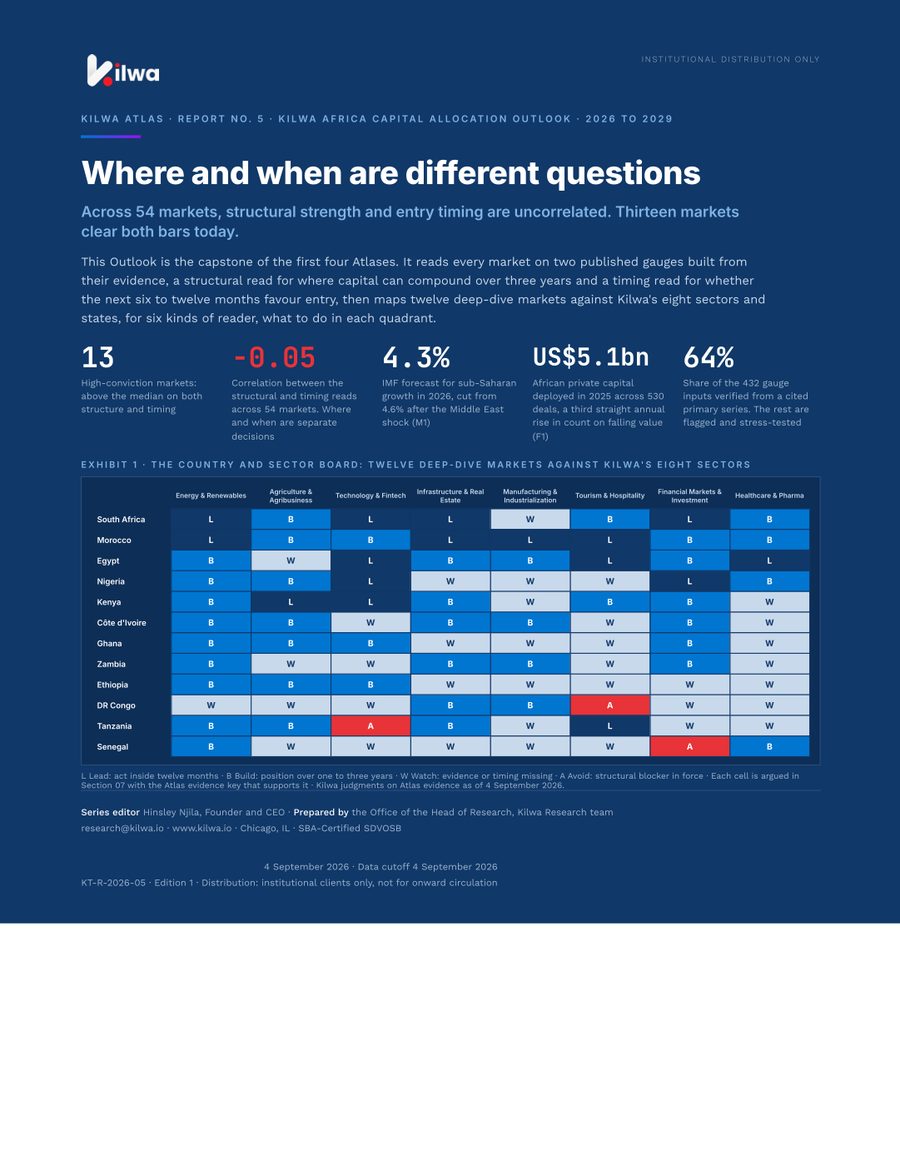
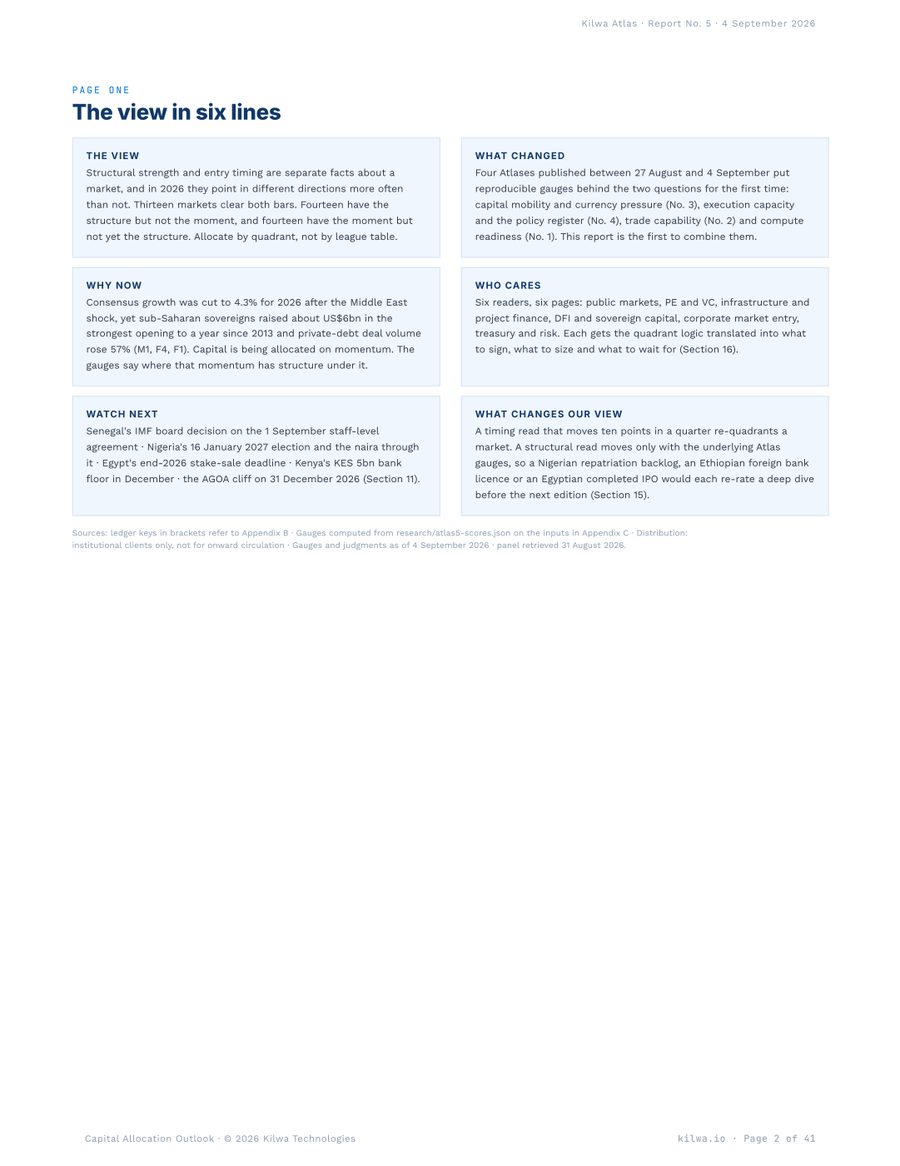
Across 54 markets, structural strength and entry timing are uncorrelated, and thirteen markets clear both bars today. The capstone of the first four Atlases reads every market on two published gauges — a structural read for where capital can compound over three years and a timing read for whether the next six to twelve months favour entry — then maps twelve deep-dive markets against Kilwa's eight sectors and says, for six kinds of reader, what to do in each quadrant.
Series editor Hinsley Njila, Founder & CEO · Prepared by the Kilwa Research team
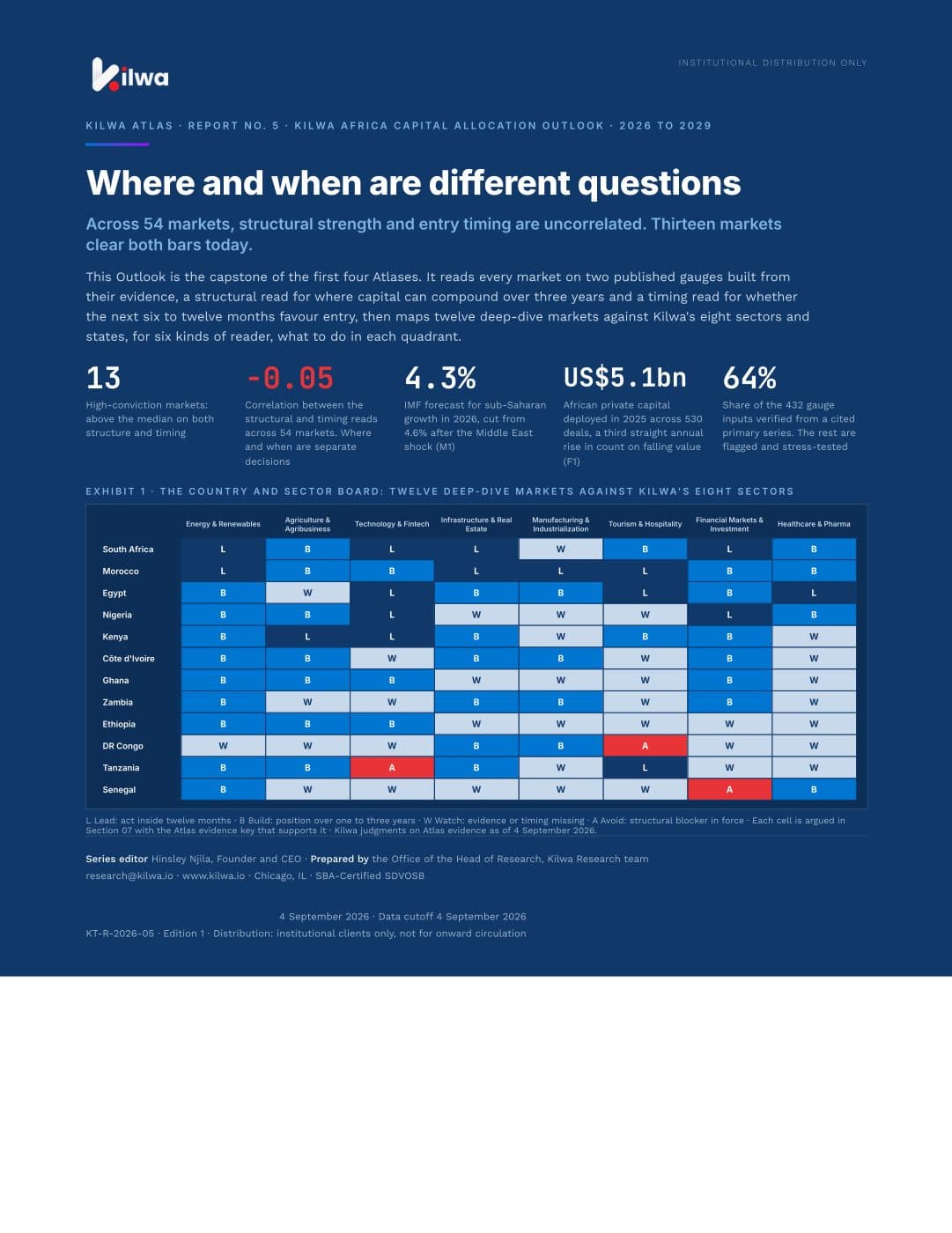
markets out of 54 that clear both bars, structure and timing — and only three of them, South Africa, Morocco and Egypt, score above 70 on structure
Key takeaways
- 01
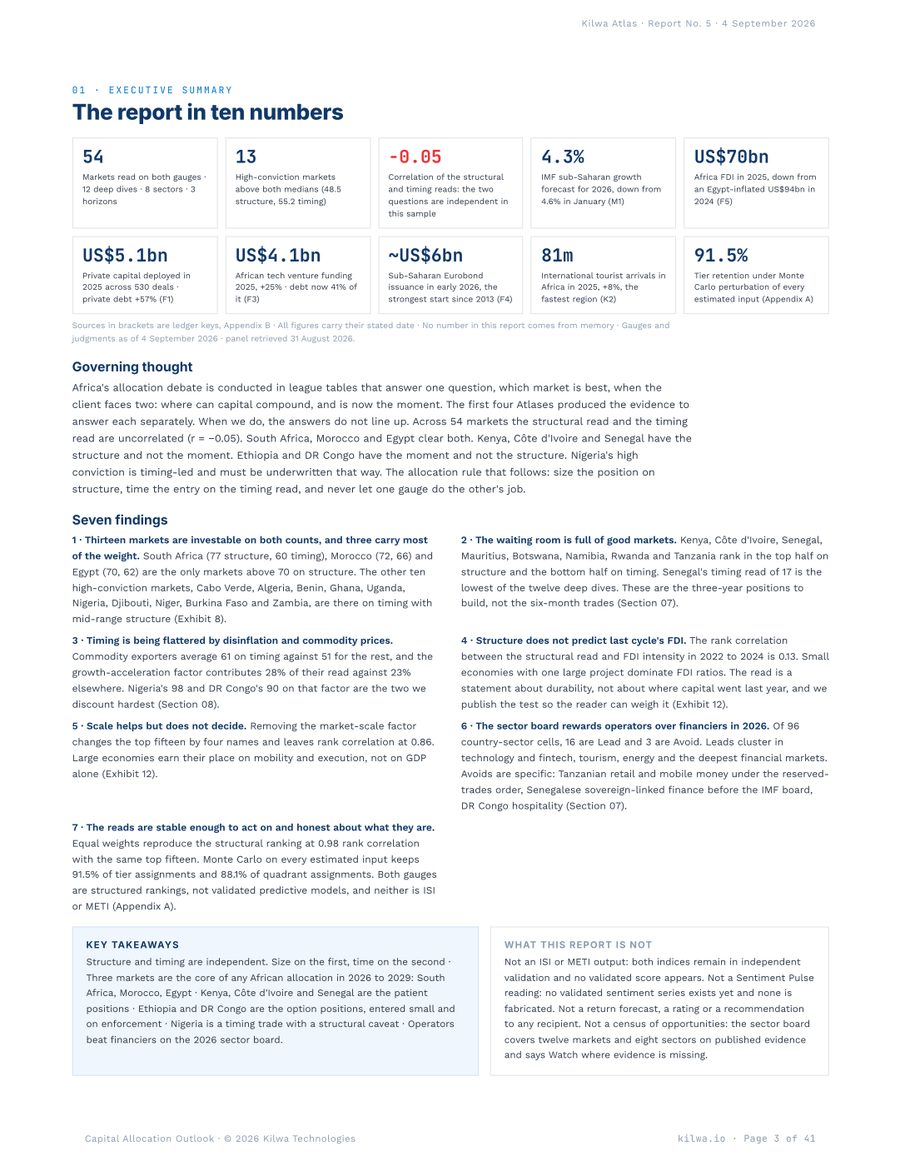
Structure and timing are independent. Across 54 markets the structural read and the timing read are uncorrelated (r = −0.05): size the position on the first and time the entry on the second.
- 02
Thirteen markets are investable on both counts and three carry most of the weight. South Africa (77 structure, 60 timing), Morocco (72, 66) and Egypt (70, 62) are the only markets above 70 on structure.
- 03
The waiting room is full of good markets. Kenya, Côte d'Ivoire, Senegal, Mauritius, Botswana, Namibia, Rwanda and Tanzania rank in the top half on structure and the bottom half on timing — three-year positions to build, not six-month trades.
- 04
Timing is being flattered by disinflation and commodity prices. Commodity exporters average 61 on timing against 51 for the rest, and Nigeria's and DR Congo's growth-acceleration readings are the two the report discounts hardest.
- 05
The sector board rewards operators over financiers in 2026. Of 96 country-sector cells, 16 are Lead and 3 are Avoid, with the Leads clustered in technology and fintech, tourism, energy and the deepest financial markets.
- 06
Consensus is allocating on momentum. Record Eurobond issuance and private debt up 57% price a reform cycle that, on the structural read, only Egypt of the five reform markets has yet earned. The reform markets are timing trades, to be held in the instrument that can leave.
The report, in brief
What it is, who it is for, and what you get.
The allocation outlook for all 54 African markets to 2029: a structural read and a timing read for each.
Written for
CIOs and allocation committees
Allocate by quadrant, not by league table: which thirteen markets clear both bars, and how each book is sized.
Private equity, infrastructure and credit funds
Which markets are core, patient or option positions for 2026 to 2029.
DFIs and sovereign funds
Where structure is strong and timing poor: the patient book most mandates can hold.
Corporate strategy teams
Which sectors lead in which of twelve deep-dive markets.
What you get
- Structure and timing reads for all 54 markets, with medians and quadrants
- Twelve deep dives mapped against eight sectors
- The variant view against consensus, stated so it can be tested
- Four paths to 2029 and what would change the view
- Method, inputs with provenance flags and robustness testing
- 41 pages as a PDF, delivered the moment payment clears
The call
Allocate by quadrant, not by league table. Size the position on structure, time the entry on the timing read, and never let one gauge do the other's job. South Africa, Morocco and Egypt are the core of any African allocation in 2026 to 2029; Kenya, Côte d'Ivoire and Senegal are the patient positions; Ethiopia and DR Congo are option positions, entered small and on enforcement evidence; Nigeria is a timing trade with a structural caveat. Operators beat financiers on the 2026 sector board.
Two gauges, four quadrants, three horizons
Kilwa's operating manual separates structural suitability from entry timing and forbids blending them into one opaque score. The structural read asks whether capital can move, whether rules get enforced, whether income and growth compound and whether the market has scale. The timing read asks whether the currency is under pressure, whether growth is accelerating against its own history, which way the policy register is pointing and whether inflation is falling. Each factor is a published output of an earlier Atlas or a cited series, each weight is stated, and each input carries the verification flag it inherits.
Quadrants split at the 54-market medians, 48.5 on structure and 55.2 on timing, so they describe a market's position relative to the continent in September 2026 and not an absolute grade. Six months is the timing read plus the catalyst calendar; twelve months adds the execution record from Atlas No. 4; three years is the structural read, because capital mobility, execution capacity and income compound slowly and reverse slowly.
“Size the position on structure, time the entry on the timing read, and never let one gauge do the other's job.”
The variant view: consensus is renting momentum
The proxy for consensus is what capital did: record Eurobond issuance at about 7.7% average cost in 2025 and about US$6bn in the first weeks of 2026, private-debt volume up 57%, venture debt at 41% of tech funding. The market is saying that the reform cycle in Nigeria, Egypt, Ghana, Ethiopia and Zambia has restored convertibility and that frontier Africa is re-investable on carry. It is a timing view, and on the timing read it is right: those five markets score 62 to 83.
Where Kilwa disagrees is that consensus is pricing structure it has not seen. Of the five reform markets only Egypt is above 55 on the structural read; Nigeria is 53, Ghana 55, Zambia 49, Ethiopia 46, and their execution capacities run from 26 to 49. The instruments being used, dollar debt and carry, are the ones that need mobility most and test it least until a coupon is due. What would prove us wrong: structural reads in the reform markets rising by more than eight points in the 2027 revision, with mobility factors leading. We will say so in the scorecard.
Four paths to 2029
Likelihood words follow the standard estimative scale. Probabilities, where implied, are Kilwa's subjective judgments as of the publication date, not measured frequencies and not forecasts of returns. Each path is anchored to a documented precedent and states which gauge it moves.
- 01Base · momentum with dispersion — likelyGrowth of 4.3% to 4.4%, programmes renewed in Kenya, Egypt and Senegal with conditions, elections passed without a regime change. Timing reads fall about 3.5 points on average as disinflation fades; five of 54 markets change quadrant and the high-conviction list goes from thirteen to nine. The core three are sized on structure, the patient book built through the cycle, the option book entered on enforcement.
- 02Upside · the convertibility dividend — roughly even chanceEthiopia licenses a foreign bank, Egypt completes IPOs with foreign anchors, the naira holds through January and Senegal's programme is approved. Mobility gains lift Ethiopia into high conviction and Senegal off Avoid. Option-book positions switch from debt to equity as licences print.
- 03Downside · the timing trap — roughly even chanceBrent below US$65 and gold below US$3,500, election-cycle FX intervention in Nigeria, Kenya's reserves under five months. Timing reads fall about 15 points for commodity exporters; fourteen markets change quadrant and high conviction drops from thirteen to five. Hold the structure-based positions, defer the timing trades.
- 04Stress · programme cascade — unlikelyMiddle East escalation closes shipping, two programmes go off track in a quarter, the WAEMU restructuring perimeter widens, CBAM is extended downstream. Twenty-one markets change quadrant, the two reads move together for the first time, and high conviction falls to two. Cover first; structures only re-underwrite on the Atlas No. 3 repatriation clause.
What would change our view
Twelve dated signposts, each naming the read it moves: FTSE Russell's Nigeria reinstatement settling without prefunding incidents (October 2026), Morocco's post-election government confirming the investment charter, IMF board approval for Senegal (Q4 2026), Ethiopia's first foreign commercial bank licence (December 2026), an Egyptian state IPO with a foreign anchor and AGOA reauthorised beyond 31 December 2026, the naira within 10% of its 4 September level on 31 January 2027, and Brent above US$70 on 31 March 2027. The Q1 2027 revision grades every one of them against what happened, in public, with misses stated as plainly as hits.
The upside sits where the reads disagree. Fourteen markets have structure and poor timing, and timing is the gauge that moves. If half of them cross the timing median by 2027, the high-conviction list goes from thirteen to twenty and the investable universe on both counts nearly doubles. Kenya's US$1.04bn of venture funding, Côte d'Ivoire's fifteen-year market access and Senegal's execution capacity of 73 are the evidence that the structure is already there.
The numbers
- −0.05
- correlation between the structural read and the timing read across 54 markets: where to invest and when to enter are independent questions
- 4.3%
- IMF forecast for sub-Saharan growth in 2026, cut from 4.6% in January after the Middle East shock — yet sovereigns raised about US$6bn in the strongest opening to a year since 2013
- US$5.1bn
- African private capital deployed in 2025 across 530 deals, a third straight annual rise in count on falling value, with private debt up 57%
- 91.5%
- of tier assignments, and 88.1% of quadrant assignments, that survive Monte Carlo perturbation of every estimated input
The model, in one table
The four quadrants
| Quadrant | Markets | What it means for capital |
|---|---|---|
| High conviction | South Africa, Morocco and Egypt above 70 on structure; Cabo Verde, Algeria, Benin, Ghana, Uganda, Nigeria, Djibouti, Niger, Burkina Faso and Zambia there on timing with mid-range structure | Clears both bars. The core three are sized on structure and built to target weight through 2026; the other ten are timing-led and held in instruments that can leave, inside NDF tenor. |
| Attractive structure, poor timing | Kenya, Côte d'Ivoire, Senegal, Mauritius, Botswana, Namibia, Rwanda, Tanzania among the fourteen | The patient book. Build exposure through the cycle, hedge the entry, lock incentives now. Senegal's timing read of 17 is the lowest of the twelve deep dives and moves only on the IMF board. |
| Improving but early | Ethiopia and DR Congo among the fourteen | The option book. Enter small, on enforcement evidence, with the Atlas No. 4 term-sheet clauses: finance the plant, not the decree, with force majeure for administrative stops. |
| Weak structure, weak timing | The remaining thirteen markets | Where a mandate needs a specific reason to be present. Presence only in the base case; no exposure under stress. |
Two published gauges, 0 to 100, higher is better, split at the 54-market medians of 48.5 on structure and 55.2 on timing as of 4 September 2026. Both reads are structured rankings built from the earlier Atlases and cited series — not validated predictive models — and neither is ISI or METI, which remain in independent validation. Thirteen markets sit in each of the high-conviction and weak-weak quadrants, fourteen in each of the other two.
By market
Markets this report tiers.
- Algeria
- Angola
- Benin
- Botswana
- Burkina Faso
- Burundi
- Cabo Verde
- Cameroon
- Central African Republic
- Chad
- Comoros
- Côte d'Ivoire
- Djibouti
- DR Congo
- Egypt
- Equatorial Guinea
- Eritrea
- Eswatini
- Ethiopia
- Gabon
- Ghana
- Guinea
- Guinea-Bissau
- Kenya
- Lesotho
- Liberia
- Libya
- Madagascar
- Malawi
- Mali
- Mauritania
- Mauritius
- Morocco
- Mozambique
- Namibia
- Niger
- Nigeria
- Republic of the Congo
- Rwanda
- São Tomé and Príncipe
- Senegal
- Seychelles
- Sierra Leone
- Somalia
- South Africa
- South Sudan
- Sudan
- Tanzania
- The Gambia
- Togo
- Tunisia
- Uganda
- Zambia
- Zimbabwe
Each market page gathers every tier the published reports print for that market, dated and linked to its source.
Series editor: Hinsley Njila, Founder & CEO. Prepared by the Kilwa Research team. research@kilwa.io
This report is research and analysis. It is not investment, legal or tax advice. Kilwa scores are structured risk rankings, not validated predictive models, except where explicitly stated otherwise. It is prepared for general circulation on a published schedule and is not tailored to any recipient.
Conflicts of interest. Kilwa does not hold, trade or take positions in the securities, currencies or instruments of the markets it scores, and receives no compensation from any government, issuer or institution in exchange for a score, a rating or favourable coverage. Where a research programme is funded by a named partner, that funding is disclosed in the report.