Kilwa Atlas · No. 3
Kilwa Atlas No. 3: Africa FX, Funding and Capital Mobility
Getting paid, getting out.
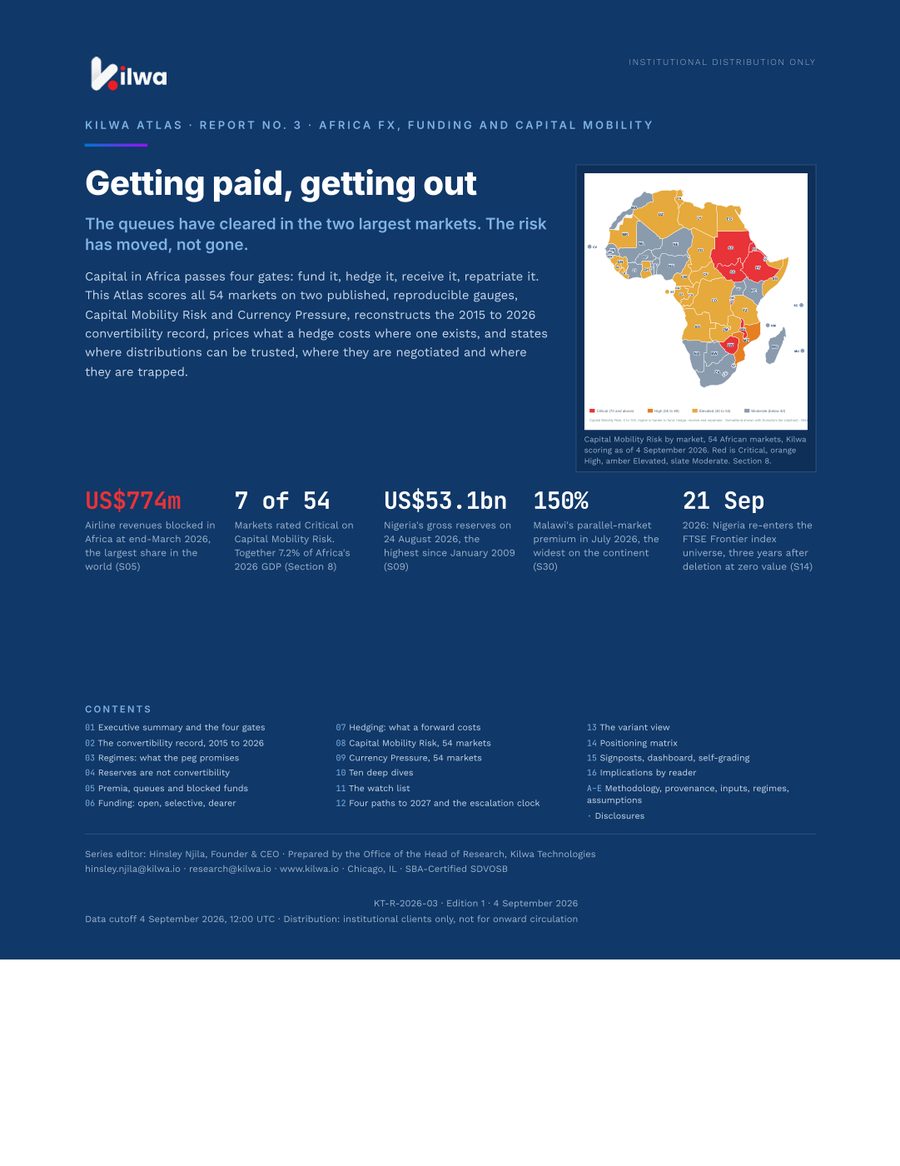
The queues have cleared in the two largest markets; the risk has moved, not gone. Capital in Africa passes four gates — fund it, hedge it, receive it, repatriate it — and this Atlas scores all 54 markets on two published gauges, Capital Mobility Risk and Currency Pressure, reconstructs the 2015 to 2026 convertibility record, prices what a hedge costs where one exists, and states where distributions can be trusted, where they are negotiated and where they are trapped.
Series editor Hinsley Njila, Founder & CEO · Prepared by the Kilwa Research team
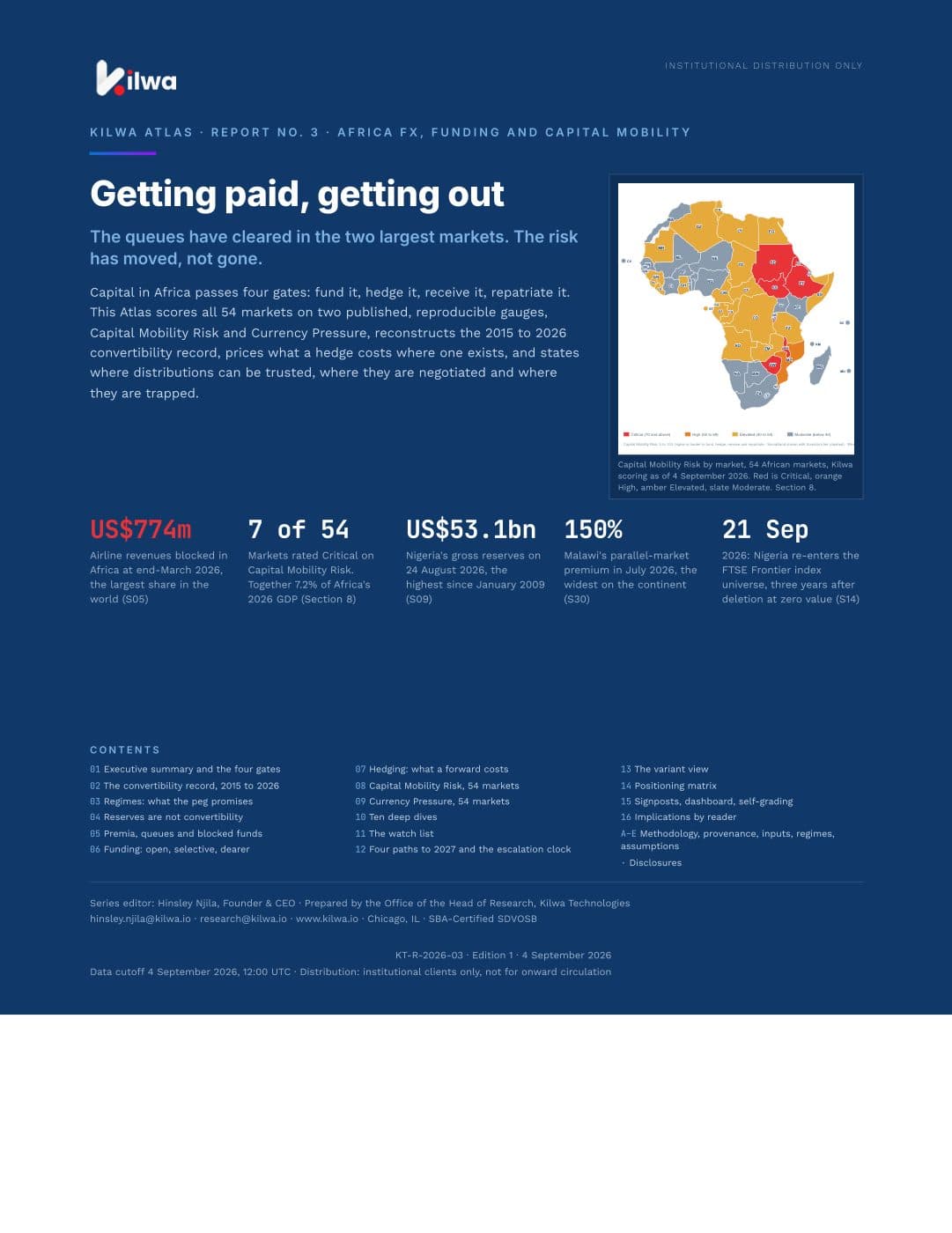
markets rated Critical on Capital Mobility Risk — Eritrea, South Sudan, Malawi, Zimbabwe, Sudan, Burundi and Ethiopia — together 7.2% of Africa's 2026 GDP, while 25 Moderate markets hold 47%
Key takeaways
- 01
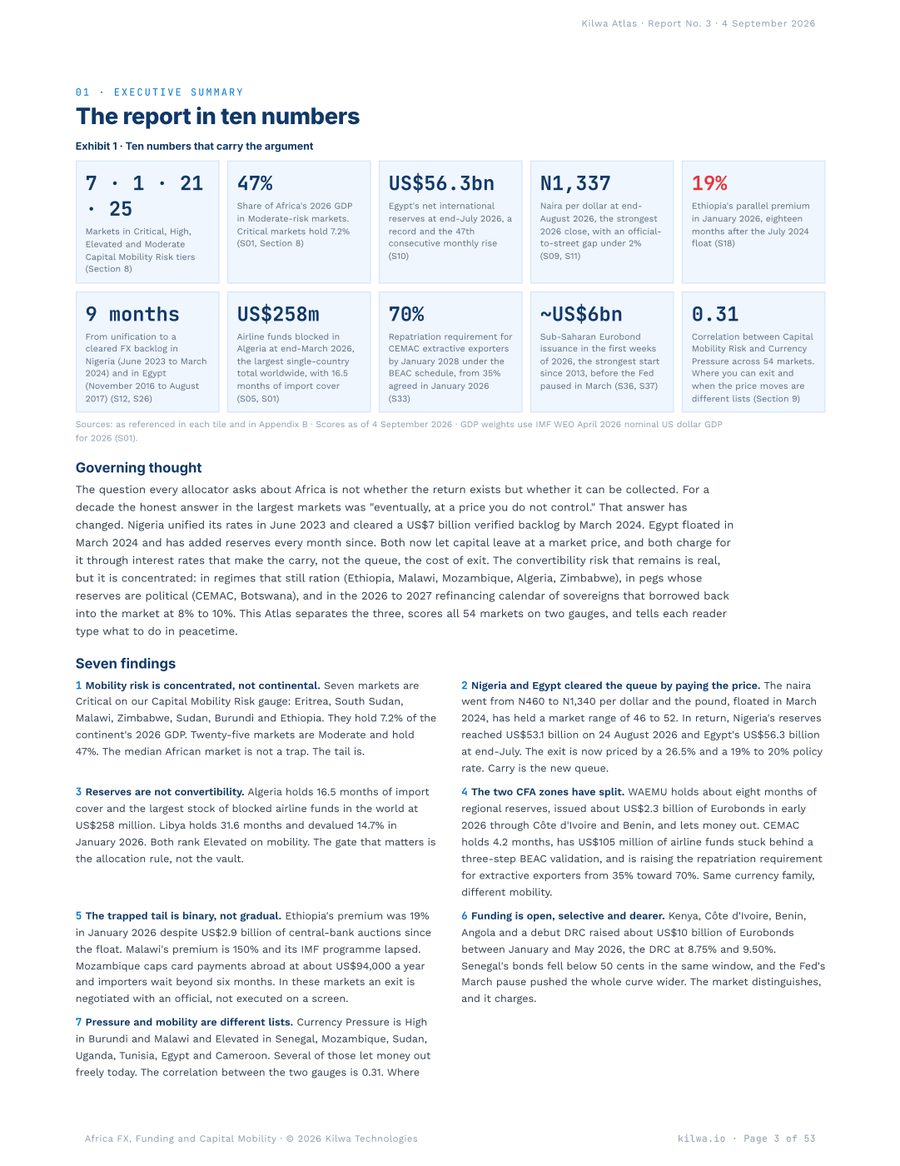
Mobility risk is concentrated, not continental. Seven markets are Critical and hold 7.2% of 2026 GDP; twenty-five are Moderate and hold 47%. The median African market is not a trap. The tail is.
- 02
Nigeria and Egypt cleared the queue by paying the price. The exit is now priced by a 26.5% and a 19 to 20% policy rate, against reserves of US$53.1bn and US$56.3bn. Carry is the new queue.
- 03
Reserves are not convertibility. Algeria holds 16.5 months of import cover and the largest stock of blocked airline funds in the world; Libya holds 31.6 months and devalued 14.7% in January 2026. The gate that matters is the allocation rule, not the vault.
- 04
The two CFA zones have split. WAEMU holds about eight months of reserves, issued about US$2.3bn of Eurobonds in early 2026 and lets money out; CEMAC holds 4.2 months and is raising the repatriation requirement for extractive exporters from 35% toward 70%. Same currency family, different mobility.
- 05
The trapped tail is binary, not gradual. Ethiopia's premium was 19% despite US$2.9bn of central-bank auctions since the float, Malawi's is 150% and its IMF programme lapsed, and Mozambique's importers wait beyond six months. In these markets an exit is negotiated with an official, not executed on a screen.
- 06
Pressure and mobility are different lists. Currency Pressure is High in Burundi and Malawi and Elevated in Senegal, Mozambique, Sudan, Uganda, Tunisia, Egypt and Cameroon — several of which let money out freely today. That is why this Atlas publishes two scores rather than one.
The report, in brief
What it is, who it is for, and what you get.
Whether money can be funded, hedged, received and taken out of each of 54 African markets, scored.
Written for
CFOs and treasurers
Where distributions can be trusted, what a hedge costs where one exists, and where the risk is a queue rather than a price.
Private equity and credit funds
How to size hedges and distribution sweeps by exit regime: priced, pegged, rationed or trapped.
DFIs and guarantors
Where hard-currency revenue and transfer guarantees are the only workable structure.
Risk committees
The 2015 to 2026 convertibility record, reconstructed market by market.
What you get
- Capital Mobility Risk and Currency Pressure for all 54 markets
- Ten deep dives
- The 2015 to 2026 convertibility record
- What a hedge costs where one exists
- Inputs, weights and estimate flags, printed in the appendix
- 53 pages as a PDF, delivered the moment payment clears
The call
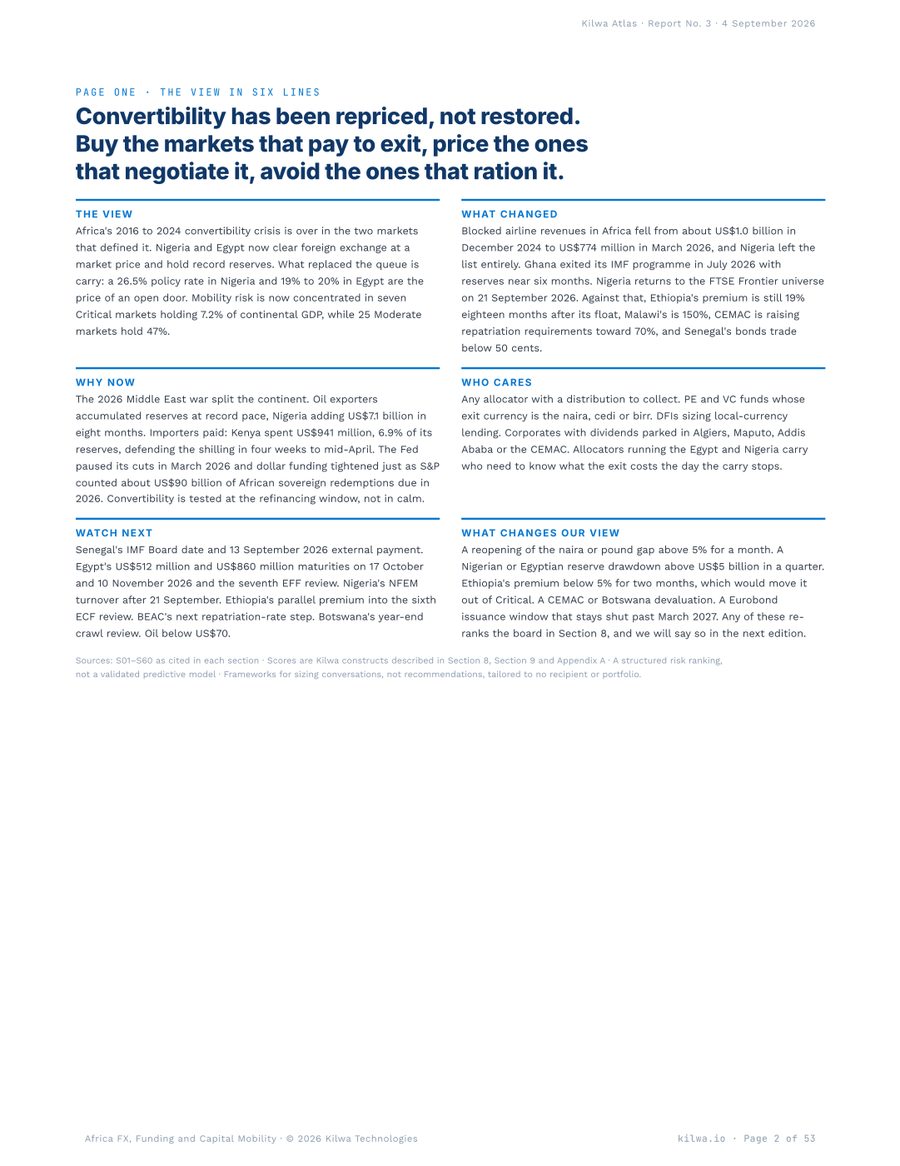
Convertibility has been repriced, not restored. Buy the markets that pay to exit, price the ones that negotiate it, avoid the ones that ration it. Nigeria and Egypt now let capital leave at a market price and charge for it through 26.5% and 19 to 20% policy rates: carry is the new queue. The mobility risk that remains is concentrated in regimes that still ration, in pegs whose reserves are political, and in the 2026 to 2027 refinancing calendar of sovereigns that borrowed back into the market at 8 to 10%.
Four gates stand between a return and a distribution
The question every allocator asks about Africa is not whether the return exists but whether it can be collected. For a decade the honest answer in the largest markets was "eventually, at a price you do not control". That answer has changed. Nigeria unified its rates in June 2023 and cleared a US$7bn verified backlog by March 2024; Egypt floated in March 2024 and has added reserves every month since. Both now let capital leave at a market price, and both charge for it through interest rates that make the carry, not the queue, the cost of exit.
Underwrite the exit before the entry: in 29 of 54 markets the binding constraint is not return but repatriation friction. Treat the Nigeria and Egypt carry as a paid option on an open door, and size it to the day the option is exercised by everyone at once, using Egypt's 2022 outflow of about US$25bn as the sizing precedent. Separate the pegs: WAEMU and the rand pegs are hedgeable through the euro and the rand; CEMAC is a repatriation regime with a euro label.
“Carry is the new queue.”
The 2026 Middle East war split the continent
Oil exporters accumulated reserves at record pace, Nigeria adding US$7.1bn in eight months. Importers paid: Kenya spent US$941m, 6.9% of its reserves, defending the shilling in four weeks to mid-April. The Fed paused its cuts in March 2026 and dollar funding tightened just as S&P counted about US$90bn of African sovereign redemptions due in 2026. Convertibility is tested at the refinancing window, not in calm.
Funding is open, selective and dearer. Kenya, Côte d'Ivoire, Benin, Angola and a debut DRC raised about US$10bn of Eurobonds between January and May 2026, the DRC at 8.75% and 9.50%. Senegal's bonds fell below 50 cents in the same window, and the Fed's pause pushed the whole curve wider. The market distinguishes, and it charges.
The other side of the risk
The upside in this report is larger than the downside, and it is concrete. Two of the three largest African economies now let capital out at a price, which was not true at any point between 2015 and 2023. Ghana cured a US$13bn default and rebuilt reserves in under two years. Zambia's currency rallied 31% after its exchange.
The structural upside is the hedge market itself. Every market that has moved to a priced exit has grown a non-deliverable forward curve, and every such curve lowers the cost of the next entry. The AfDB's ICX investment, the JPMorgan frontier index consultation and Nigeria's T+1 settlement are the plumbing of a continent that is becoming investable in local currency.
What would change our view
Dated signposts to the next edition: Senegal's 13 September 2026 external payment and IMF board date; Nigeria's re-entry to the FTSE Frontier universe on 21 September with rising NFEM turnover; Egypt's US$512m and US$860m maturities on 17 October and 10 November 2026 paid from reserves without a monthly decline in net international reserves; the successor to Egypt's EFF at its 16 December expiry; Botswana's year-end crawl review; BEAC's next repatriation step; Ethiopia's sixth ECF review.
What re-ranks the board: a reopening of the naira or pound gap above 5% for a month; a Nigerian or Egyptian reserve drawdown above US$5bn in a quarter; Ethiopia's premium below 5% for two months, which would move it out of Critical; a CEMAC or Botswana devaluation; a Eurobond issuance window that stays shut past March 2027. The next FX and capital mobility edition grades every dated signpost and every scenario indicator in public, and prints each miss beside each hit.
The numbers
- US$53.1bn
- Nigeria's gross reserves on 24 August 2026, the highest since January 2009, after the naira's move from N460 to about N1,340 per dollar bought a priced exit
- US$774m
- airline revenues blocked in Africa at end-March 2026, down from about US$1.0bn in December 2024 — with Nigeria off the list entirely and Algeria now first
- 150%
- Malawi's parallel-market premium in July 2026, the widest on the continent, against 19% in Ethiopia eighteen months after its float
- 0.31
- correlation between Capital Mobility Risk and Currency Pressure across 54 markets: where you can exit and when the price will move are different lists
The model, in one table
Capital Mobility Risk, 54 markets
| Exit regime | Markets | What it means for capital |
|---|---|---|
| Priced exit | Nigeria, Egypt | Capital leaves at a market price and pays through the policy rate. Hold with a hedge ratio sized to a 25% gap-down, sweep distributions quarterly, and treat Q4 2026 maturities as one window. Offshore NDFs are the proxy, and their liquidity disappears in the week everyone needs it, as in March 2022. |
| Hedgeable pegs | WAEMU — Côte d'Ivoire, Senegal, Benin — and the rand pegs | Hedge the euro or rand leg only, and underwrite each sovereign alone: the euro hedge is silent on a peg change and on BCEAO repatriation rules, and Ivorian paper does not price Senegal. |
| Rationing regimes | CEMAC, Algeria, Libya, Mozambique | A euro label or a full vault does not move money. Model BEAC's repatriation ramp toward 70% into cash-flow forecasts now and secure validation for offshore accounts before the next step; the risk is a queue, not a price. |
| Critical — trapped | Eritrea, South Sudan, Malawi, Zimbabwe, Sudan, Burundi, Ethiopia | An exit is negotiated with an official. Underwrite on hard-currency revenue, reinvestment rights and DFI transfer guarantees; value local cash at the parallel rate; the 2024 Ethiopia Eurobond trades on restructuring terms, not on the gauge. |
Capital Mobility Risk runs 0 to 100, higher is harder to fund, hedge, receive and repatriate, as of 4 September 2026: Critical 70 and above, High 55 to 69, Elevated 40 to 54, Moderate below 40. It is a structured risk ranking, not a validated predictive model, and not an exchange-rate forecast; inputs, weights and estimate flags are printed in the report's Appendix C. No ISI or METI output appears; both remain in independent validation. Exchange-control law changes by circular and must be confirmed with local counsel before any transfer.
By market
Markets this report tiers.
- Algeria
- Benin
- Burundi
- Côte d'Ivoire
- Egypt
- Eritrea
- Ethiopia
- Libya
- Malawi
- Mozambique
- Nigeria
- Senegal
- South Sudan
- Sudan
- Zimbabwe
Discussed by name, without a tier:
Each market page gathers every tier the published reports print for that market, dated and linked to its source.
Series editor: Hinsley Njila, Founder & CEO. Prepared by the Kilwa Research team. research@kilwa.io
This report is research and analysis. It is not investment, legal or tax advice. Kilwa scores are structured risk rankings, not validated predictive models, except where explicitly stated otherwise. It is prepared for general circulation on a published schedule and is not tailored to any recipient.
Conflicts of interest. Kilwa does not hold, trade or take positions in the securities, currencies or instruments of the markets it scores, and receives no compensation from any government, issuer or institution in exchange for a score, a rating or favourable coverage. Where a research programme is funded by a named partner, that funding is disclosed in the report.