Kilwa Atlas · No. 1
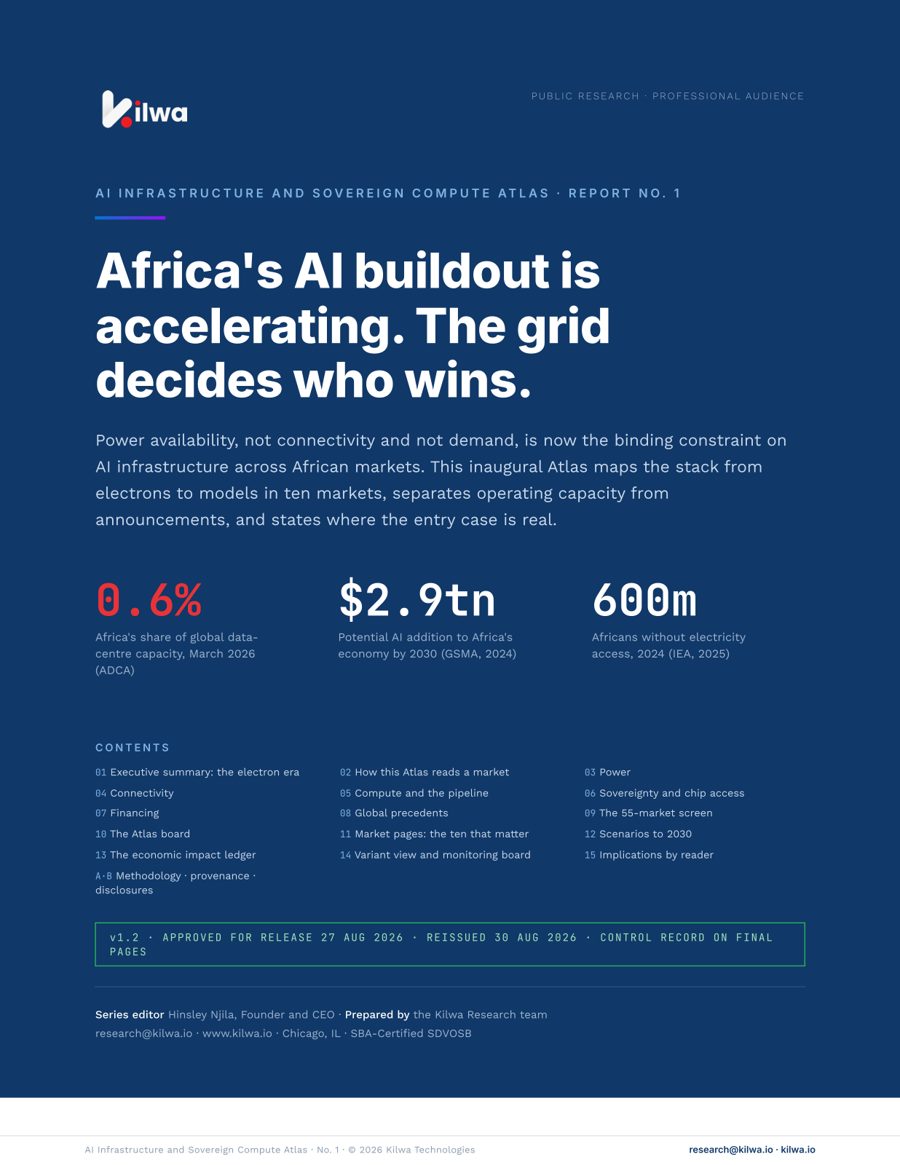
Kilwa Atlas No. 1: AI Infrastructure & Sovereign Compute
Africa's AI buildout is accelerating. The grid decides who wins.
Power availability, not connectivity and not demand, is now the binding constraint on AI infrastructure across African markets. The inaugural Atlas maps the stack from electrons to models in ten markets, separates operating capacity from announcements, and states where the entry case is real.
Series editor Hinsley Njila, Founder & CEO · Prepared by the Kilwa Research team
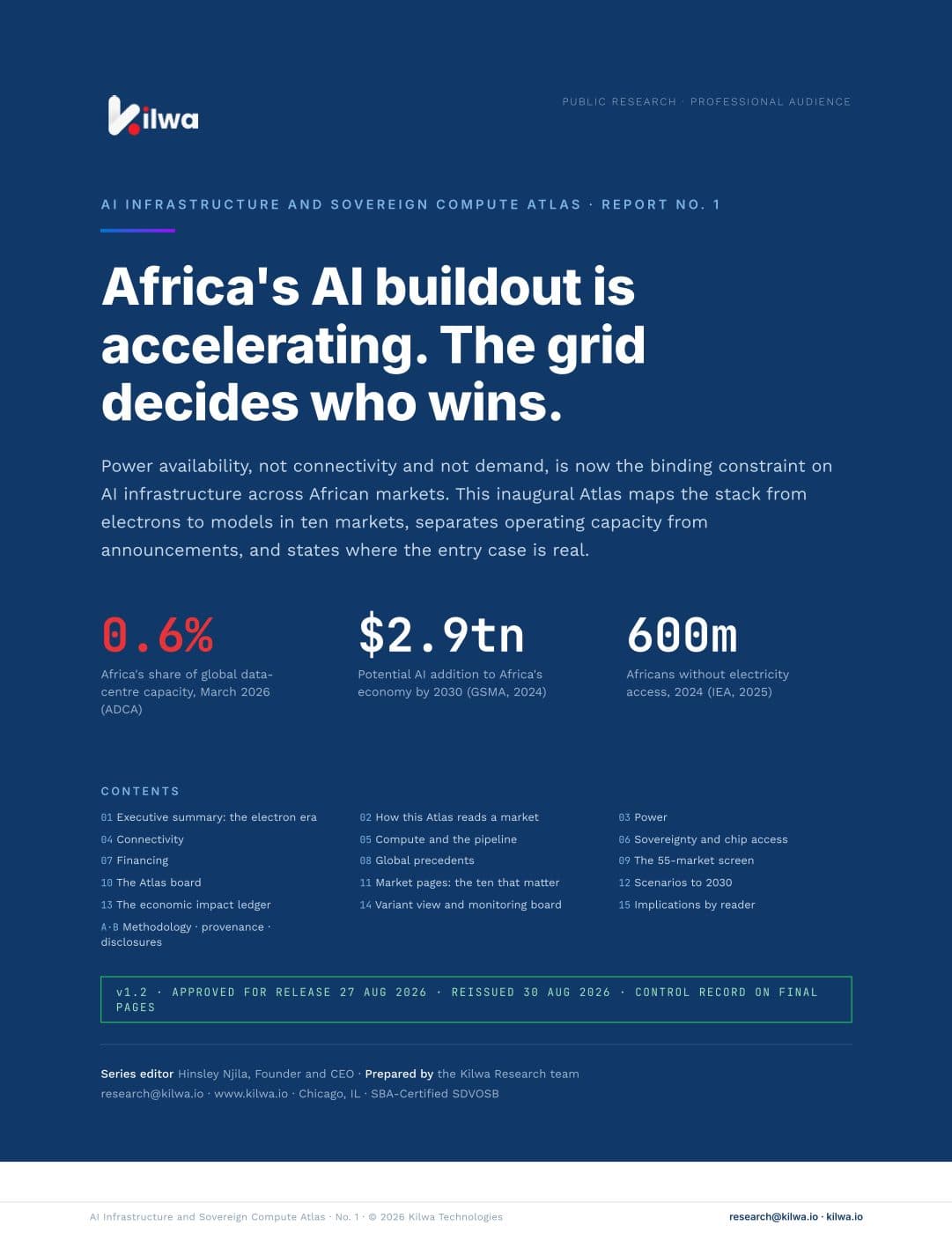
Africa's share of global data-centre capacity, March 2026 (ADCA) — against a projected 2 GW of continental demand by 2030
Key takeaways
- 01
Power has replaced connectivity as the binding constraint. Africa operates roughly 360 MW of data-centre capacity, 0.6% of the global total, while nearly two in five Africans lack electricity access entirely.
- 02
The market is far smaller than the announcements. Morocco alone carries close to 2 GW of announced projects against a continental operating base of 360 MW; on a four-step status ladder, the investable pipeline is a fraction of the headline one.
- 03
Three buildout models are emerging and they price differently: anchor hubs (South Africa) monetise domestic demand, export platforms (Morocco, Egypt) sell renewable compute abroad, gateways (Djibouti, coastal West Africa) monetise interconnection. Most 2026–28 capital lands in the first two.
- 04
Sovereignty is negotiated, not built. The $60bn Africa AI Fund's largest hardware line is 12,000 Nvidia GPUs, and flagship national programmes run on hyperscaler partnerships — sovereign AI in practice means better contract terms, data residency and skills transfer, not independence.
- 05
Chip access is policy-contingent and unresolved: the US AI Diffusion Rule was rescinded in announcement but, per a May 2026 GAO decision, remains legally on the books under a contested non-enforcement posture. Contracts should price both states of the world.
- 06
Development finance is underwriting the first mile — IFC's $100m Raxio facility is its largest African digital-infrastructure commitment — while commercial AI compute will concentrate in three or four markets this cycle. The two capital tracks should not be confused.
The report, in brief
What it is, who it is for, and what you get.
Where AI infrastructure in Africa is commercially real: ten markets rated on power, connectivity and compute.
Written for
Data-centre and digital-infrastructure investors
Which markets can contract firm power at data-centre scale, the binding constraint.
Hyperscalers, telecoms and operators
Where to take anchor-tenant capacity early, and which announcements will shrink to the size of the grid.
DFIs and sovereign funds
Where a DFI-wrapped colocation platform beats a standalone build.
Governments and regulators
How policy and sovereignty positioning rates against nine peer markets.
What you get
- The Atlas board: ten markets rated on four dimensions, with confidence flags
- A continental screen of all 55 African Union members
- Market archetypes, from anchor hub to frontier scale, with the entry case for each
- Three paths and a stress test
- What changed since mid-2025, and what would change the view
- 35 pages as a PDF, delivered the moment payment clears
The call
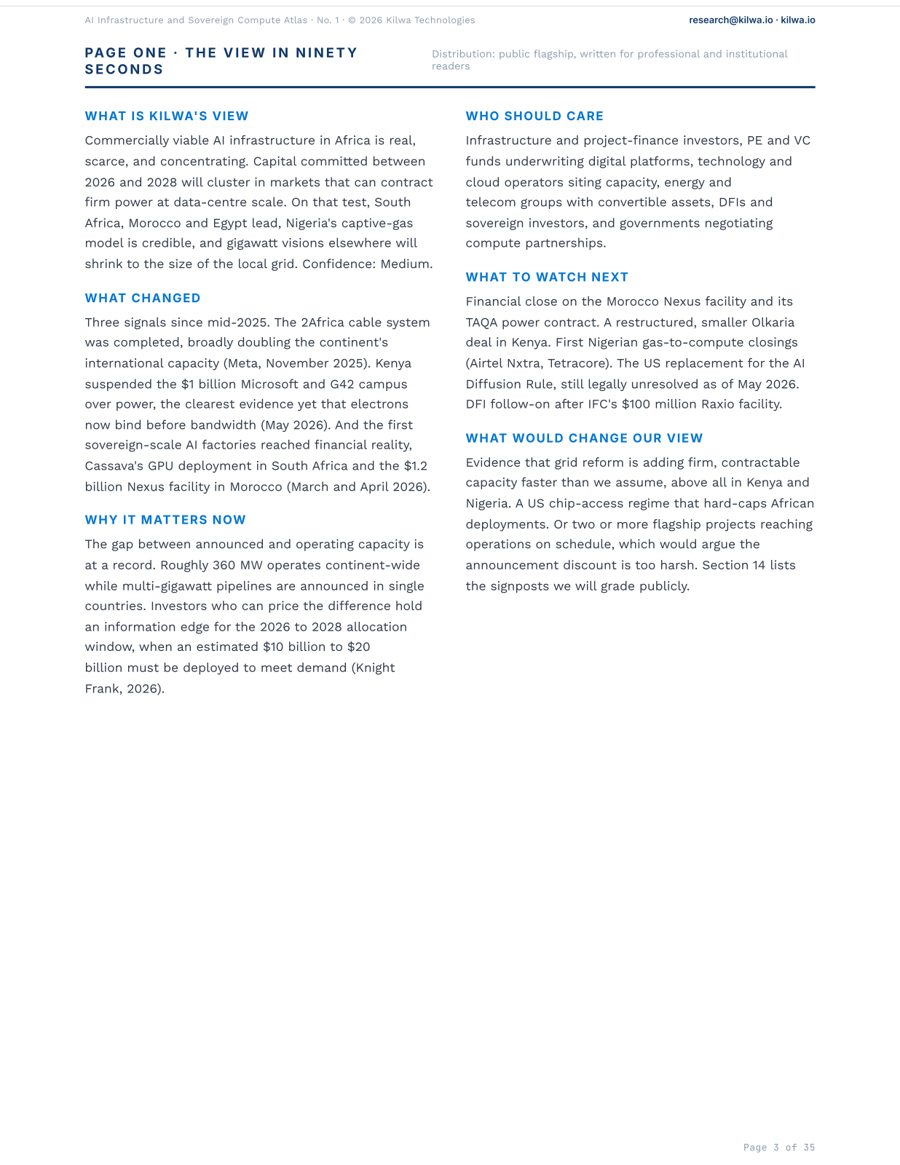
Commercially viable AI infrastructure in Africa is real, scarce, and concentrating. Capital committed between 2026 and 2028 will cluster in markets that can contract firm power at data-centre scale. On that test, South Africa, Morocco and Egypt lead, Nigeria's captive-gas model is credible, and gigawatt visions elsewhere will shrink to the size of the local grid. Confidence: medium.
The electron era
For two decades the question about African digital infrastructure was whether the data could get there. That question is largely answered: the 2Africa system alone carries a design capacity of 180 terabits per second, more than every previous cable serving the continent combined (Meta, November 2025).
The question that now decides projects, returns and national strategies is whether the electrons can get there, at data-centre quality, at a contractable price. Every material event of the past eighteen months — Kenya's suspension of a $1 billion campus, Nigeria's gas-fired build plans, Morocco's renewable-backed AI factory — is a variation on that single constraint.
“Electrons now bind before bandwidth.”
What changed since mid-2025
Three signals. The 2Africa cable system was completed, broadly doubling the continent's international capacity. Kenya suspended the $1 billion Microsoft and G42 campus over power — the clearest evidence yet of the new binding constraint (May 2026). And the first sovereign-scale AI factories reached financial reality: Cassava's GPU deployment in South Africa and the $1.2 billion Nexus facility in Morocco (March and April 2026).
The gap between announced and operating capacity is at a record. Roughly 360 MW operates continent-wide while multi-gigawatt pipelines are announced in single countries. Investors who can price the difference hold an information edge for the 2026 to 2028 allocation window.
Three paths and a stress test
Likelihood bands follow the standard estimative scale and are Kilwa's subjective judgments as of the publication date, not measured frequencies and not forecasts of returns.
- 01Base · grid-led, hub-concentrated buildout — 55–65%Operating capacity roughly doubles by 2030 against the projected 2 GW of demand, but 70% or more of new AI-grade capacity lands in South Africa, Morocco, Egypt and Lagos. Gigawatt visions elsewhere deflate quietly.
- 02Upside · export breakout — 15–20%European power scarcity persists and North African renewable compute wins real training offtake. Morocco's pipeline converts at several hundred megawatts; Egypt follows.
- 03Downside · announcement recession — 20–25%Global AI capex cools or financing costs stay punitive. Flagships slip, sovereign funds pledge but do not draw, and the announced pipeline visibly recedes.
- 04Stress · access shock — 5–10%A restrictive successor to the Diffusion Rule or a GAIN-style allocation priority effectively caps advanced-chip flows to middle-tier countries.
What would change our view
Evidence that grid reform is adding firm, contractable capacity faster than we assume, above all in Kenya and Nigeria. A US chip-access regime that hard-caps African deployments. Or two or more flagship projects reaching operations on schedule, which would argue the announcement discount is too harsh.
The ten-indicator monitoring board — Eskom load-shedding days, the Olkaria restructuring outcome, Nexus financial close, Cassava GPU count, Nigerian gas-to-compute closings, the US chip rule, IFC benchmark commitments, ADCA construction-to-active conversion, funded national AI programmes, Red Sea cable incidents — is graded in public. The next infrastructure Atlas will publish every dated signpost above against what happened, with misses stated as plainly as hits.
The numbers
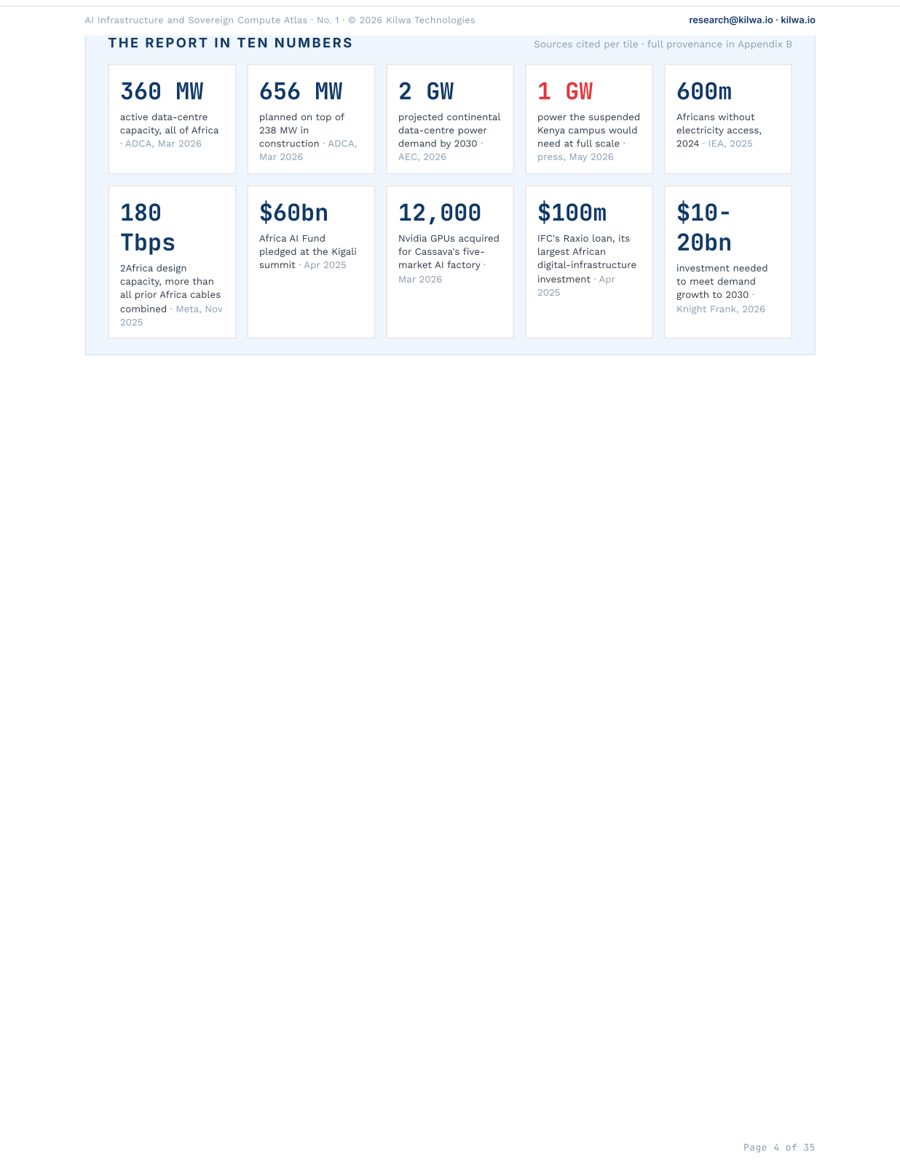
- 360 MW
- active data-centre capacity across all of Africa, with 656 MW planned on top of 238 MW in construction (ADCA, March 2026)
- $2.9tn
- potential AI addition to Africa's economy by 2030 (GSMA, 2024)
- 600m
- Africans without electricity access in 2024 (IEA, 2025) — the constraint that now binds before bandwidth
- $10–20bn
- investment needed to meet data-centre demand growth to 2030 (Knight Frank, 2026)
The model, in one table
The Atlas board
| Tier | Markets | What it means for capital |
|---|---|---|
| Anchor hub | South Africa — power, connectivity and compute all Advantaged; policy Forming | Deep domestic demand, operating scale, a functioning grid. Prices like infrastructure. The only full example this cycle: contract Johannesburg and Cape Town capacity early at anchor-tenant terms. |
| Export platform | Morocco (power and connectivity Advantaged), Egypt (connectivity and policy Advantaged) | Sells renewable compute to external buyers. Rises or falls on contracted power and offtake, not local demand. Underwrite on executed power-purchase and offtake contracts only; Morocco's Nexus financial close is the litmus test for the whole 2 GW narrative. |
| Demand market, power-bound | Nigeria (captive gas), Kenya (geothermal, restructuring) | Large user bases the grid cannot yet serve at compute scale. Nigeria solves with captive gas; Kenya must restructure around its geothermal park. Back gas-to-compute joint ventures with take-or-pay fuel supply; watch the Okaria restructuring as the signal for round two. |
| Gateways, niches and frontier scale | Djibouti, Ghana, Senegal (gateways and sovereign niche), Rwanda (policy lab), Ethiopia (frontier scale, DFI-led) | Djibouti and coastal West Africa monetise interconnection, Senegal and Rwanda monetise policy positioning, Ethiopia is a DFI-led volume story for the 2030s. Enter through DFI-wrapped colocation platforms rather than standalone builds. |
A structured qualitative assessment, not a validated predictive model. Ten focus markets are rated Advantaged, Forming or Constrained on four dimensions — power, connectivity, compute and pipeline, policy and sovereignty — and cells marked (e) rest on thinner sourcing and carry low-to-medium confidence. The continental screen classifies all 55 African Union members: 10 focus, 10 watch, 34 screened, 1 unscored, as of 27 August 2026.
By market
Markets this report tiers.
Each market page gathers every tier the published reports print for that market, dated and linked to its source.
Series editor: Hinsley Njila, Founder & CEO. Prepared by the Kilwa Research team. research@kilwa.io
This report is research and analysis. It is not investment, legal or tax advice. Kilwa scores are structured risk rankings, not validated predictive models, except where explicitly stated otherwise. It is prepared for general circulation on a published schedule and is not tailored to any recipient.
Conflicts of interest. Kilwa does not hold, trade or take positions in the securities, currencies or instruments of the markets it scores, and receives no compensation from any government, issuer or institution in exchange for a score, a rating or favourable coverage. Where a research programme is funded by a named partner, that funding is disclosed in the report.