Geopolitical Risk · No. 5
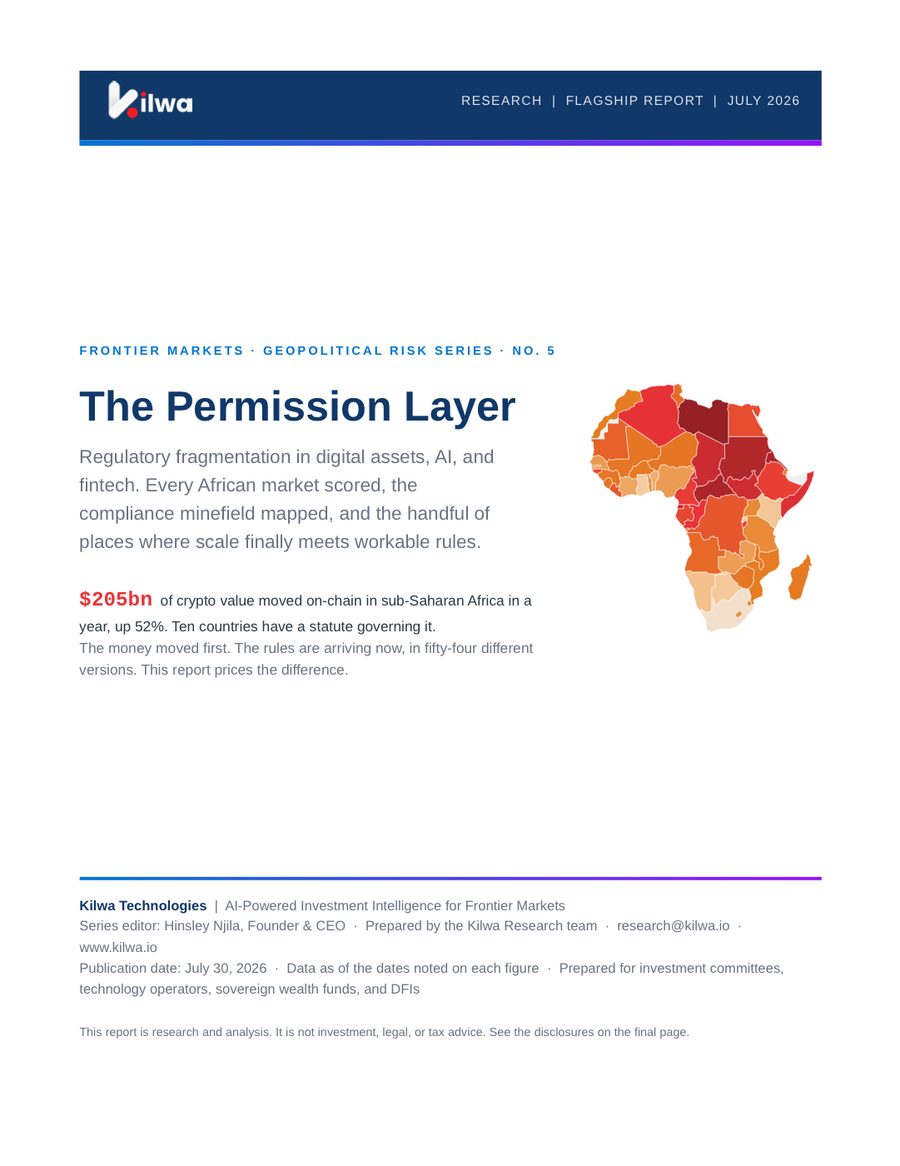
The Permission Layer
Regulatory fragmentation in digital assets, AI and fintech
Every African market scored, the compliance minefield mapped, and the handful of places where scale finally meets workable rules.
Series editor Hinsley Njila, Founder & CEO · Prepared by the Kilwa Research team
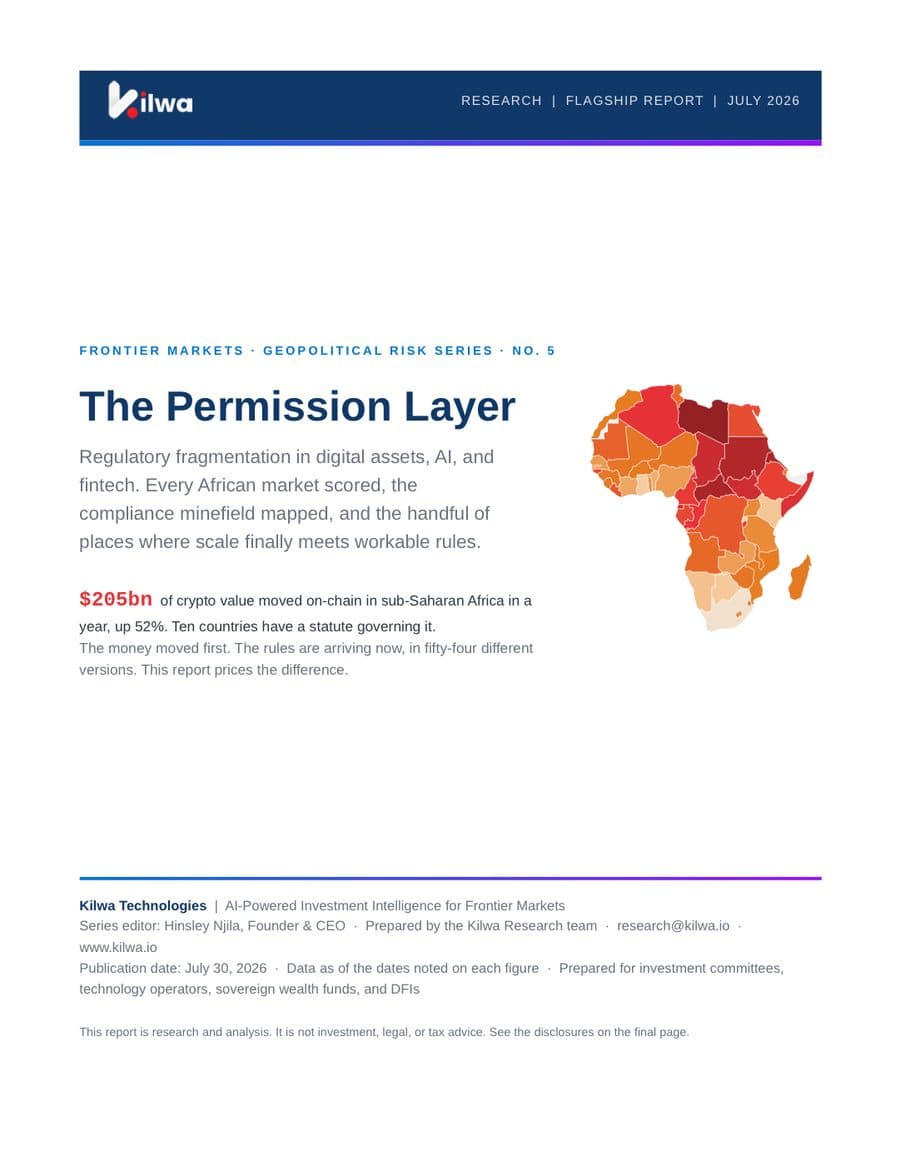
of on-chain value received in sub-Saharan Africa in a year, up 52%. Ten of 54 countries have a binding statute governing it
Key takeaways
- 01
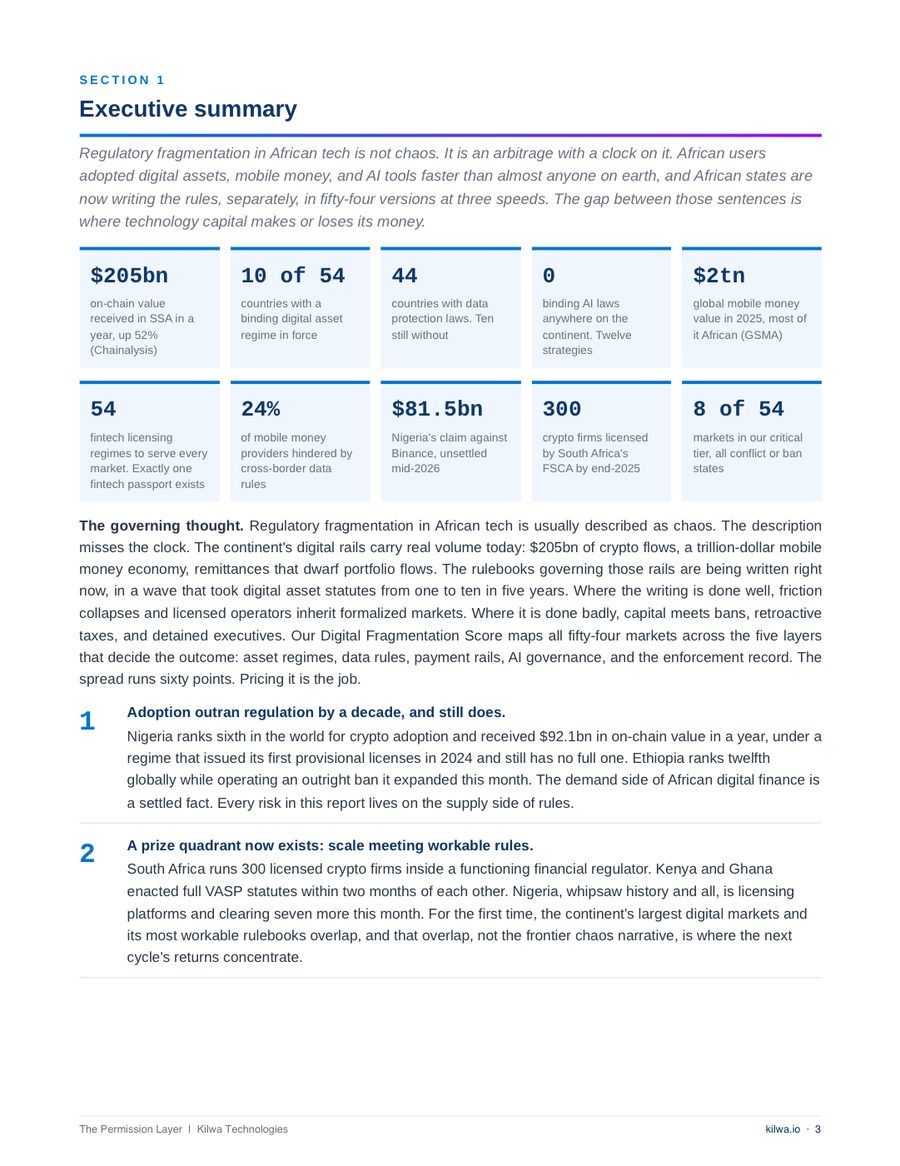
Regulatory fragmentation in African tech is not chaos; it is an arbitrage with a clock on it. $205bn of on-chain value reached sub-Saharan Africa in a year, and only ten of 54 countries have a binding digital-asset regime in force.
- 02
There are no binding AI laws anywhere on the continent against twelve published strategies, and 54 fintech licensing regimes with exactly one passport — the next regulatory wave is entirely unwritten and predictable in direction.
- 03
Where rules are written well, licensed operators inherit formalised markets — South Africa's FSCA had licensed 300 crypto firms by end-2025. Where they are written badly, capital meets bans, retroactive taxes and detained executives; eight of 54 markets sit in the critical tier.
The report, in brief
What it is, who it is for, and what you get.
Digital-asset, data, payments and AI rules scored for all 54 African markets.
Written for
Fintech, payments and digital-asset operators
Where a licence can be held, where operating is unlawful, and which rulebooks are being written now.
Venture and growth investors
Which markets' compliance cost sinks the model, and where licensed operators inherit formalised markets.
Banks, telecoms and technology companies
Data-rule and AI-governance exposure, market by market.
Regulators and policy teams
How your regime scores against 53 peers on five layers.
What you get
- The Digital Fragmentation Score for all 54 markets
- Five layers mapped: digital assets, data rules, payment rails, AI governance and enforcement record
- The markets where a single statute changes the investment case
- Inputs flagged verified or estimate
- 30 pages as a PDF, delivered the moment payment clears
The call
Regulatory fragmentation in African tech is usually described as chaos. The description misses the clock. It is an arbitrage with a deadline: the rulebooks governing rails that already carry real volume are being written right now, in fifty-four versions at three speeds.
The money moved first. The rules are arriving second
The continent's digital rails carry real volume today: $205bn of crypto flows into sub-Saharan Africa in a year, a trillion-dollar mobile money economy, and remittances that dwarf portfolio flows.
Digital asset statutes went from one to ten in five years. Forty-four countries now have data protection laws and ten still have none. There are no binding AI laws anywhere on the continent, against twelve published strategies — which means the next regulatory wave is entirely unwritten and entirely predictable in its direction.
“Fifty-four fintech licensing regimes to serve every market. Exactly one fintech passport exists.”
Where it is written well, licensed operators inherit formalised markets
Where the writing is done well, friction collapses and licensed operators inherit a formalised market: South Africa's FSCA had licensed 300 crypto firms by end-2025. Where it is done badly, capital meets bans, retroactive taxes and detained executives — Nigeria's claim against Binance stood at $81.5bn, unsettled, in mid-2026.
Twenty-four per cent of mobile money providers report being hindered by cross-border data rules. The compliance cost is not the licence fee. It is the fifty-four-way divergence, and it falls hardest on exactly the operators whose economics depend on scale.
The numbers
- 10 of 54
- countries with a binding digital asset regime in force
- 0
- binding AI laws anywhere on the continent, against twelve published strategies
- 54
- fintech licensing regimes to serve every market. Exactly one fintech passport exists
- 8 of 54
- markets in the critical tier, all conflict or ban states
The model, in one table
Digital Fragmentation Score
| Tier | Markets | What it means for capital |
|---|---|---|
| Critical | 8: Libya 83.5, Eritrea 79.2, Sudan 78.8, CAR 76.8, Chad 74.0, South Sudan 73.5, Eq. Guinea 72.8, Somalia 70.8 | Conflict or prohibition states. Enforced bans or no functioning regime at all — the question is not compliance cost but whether operating is lawful. |
| High | 15 including Algeria 69.2, Congo Rep. 68.5, Cameroon 67.0, Ethiopia 66.2, Egypt 63.0, DR Congo 61.0, Tunisia 56.8 | Prohibition or heavy restriction on assets, thin data capacity, and an unpredictable enforcement record. Large addressable markets behind hostile rules. |
| Elevated | 18 including Morocco 52.5, Uganda 49.8, Tanzania 49.5, Senegal 46.5, Nigeria 46.0, Côte d'Ivoire 43.8, Benin 42.2 | Rules being written now. This tier moves fastest in both directions and is where a single statute changes the investment case. |
| Moderate | 13 including Namibia 37.8, Kenya 36.8, Botswana 36.0, Ghana 35.0, Rwanda 33.8, South Africa 28.0, Mauritius 25.5 | Workable rules and a predictable enforcement record. Where scale finally meets a licence you can actually hold. |
Maps all 54 markets across the five layers that decide the outcome. Digital asset regime 30%, data rules 20%, payment rails 20%, AI governance 15%, enforcement record 15%. Critical at 70+, High 55–69, Elevated 40–54, Moderate below 40. Inputs flagged v for verified and e for estimate. A structured risk ranking, not a validated predictive model.
By market
Markets this report tiers.
- Algeria
- Benin
- Botswana
- Cameroon
- Central African Republic
- Chad
- Côte d'Ivoire
- DR Congo
- Egypt
- Equatorial Guinea
- Eritrea
- Ethiopia
- Ghana
- Kenya
- Libya
- Mauritius
- Morocco
- Namibia
- Nigeria
- Republic of the Congo
- Rwanda
- Senegal
- Somalia
- South Africa
- South Sudan
- Sudan
- Tanzania
- Tunisia
- Uganda
Each market page gathers every tier the published reports print for that market, dated and linked to its source.
Series editor: Hinsley Njila, Founder & CEO. Prepared by the Kilwa Research team. research@kilwa.io
This report is research and analysis. It is not investment, legal or tax advice. Kilwa scores are structured risk rankings, not validated predictive models, except where explicitly stated otherwise. It is prepared for general circulation on a published schedule and is not tailored to any recipient.
Conflicts of interest. Kilwa does not hold, trade or take positions in the securities, currencies or instruments of the markets it scores, and receives no compensation from any government, issuer or institution in exchange for a score, a rating or favourable coverage. Where a research programme is funded by a named partner, that funding is disclosed in the report.