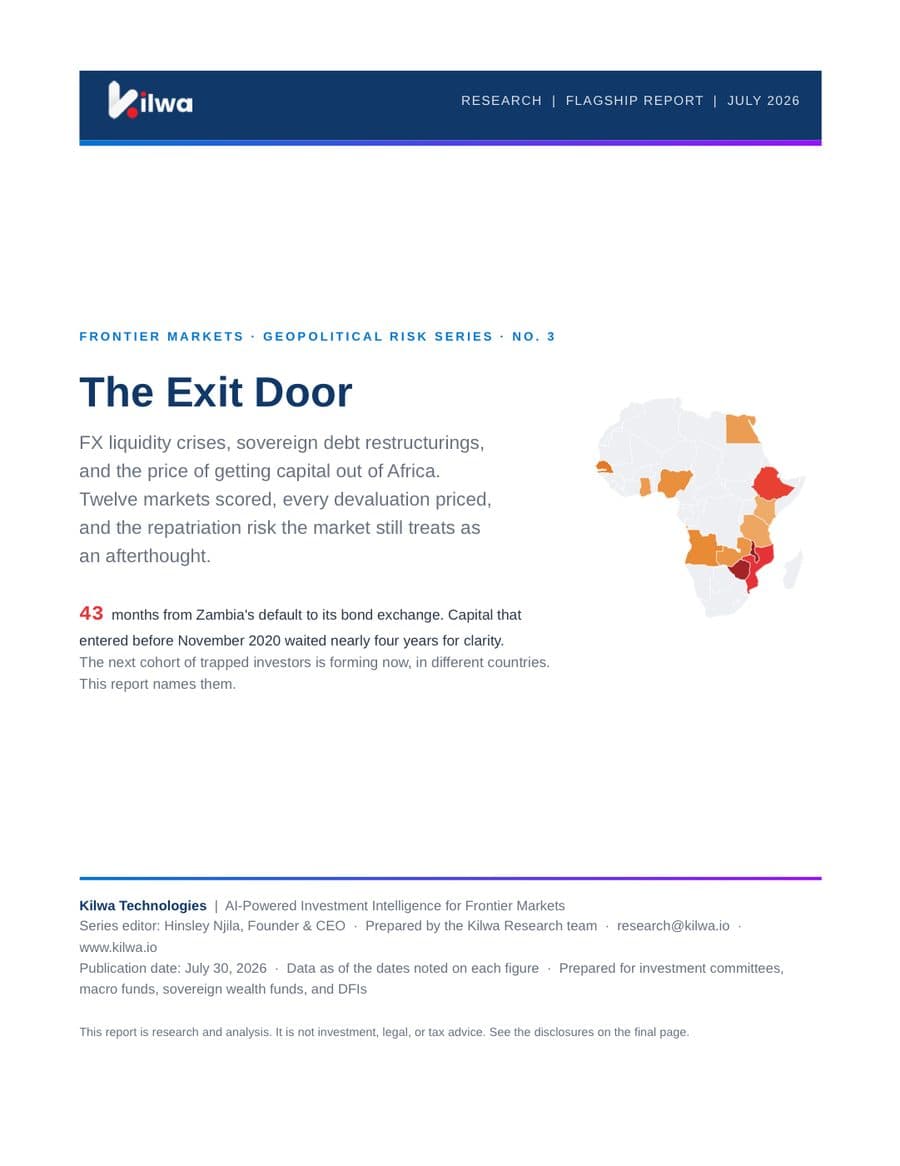
Geopolitical Risk · No. 1
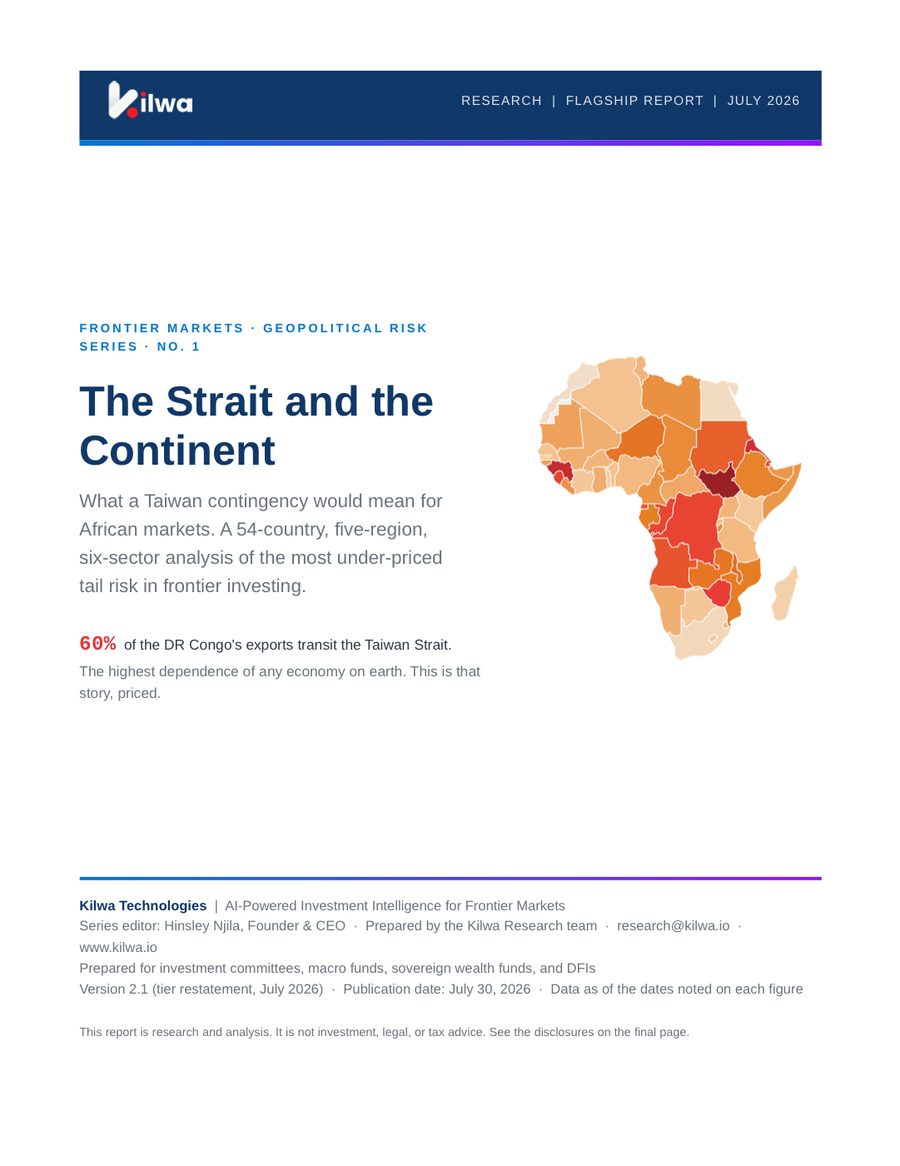
The Strait and the Continent
What a Taiwan contingency would mean for African markets
A 54-country, five-region, six-sector analysis of the most under-priced tail risk in frontier investing.
Series editor Hinsley Njila, Founder & CEO · Prepared by the Kilwa Research team
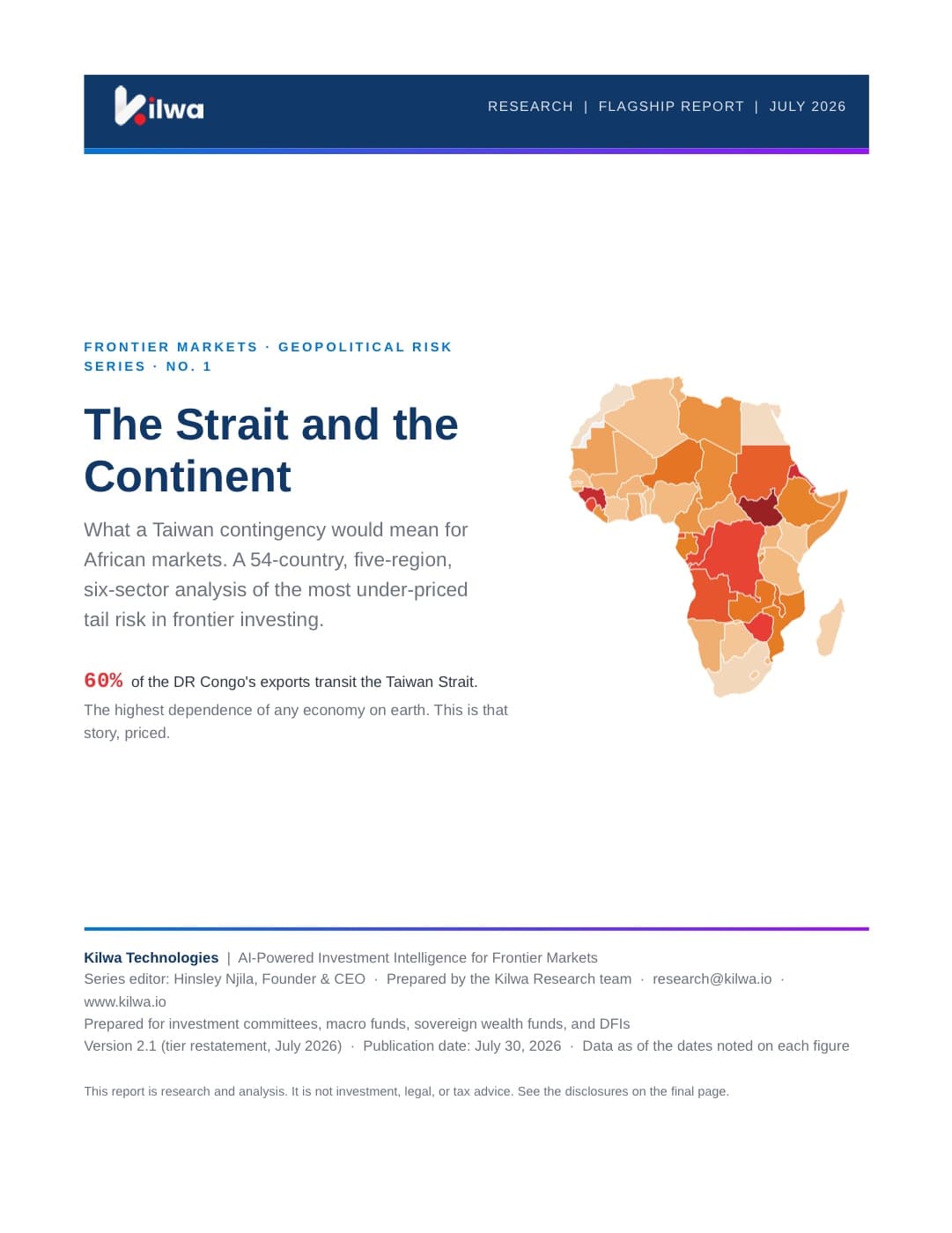
of DR Congo's exports transit the Taiwan Strait — the highest dependence of any economy on earth
Key takeaways
- 01
The world models a Taiwan conflict as an Asian event. Measured by dependence on the Taiwan Strait, the most exposed economies on earth are African — and almost nobody prices that exposure.
- 02
If deterrence fails, Africa takes a compound shock through five channels at once: commodity demand, freight and war-risk insurance, sovereign funding, technology hardware, and a payments system that splits into blocs. The compounding is what markets have not priced.
- 03
The continent would meet that shock with thin defences: twenty-one low-income African countries already sit in or near debt distress (IMF, March 2026), and the most exposed markets hold less than three months of import cover.
The report, in brief
What it is, who it is for, and what you get.
What a Taiwan Strait contingency would cost African markets: 54 countries, five regions, six sectors.
Written for
Risk committees and chief risk officers
Which African economies are the most strait-dependent on earth, and through which channel.
Sovereign and emerging-market debt investors
Where the shock lands on imports, reserves and credit.
Corporates with Asia-linked supply chains
Which sectors and corridors stop first.
Insurers and DFIs
A tail scenario with its transmission channels laid out.
What you get
- A 54-market exposure read across five regions and six sectors
- The transmission channels, stated one by one
- What would change the view
- 40 pages as a PDF, delivered the moment payment clears
The call
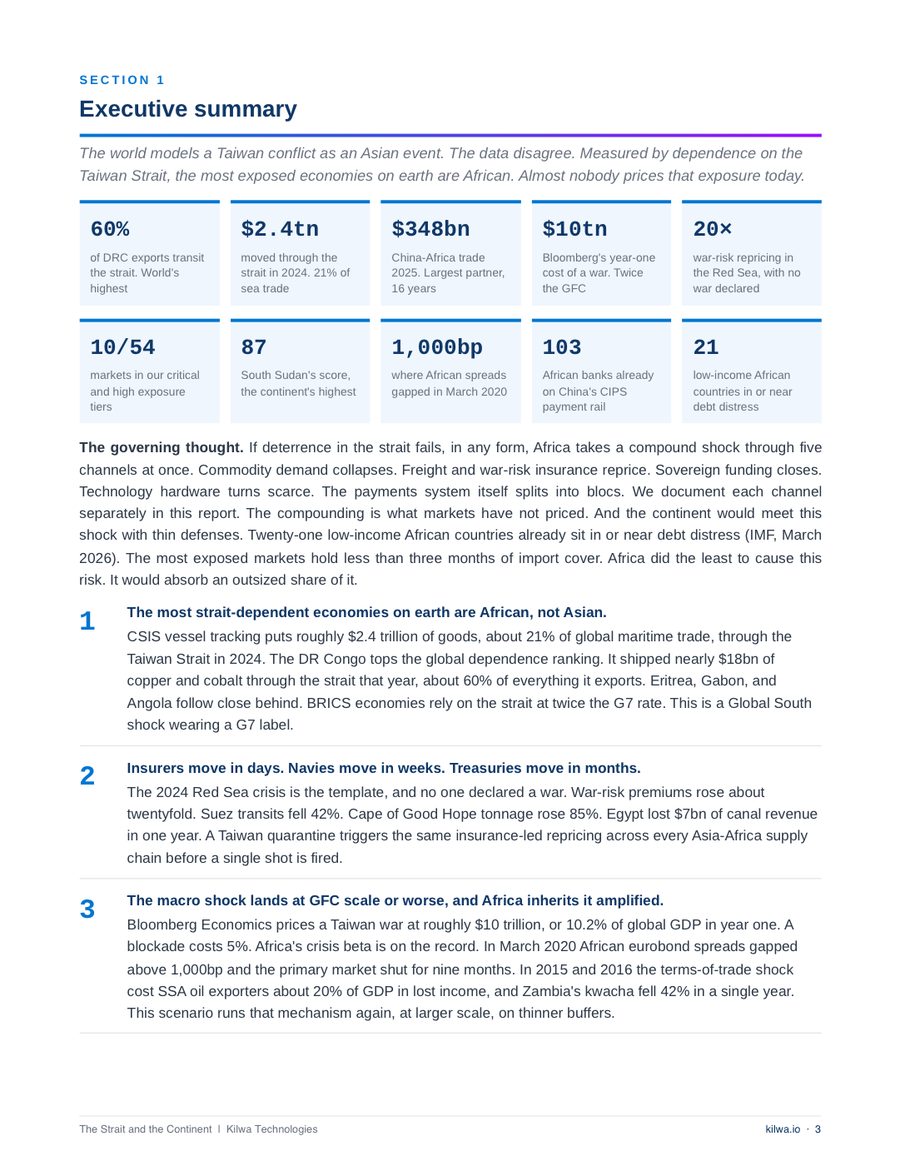
The world models a Taiwan conflict as an Asian event. The data disagree. Measured by dependence on the Taiwan Strait, the most exposed economies on earth are African — and almost nobody prices that exposure today.
The governing thought
If deterrence in the strait fails, in any form, Africa takes a compound shock through five channels at once. Commodity demand collapses. Freight and war-risk insurance reprice. Sovereign funding closes. Technology hardware turns scarce. The payments system itself splits into blocs.
We document each channel separately in this report. The compounding is what markets have not priced. And the continent would meet this shock with thin defenses. Twenty-one low-income African countries already sit in or near debt distress (IMF, March 2026). The most exposed markets hold less than three months of import cover.
Africa did the least to cause this risk. It would absorb an outsized share of it.
“This is a Global South shock wearing a G7 label.”
The most strait-dependent economies on earth are African, not Asian
CSIS vessel tracking puts roughly $2.4 trillion of goods — about 21% of global maritime trade — through the Taiwan Strait in 2024. The DR Congo tops the global dependence ranking: it shipped nearly $18bn of copper and cobalt through the strait that year, about 60% of everything it exports.
Eritrea, Gabon and Angola follow close behind. BRICS economies rely on the strait at twice the G7 rate.
What would change our view
This report publishes its own signposts. We grade ourselves against them, and the score updates as the inputs move — not on a quarterly editorial cycle.
The numbers
- $2.4tn
- moved through the strait in 2024 — 21% of global sea trade
- $348bn
- China–Africa trade in 2025. Largest partner for 16 years
- 10 / 54
- markets in our critical and high exposure tiers
- 20×
- war-risk repricing in the Red Sea, with no war declared
- 21
- low-income African countries in or near debt distress
- 103
- African banks already on China's CIPS payment rail
By market
Markets this report discusses.
Each market page gathers every tier the published reports print for that market, dated and linked to its source.
Series editor: Hinsley Njila, Founder & CEO. Prepared by the Kilwa Research team. research@kilwa.io
This report is research and analysis. It is not investment, legal or tax advice. Kilwa scores are structured risk rankings, not validated predictive models, except where explicitly stated otherwise. It is prepared for general circulation on a published schedule and is not tailored to any recipient.
Conflicts of interest. Kilwa does not hold, trade or take positions in the securities, currencies or instruments of the markets it scores, and receives no compensation from any government, issuer or institution in exchange for a score, a rating or favourable coverage. Where a research programme is funded by a named partner, that funding is disclosed in the report.