Geopolitical Risk · No. 2
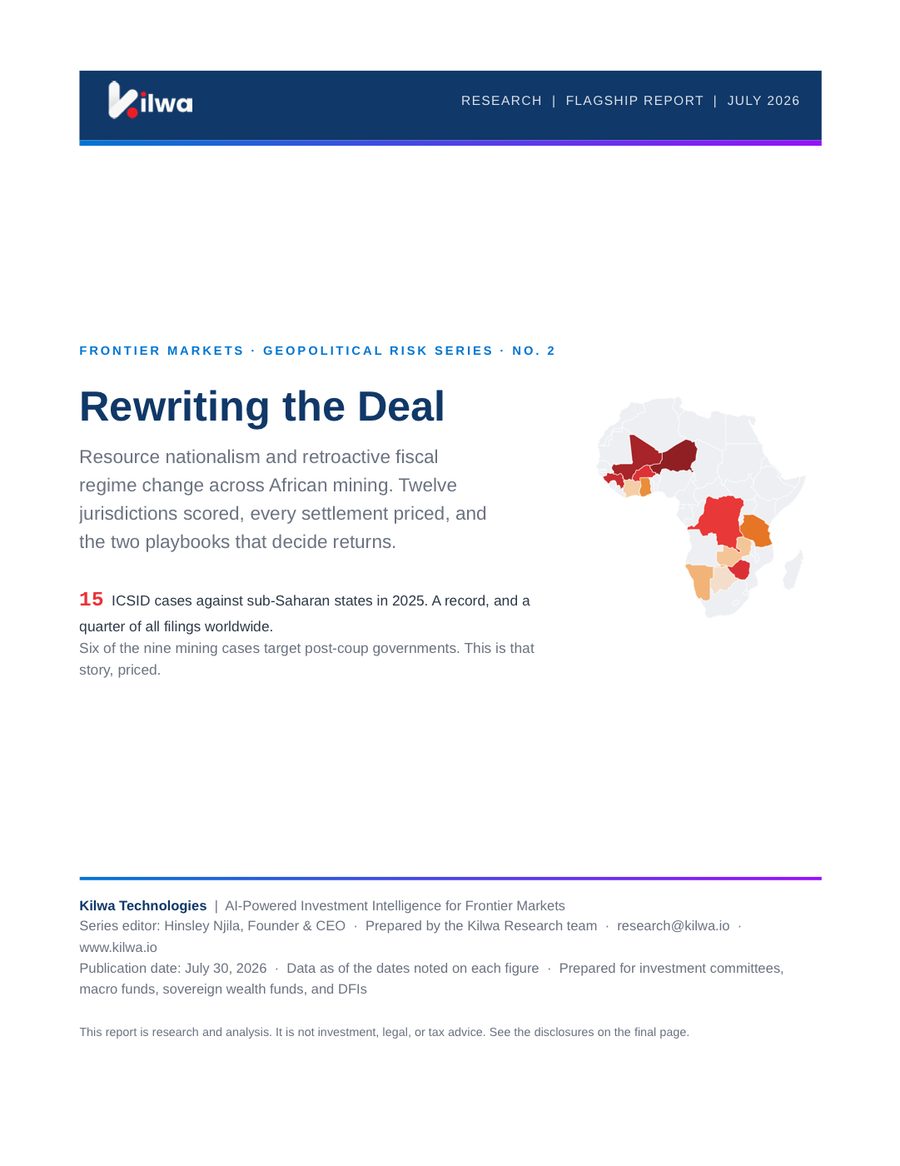
Rewriting the Deal
Resource nationalism and retroactive fiscal regime change across African mining
Twelve jurisdictions scored, every settlement priced, and the two playbooks that decide returns.
Series editor Hinsley Njila, Founder & CEO · Prepared by the Kilwa Research team
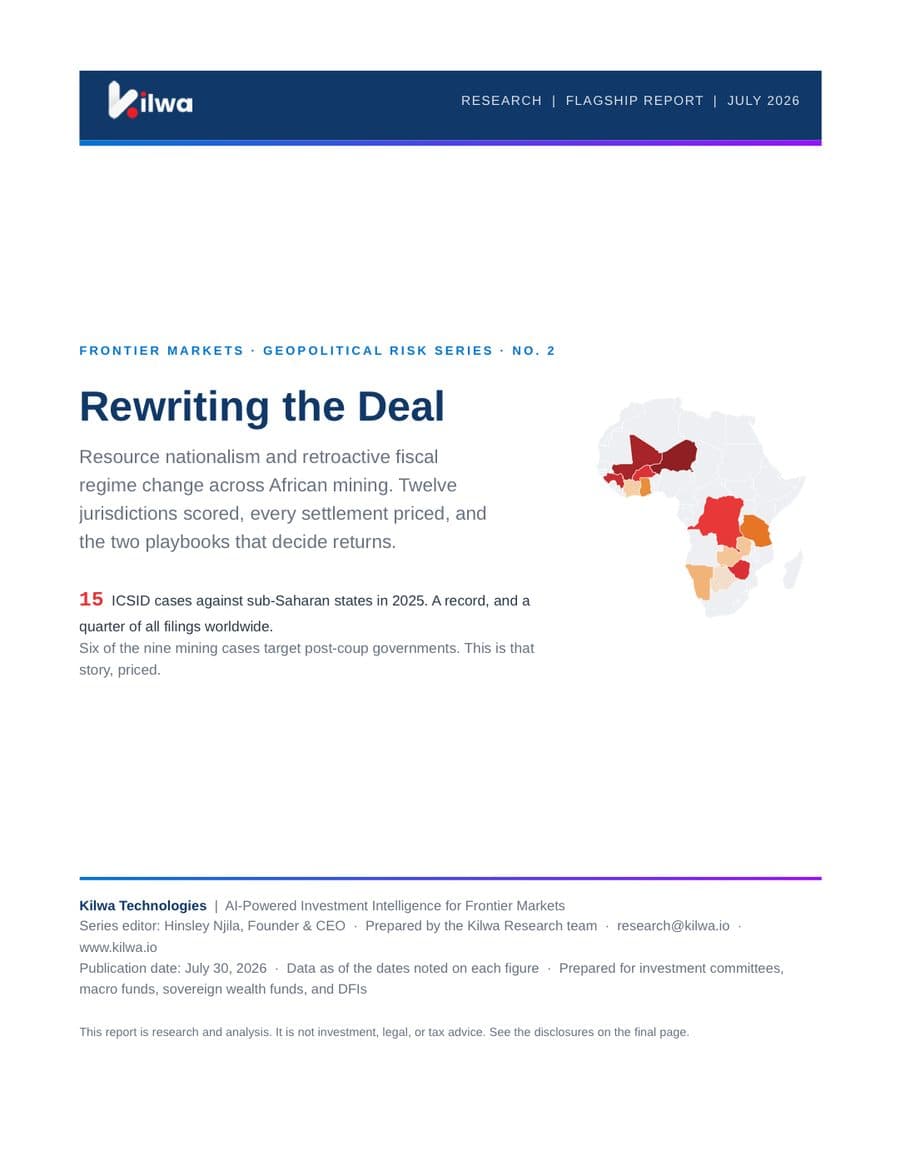
ICSID cases against sub-Saharan states in 2025 — a record, and a quarter of all filings worldwide
Key takeaways
- 01
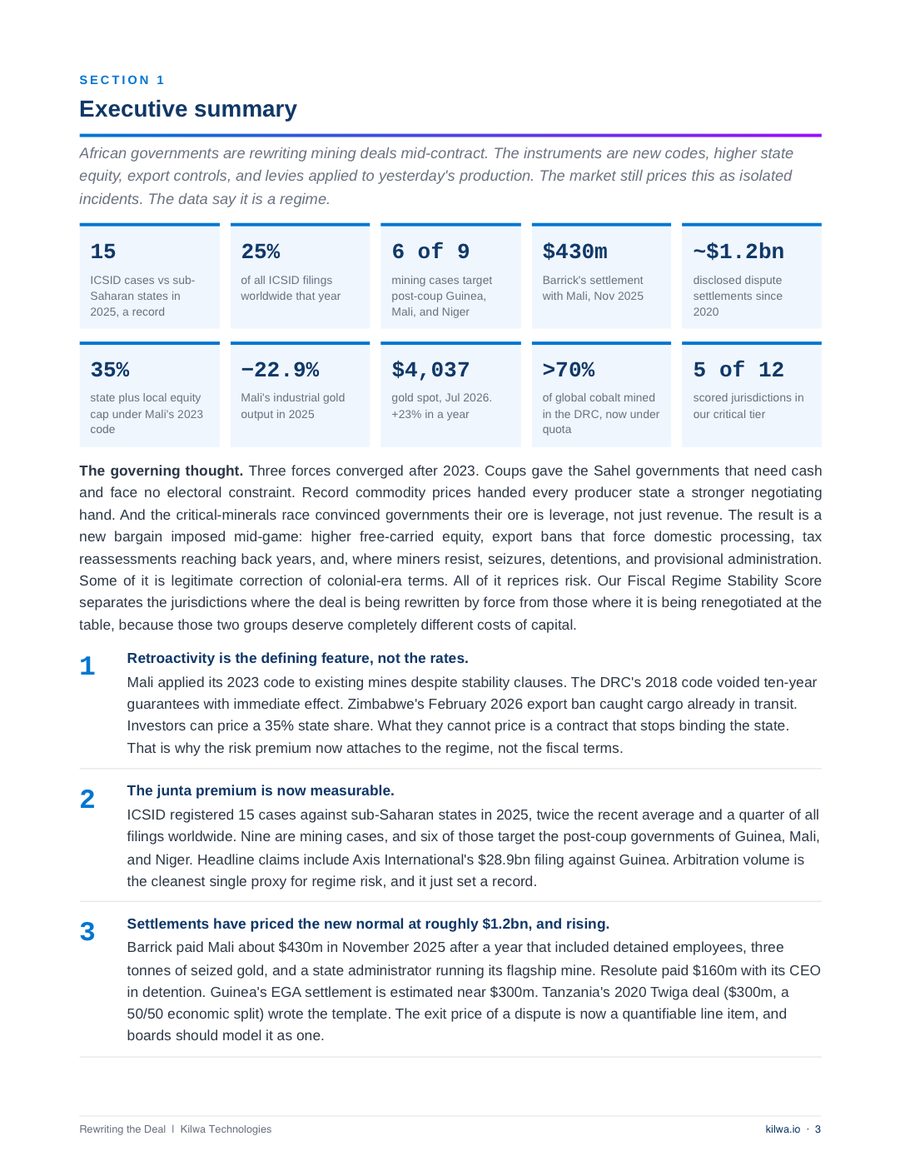
African governments are rewriting mining deals mid-contract — new codes, higher state equity, export controls, levies on yesterday's production. The market prices this as isolated incidents; the data say it is a regime.
- 02
Retroactivity is the defining feature, not the rates. Investors can price a 35% state share; what they cannot price is a contract that stops binding the state, so the risk premium now attaches to the regime rather than the fiscal terms.
- 03
ICSID registered 15 cases against sub-Saharan states in 2025, a record and a quarter of all filings worldwide; six of the nine mining cases target post-coup governments. Five of twelve scored jurisdictions sit in the critical tier.
The report, in brief
What it is, who it is for, and what you get.
Mid-contract fiscal regime change in African mining: twelve jurisdictions scored, every settlement priced.
Written for
Mining companies and their boards
Which jurisdictions rewrite by decree, which renegotiate at the table, and what each settlement cost.
Mining investors and lenders
How to price retroactivity: the contract that stops binding the state.
Political-risk underwriters and counsel
The arbitration and settlement record, jurisdiction by jurisdiction.
Battery-metal and commodity buyers
Where export controls sit on top of a documented retroactivity record.
What you get
- The Fiscal Regime Stability Score for twelve jurisdictions, five weighted factors
- Every settlement priced
- The two playbooks that decide returns
- Inputs flagged verified or estimate, with the anchoring events named
- 27 pages as a PDF, delivered the moment payment clears
The call
African governments are rewriting mining deals mid-contract, and the market still prices this as isolated incidents. The data say it is a regime. Investors can price a 35% state share; what they cannot price is a contract that stops binding the state.
Retroactivity is the defining feature, not the rates
Three forces converged after 2023. Coups gave the Sahel governments that need cash and face no electoral constraint. Record commodity prices handed every producer state a stronger negotiating hand. And the critical-minerals race convinced governments their ore is leverage, not just revenue.
Mali applied its 2023 code to existing mines despite stability clauses. The DRC's 2018 code voided ten-year guarantees with immediate effect. Zimbabwe's February 2026 export ban caught cargo already in transit. The risk premium now attaches to the regime, not the fiscal terms.
Some of this is legitimate correction of colonial-era terms. All of it reprices risk. The Fiscal Regime Stability Score separates jurisdictions where the deal is being rewritten by force from those where it is being renegotiated at the table, because those two groups deserve completely different costs of capital.
“Investors can price a 35% state share. What they cannot price is a contract that stops binding the state.”
The junta premium is now measurable
ICSID registered 15 cases against sub-Saharan states in 2025 — twice the recent average and a quarter of all filings worldwide. Nine are mining cases, and six of those target post-coup governments.
Roughly $1.2bn of disclosed dispute settlements have been reached since 2020. Mali's industrial gold output fell 22.9% in 2025 while gold spot ran to $4,037 in July 2026, up 23% in a year. The state captured more of a smaller pie, and the production number is the part the fiscal case tends to omit.
The numbers
- 6 of 9
- mining cases target post-coup Guinea, Mali and Niger
- $430m
- Barrick's settlement with Mali, November 2025
- 35%
- state plus local equity cap under Mali's 2023 code, applied to existing mines
- 5 of 12
- scored jurisdictions in the critical tier
The model, in one table
Fiscal Regime Stability Score
| Tier | Markets | What it means for capital |
|---|---|---|
| Critical | 5: Niger 90, Mali 84, Guinea 76, Zimbabwe 71, Burkina Faso 70 | The deal is being rewritten by force. Retroactive application to existing licences, coercive settlement conduct, and a live arbitration docket. |
| High | 1: DR Congo 66 | Export control used aggressively against a documented retroactivity record. Scale makes it unavoidable rather than optional. |
| Elevated | 2: Tanzania 48, Ghana 40 | Renegotiation at the table rather than by decree, but the direction of state participation is one way. |
| Moderate | 4: Namibia 29, Zambia 24, Côte d'Ivoire 20, Botswana 12 | Terms change through process. The cost of capital here should not carry the regional premium the market applies. |
A risk composite, 0–100, higher meaning greater risk of mid-contract regime change. Retroactivity precedent 30%, state-equity trajectory 20%, export-control usage 20%, dispute and arbitration record 15%, settlement conduct 15%. Critical at 70+, High 55–69, Elevated 35–54, Moderate below 35. Inputs are flagged (v) where anchoring events are verified against primary reporting and (e) where judgment dominates — the flag attests the events, not the scores. A structured risk ranking, not a validated predictive model.
By market
Markets this report tiers.
Each market page gathers every tier the published reports print for that market, dated and linked to its source.
Series editor: Hinsley Njila, Founder & CEO. Prepared by the Kilwa Research team. research@kilwa.io
This report is research and analysis. It is not investment, legal or tax advice. Kilwa scores are structured risk rankings, not validated predictive models, except where explicitly stated otherwise. It is prepared for general circulation on a published schedule and is not tailored to any recipient.
Conflicts of interest. Kilwa does not hold, trade or take positions in the securities, currencies or instruments of the markets it scores, and receives no compensation from any government, issuer or institution in exchange for a score, a rating or favourable coverage. Where a research programme is funded by a named partner, that funding is disclosed in the report.