Geopolitical Risk · No. 3
The Exit Door
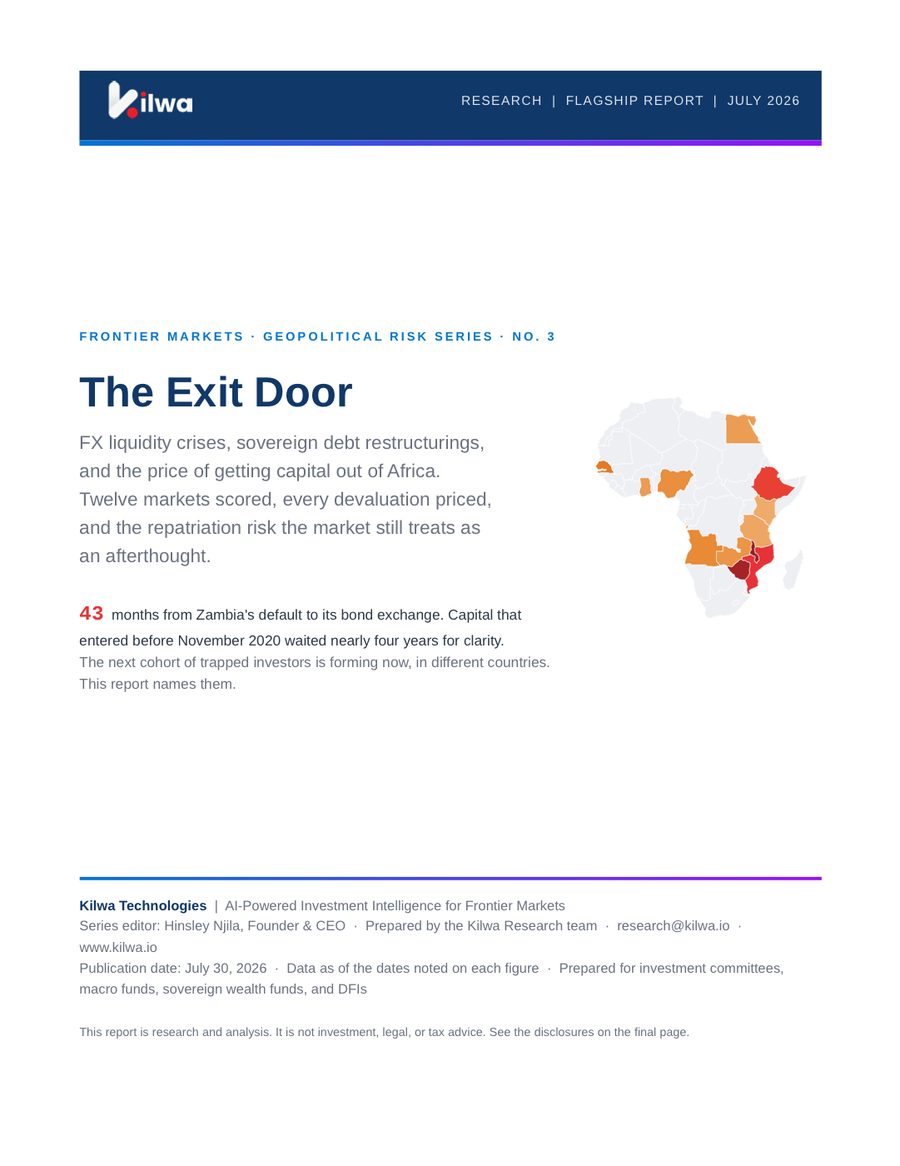
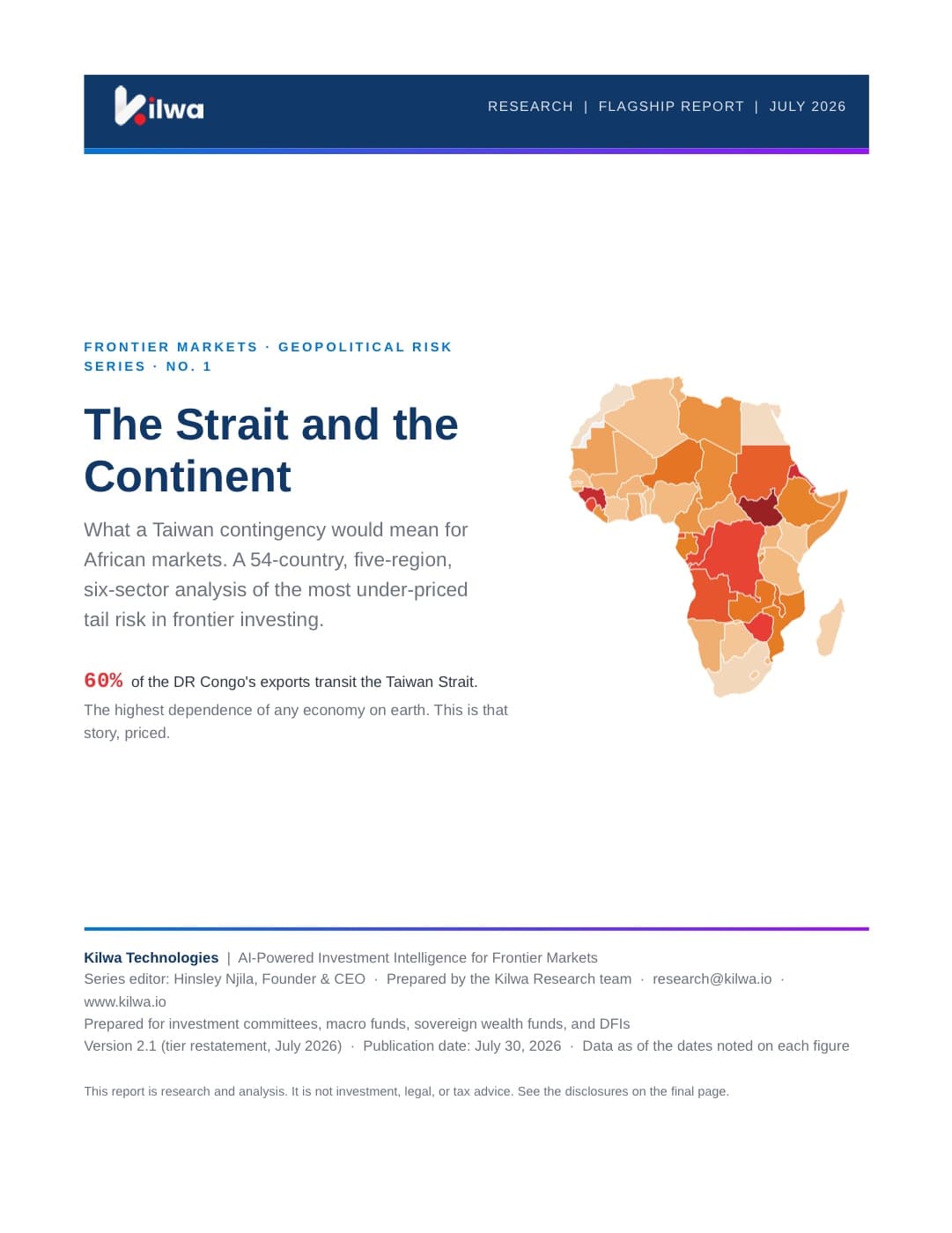
FX liquidity crises, sovereign restructurings, and the price of getting capital out
Twelve markets scored, every devaluation priced, and the repatriation risk the market still treats as an afterthought.
Series editor Hinsley Njila, Founder & CEO · Prepared by the Kilwa Research team
months from Zambia's default to its bond exchange. Capital that entered before November 2020 waited nearly four years for clarity
Key takeaways
- 01
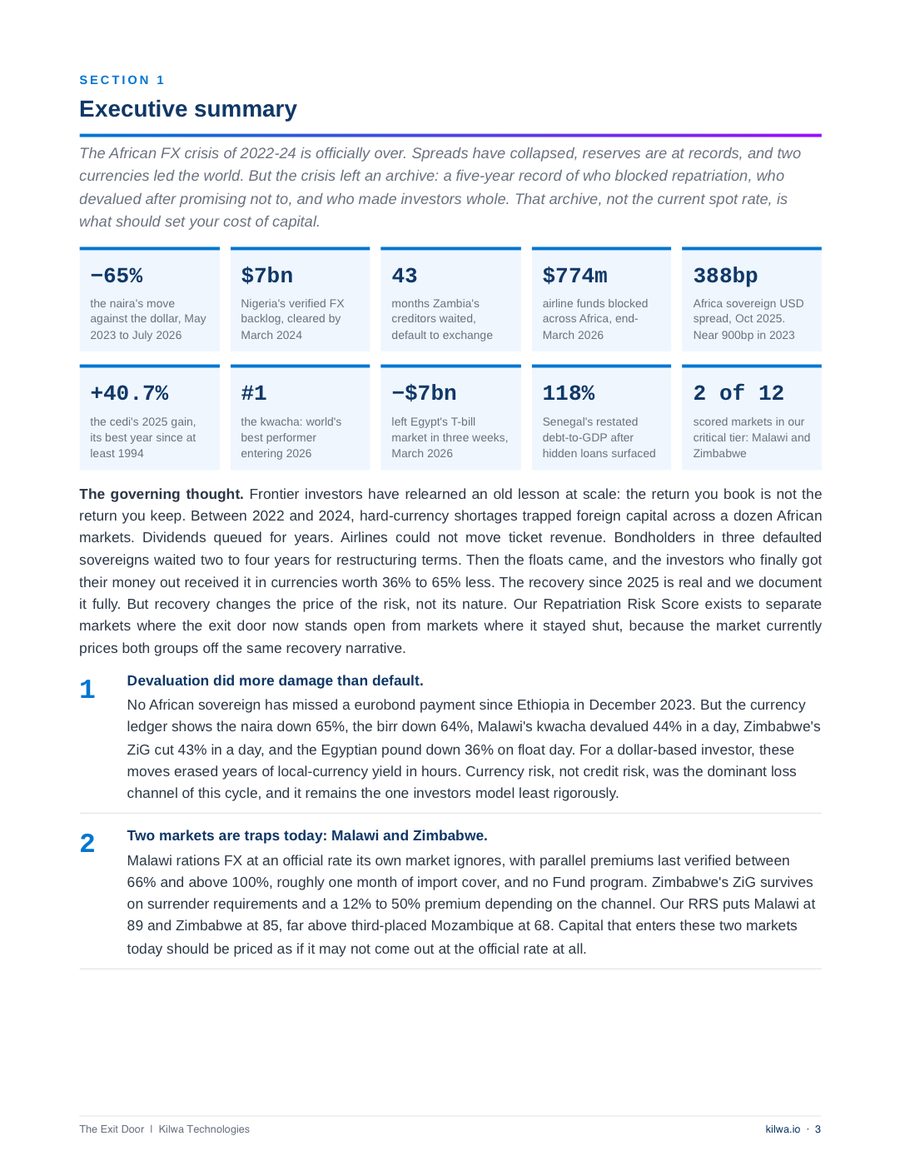
The African FX crisis of 2022–24 is officially over, but it left an archive: a five-year record of who blocked repatriation, who devalued after promising not to, and who made investors whole. That archive, not the spot rate, should set the cost of capital.
- 02
Devaluation did more damage than default. No African sovereign has missed a eurobond payment since Ethiopia in December 2023, yet the naira fell 65%, the birr 64%, and Malawi's kwacha lost 44% in a day — currency, not credit, was the dominant loss channel.
- 03
The recovery changes the price of the risk, not its nature. $7bn left Egypt's T-bill market in three weeks in March 2026; Senegal's debt-to-GDP was restated to 118%. Two of twelve scored markets — Malawi and Zimbabwe — sit in the critical tier.
The report, in brief
What it is, who it is for, and what you get.
Repatriation risk in twelve African markets, scored on who blocked exits, who devalued and who paid.
Written for
Treasurers and CFOs
Which markets priced, delayed or blocked repatriation in 2021 to 2026, and what that should add to your cost of capital.
Private equity, credit and infrastructure funds
Where the normalisation trade lives, and where it can reverse.
Risk committees and DFIs
A scored convertibility record in place of the current spot rate.
Sovereign-debt investors
Why devaluation did more damage than default.
What you get
- The Repatriation Risk Score for twelve markets, five weighted factors
- Every devaluation priced
- The five-year convertibility record, market by market
- Inputs flagged verified or estimate
- 26 pages as a PDF, delivered the moment payment clears
The call
The African FX crisis of 2022–24 is officially over, and the recovery is real. But it left an archive: a five-year record of who blocked repatriation, who devalued after promising not to, and who made investors whole. That archive, not the current spot rate, is what should set your cost of capital.
Devaluation did more damage than default
No African sovereign has missed a eurobond payment since Ethiopia in December 2023. But the currency ledger shows the naira down 65%, the birr down 64%, Malawi's kwacha devalued 44% in a day, Zimbabwe's ZiG cut 43% in a day, and the Egyptian pound down 36% on float day.
For a dollar-based investor these moves erased years of local-currency yield in hours. Currency risk, not credit risk, was the dominant loss channel — and it is the one most frontier mandates are least equipped to measure.
“The return you book is not the return you keep.”
The recovery changes the price of the risk, not its nature
Spreads have collapsed, reserves are at records, and two African currencies led the world: the cedi gained 40.7% in 2025, its best year since at least 1994, and the kwacha entered 2026 as the world's best performer.
The market now prices the whole continent off that recovery narrative. It should not. $7bn left Egypt's T-bill market in three weeks in March 2026, and Senegal's debt-to-GDP was restated to 118% after hidden loans surfaced. The Repatriation Risk Score exists to separate markets where the exit door now stands open from those where it stayed shut.
The numbers
- −65%
- the naira against the dollar, May 2023 to July 2026
- $774m
- airline funds blocked across Africa at end-March 2026
- 388bp
- Africa sovereign USD spread, October 2025 — near 900bp in 2023
- 2 of 12
- scored markets in the critical tier: Malawi and Zimbabwe
The model, in one table
Repatriation Risk Score
| Tier | Markets | What it means for capital |
|---|---|---|
| Critical | 2: Malawi 89.2, Zimbabwe 84.8 | The exit door stayed shut. Convertibility restrictions across the full 2021–26 window, thin reserves, and no credible anchor. |
| High | 2: Mozambique 68.2, Ethiopia 63.2 | A documented blocking record against an unresolved debt position. Ethiopia's exchange completion is the single largest swing factor. |
| Elevated | 6: Senegal 46.5, Angola 41.2, Nigeria 40.0, Zambia 38.0, Ghana 36.2, Egypt 35.8 | Reformed or reforming, with the record still inside the five-year window. This is where the normalisation trade lives and where it can reverse. |
| Moderate | 2: Tanzania 32.8, Kenya 31.5 | No material convertibility episode in the window. The clean pair, and priced as though they were not. |
A weighted composite, 0–100, higher meaning greater risk that foreign capital cannot exit at the official rate on a commercial schedule. Five-year convertibility record 30%, parallel-market premium 20%, reserve adequacy 20%, debt overhang 15%, IMF anchor health 15%. Critical at 70+, High 55–69, Elevated 35–54, Moderate below 35. Inputs flagged v for verified against primary data and e for estimate where primary data is stale or contested. A structured risk ranking, not a validated predictive model.
By market
Markets this report tiers.
Each market page gathers every tier the published reports print for that market, dated and linked to its source.
Series editor: Hinsley Njila, Founder & CEO. Prepared by the Kilwa Research team. research@kilwa.io
This report is research and analysis. It is not investment, legal or tax advice. Kilwa scores are structured risk rankings, not validated predictive models, except where explicitly stated otherwise. It is prepared for general circulation on a published schedule and is not tailored to any recipient.
Conflicts of interest. Kilwa does not hold, trade or take positions in the securities, currencies or instruments of the markets it scores, and receives no compensation from any government, issuer or institution in exchange for a score, a rating or favourable coverage. Where a research programme is funded by a named partner, that funding is disclosed in the report.