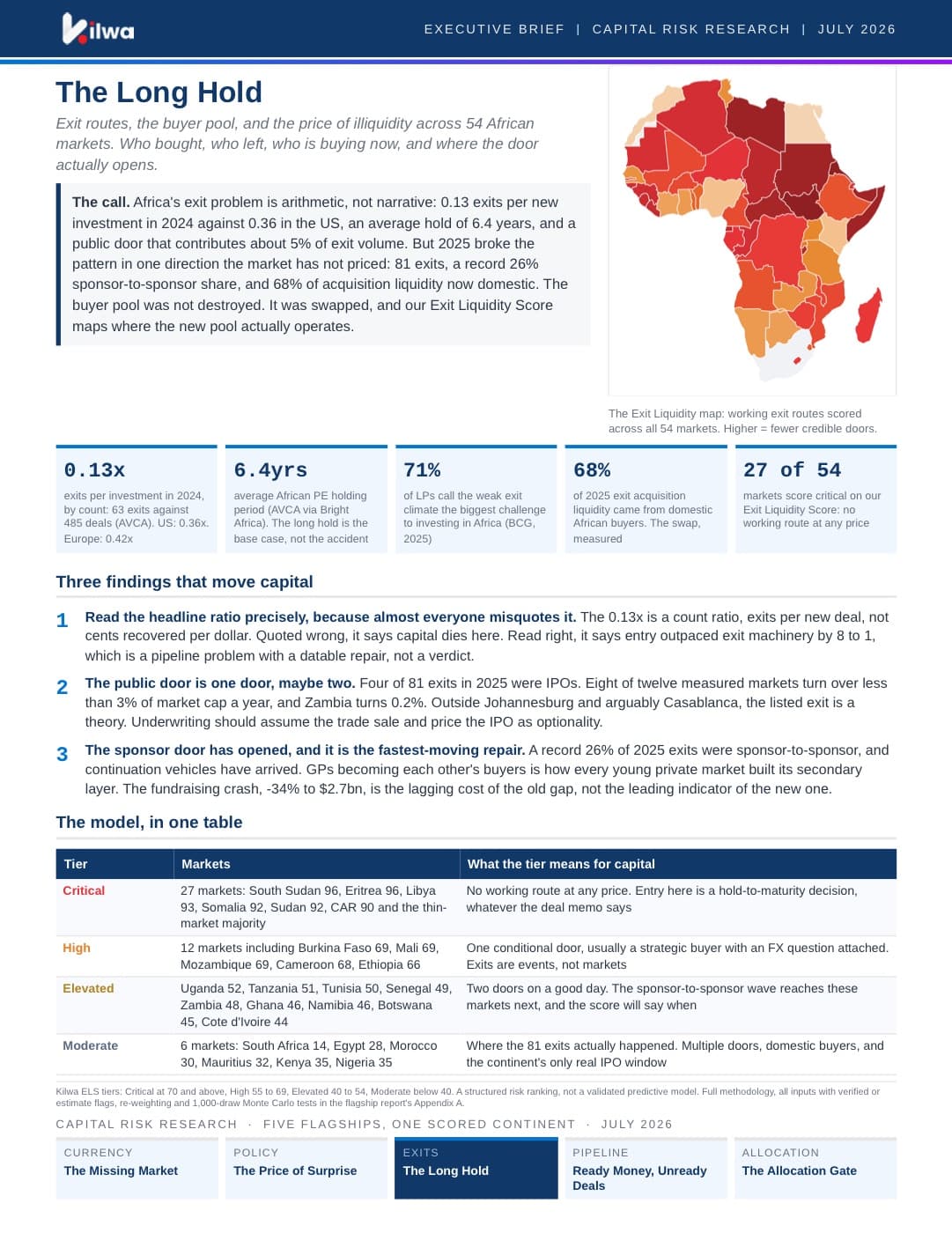
The Long Hold
Exit routes, the buyer pool, and the price of illiquidity
Who bought, who left, who is buying now, and where the door actually opens across 54 African markets.
Series editor Hinsley Njila, Founder & CEO · Prepared by the Kilwa Research team
exits per new investment in 2024 — 63 exits against 485 deals. The US runs 0.36×, Europe 0.42×
The call
Africa's exit problem is arithmetic, not narrative. But 2025 broke the pattern in one direction the market has not priced: 81 exits, a record 26% sponsor-to-sponsor share, and 68% of acquisition liquidity now domestic. The buyer pool was not destroyed. It was swapped.
Three findings that move capital
- 01Read the headline ratio precisely, because almost everyone misquotes itThe 0.13× is a count ratio — exits per new deal — not cents recovered per dollar. Quoted wrong, it says capital dies here. Read right, it says entry outpaced exit machinery by 8 to 1, which is a pipeline problem with a datable repair, not a verdict.
- 02The public door is one door, maybe twoFour of 81 exits in 2025 were IPOs. Eight of twelve measured markets turn over less than 3% of market cap a year, and Zambia turns 0.2%. Outside Johannesburg and arguably Casablanca, the listed exit is a theory. Underwriting should assume the trade sale and price the IPO as optionality.
- 03The sponsor door has opened, and it is the fastest-moving repairA record 26% of 2025 exits were sponsor-to-sponsor, and continuation vehicles have arrived. GPs becoming each other's buyers is how every young private market built its secondary layer. The fundraising crash, −34% to $2.7bn, is the lagging cost of the old gap, not the leading indicator of the new one.
“The buyer pool was not destroyed. It was swapped.”
The numbers
- 6.4 yrs
- average African PE holding period. The long hold is the base case, not the accident
- 71%
- of LPs call the weak exit climate the biggest challenge to investing in Africa (BCG, 2025)
- 68%
- of 2025 exit acquisition liquidity came from domestic African buyers
- 27 of 54
- markets score critical on our Exit Liquidity Score: no working route at any price
The model, in one table
Kilwa Exit Liquidity Score (ELS)
| Tier | Markets | What it means for capital |
|---|---|---|
| Critical | 27 markets: South Sudan 96, Eritrea 96, Libya 93, Somalia 92, Sudan 92, CAR 90 and the thin-market majority | No working route at any price. Entry here is a hold-to-maturity decision, whatever the deal memo says. |
| High | 12 markets including Burkina Faso 69, Mali 69, Mozambique 69, Cameroon 68, Ethiopia 66 | One conditional door, usually a strategic buyer with an FX question attached. Exits are events, not markets. |
| Elevated | Uganda 52, Tanzania 51, Tunisia 50, Senegal 49, Zambia 48, Ghana 46, Namibia 46, Botswana 45, Côte d'Ivoire 44 | Two doors on a good day. The sponsor-to-sponsor wave reaches these markets next, and the score will say when. |
| Moderate | 6 markets: South Africa 14, Egypt 28, Morocco 30, Mauritius 32, Kenya 35, Nigeria 35 | Where the 81 exits actually happened. Multiple doors, domestic buyers, and the continent's only real IPO window. |
Critical at 70 and above, High 55 to 69, Elevated 40 to 54, Moderate below 40. A structured risk ranking, not a validated predictive model. Full methodology and robustness testing appear in the flagship report's Appendix A.
By market
Markets this report tiers.
- Botswana
- Burkina Faso
- Cameroon
- Central African Republic
- Côte d'Ivoire
- Egypt
- Eritrea
- Ethiopia
- Ghana
- Kenya
- Libya
- Mali
- Mauritius
- Morocco
- Mozambique
- Namibia
- Nigeria
- Senegal
- Somalia
- South Africa
- South Sudan
- Sudan
- Tanzania
- Tunisia
- Uganda
- Zambia
Each market page gathers every tier the published reports print for that market, dated and linked to its source.
Series editor: Hinsley Njila, Founder & CEO. Prepared by the Kilwa Research team. research@kilwa.io
This report is research and analysis. It is not investment, legal or tax advice. Kilwa scores are structured risk rankings, not validated predictive models, except where explicitly stated otherwise. It is prepared for general circulation on a published schedule and is not tailored to any recipient.
Conflicts of interest. Kilwa does not hold, trade or take positions in the securities, currencies or instruments of the markets it scores, and receives no compensation from any government, issuer or institution in exchange for a score, a rating or favourable coverage. Where a research programme is funded by a named partner, that funding is disclosed in the report.