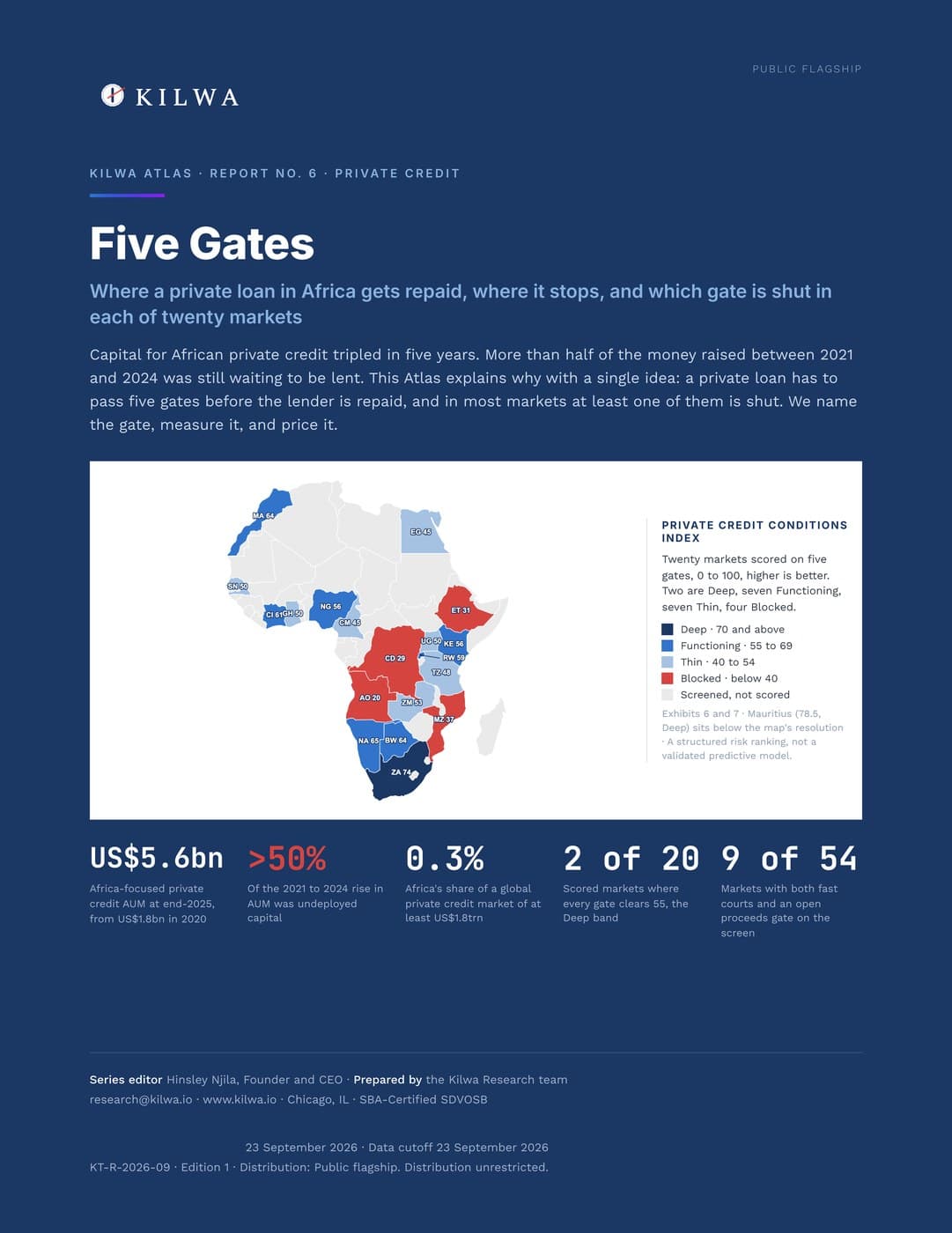
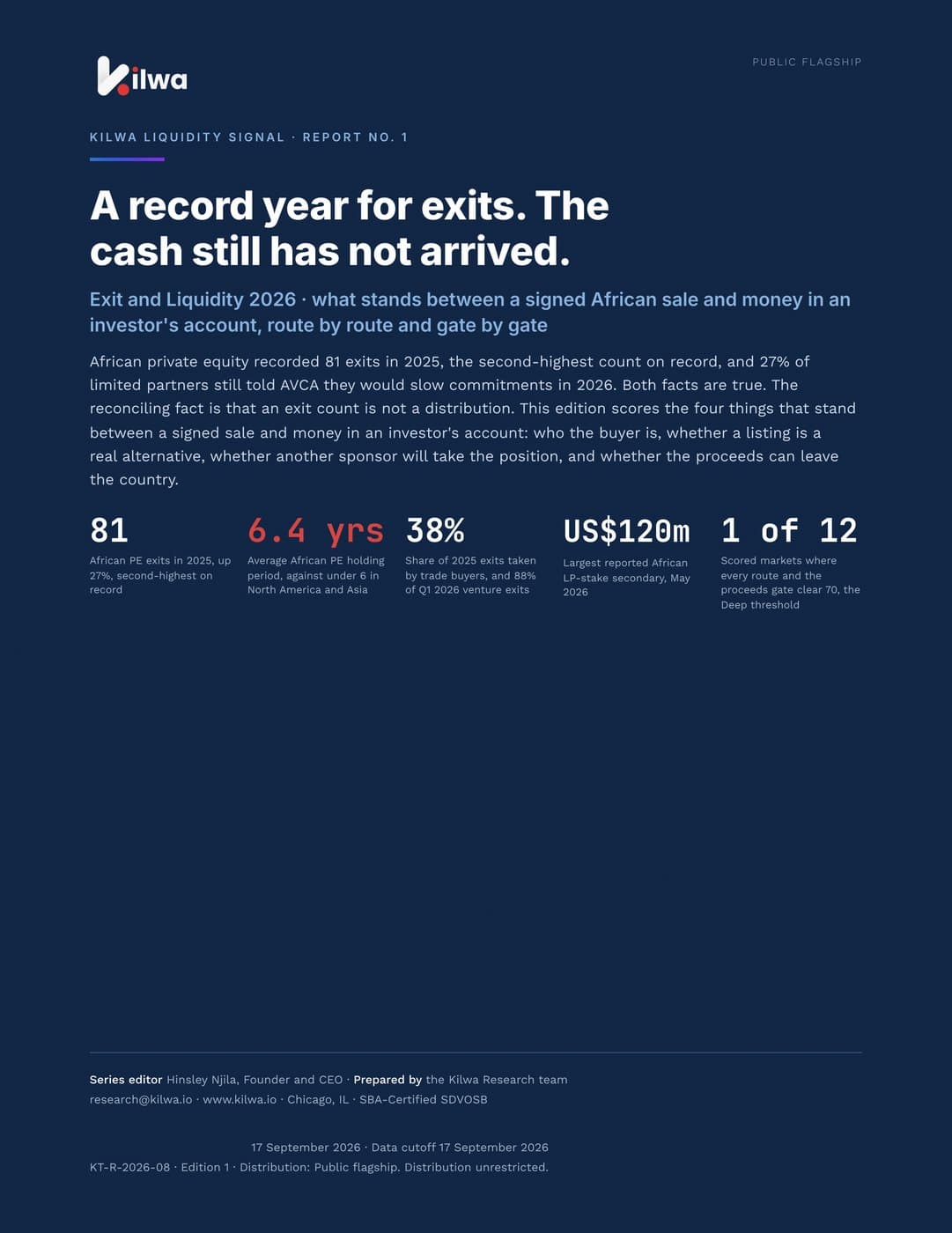
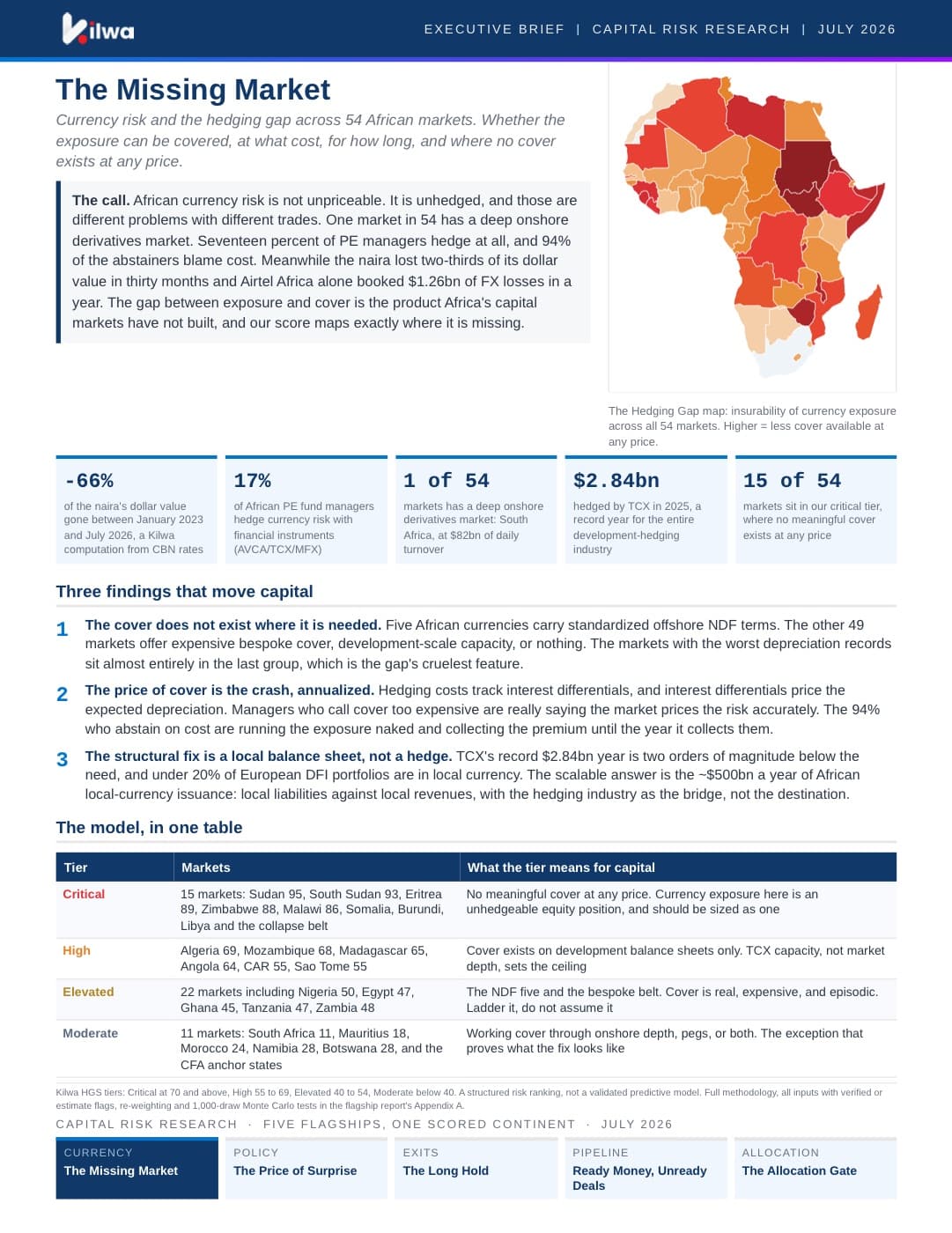
The Missing Market
Currency risk and the hedging gap across 54 African markets
Whether the exposure can be covered, at what cost, for how long, and where no cover exists at any price.
Series editor Hinsley Njila, Founder & CEO · Prepared by the Kilwa Research team
of the naira's dollar value gone between January 2023 and July 2026 — a Kilwa computation from CBN rates
The call
African currency risk is not unpriceable. It is unhedged, and those are different problems with different trades.
Three findings that move capital
One market in 54 has a deep onshore derivatives market. Seventeen percent of PE managers hedge at all, and 94% of the abstainers blame cost. Meanwhile the naira lost two-thirds of its dollar value in thirty months and Airtel Africa alone booked $1.26bn of FX losses in a year.
- 01The cover does not exist where it is neededFive African currencies carry standardized offshore NDF terms. The other 49 markets offer expensive bespoke cover, development-scale capacity, or nothing. The markets with the worst depreciation records sit almost entirely in the last group, which is the gap's cruelest feature.
- 02The price of cover is the crash, annualizedHedging costs track interest differentials, and interest differentials price the expected depreciation. Managers who call cover too expensive are really saying the market prices the risk accurately. The 94% who abstain on cost are running the exposure naked and collecting the premium until the year it collects them.
- 03The structural fix is a local balance sheet, not a hedgeTCX's record $2.84bn year is two orders of magnitude below the need, and under 20% of European DFI portfolios are in local currency. The scalable answer is the ~$500bn a year of African local-currency issuance: local liabilities against local revenues, with the hedging industry as the bridge, not the destination.
“The gap between exposure and cover is the product Africa's capital markets have not built.”
The numbers
- 17%
- of African PE fund managers hedge currency risk with financial instruments
- 1 of 54
- markets has a deep onshore derivatives market: South Africa, at $82bn daily turnover
- $2.84bn
- hedged by TCX in 2025 — a record year for the entire development-hedging industry
- 15 of 54
- markets sit in our critical tier, where no meaningful cover exists at any price
The model, in one table
Kilwa Hedging Gap Score (HGS)
| Tier | Markets | What it means for capital |
|---|---|---|
| Critical | 15 markets: Sudan 95, South Sudan 93, Eritrea 89, Zimbabwe 88, Malawi 86, Somalia, Burundi, Libya and the collapse belt | No meaningful cover at any price. Currency exposure here is an unhedgeable equity position, and should be sized as one. |
| High | Algeria 69, Mozambique 68, Madagascar 65, Angola 64, CAR 55, São Tomé 55 | Cover exists on development balance sheets only. TCX capacity, not market depth, sets the ceiling. |
| Elevated | 22 markets including Nigeria 50, Egypt 47, Ghana 45, Tanzania 47, Zambia 48 | The NDF five and the bespoke belt. Cover is real, expensive and episodic. Ladder it, do not assume it. |
| Moderate | 11 markets: South Africa 11, Mauritius 18, Morocco 24, Namibia 28, Botswana 28, and the CFA anchor states | Working cover through onshore depth, pegs, or both. The exception that proves what the fix looks like. |
Critical at 70 and above, High 55 to 69, Elevated 40 to 54, Moderate below 40. A structured risk ranking, not a validated predictive model. Full methodology, all inputs with verified or estimate flags, re-weighting and 1,000-draw Monte Carlo tests appear in the flagship report's Appendix A.
By market
Markets this report tiers.
- Algeria
- Angola
- Botswana
- Burundi
- Central African Republic
- Egypt
- Eritrea
- Ghana
- Libya
- Madagascar
- Malawi
- Mauritius
- Morocco
- Mozambique
- Namibia
- Nigeria
- São Tomé and Príncipe
- Somalia
- South Africa
- South Sudan
- Sudan
- Tanzania
- Zambia
- Zimbabwe
Each market page gathers every tier the published reports print for that market, dated and linked to its source.
Series editor: Hinsley Njila, Founder & CEO. Prepared by the Kilwa Research team. research@kilwa.io
This report is research and analysis. It is not investment, legal or tax advice. Kilwa scores are structured risk rankings, not validated predictive models, except where explicitly stated otherwise. It is prepared for general circulation on a published schedule and is not tailored to any recipient.
Conflicts of interest. Kilwa does not hold, trade or take positions in the securities, currencies or instruments of the markets it scores, and receives no compensation from any government, issuer or institution in exchange for a score, a rating or favourable coverage. Where a research programme is funded by a named partner, that funding is disclosed in the report.