Minerals Signal · No. 1
Critical Minerals 2026
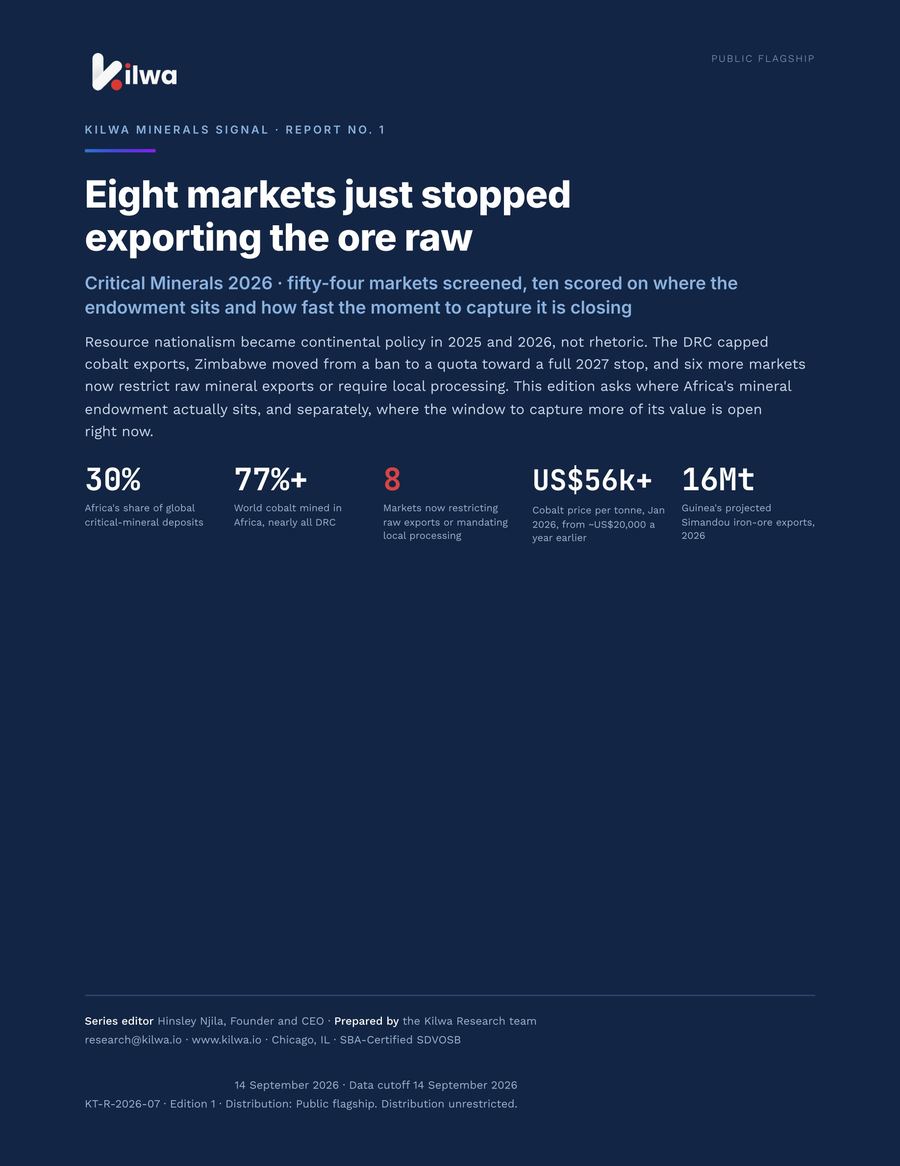
Eight markets just stopped exporting the ore raw.
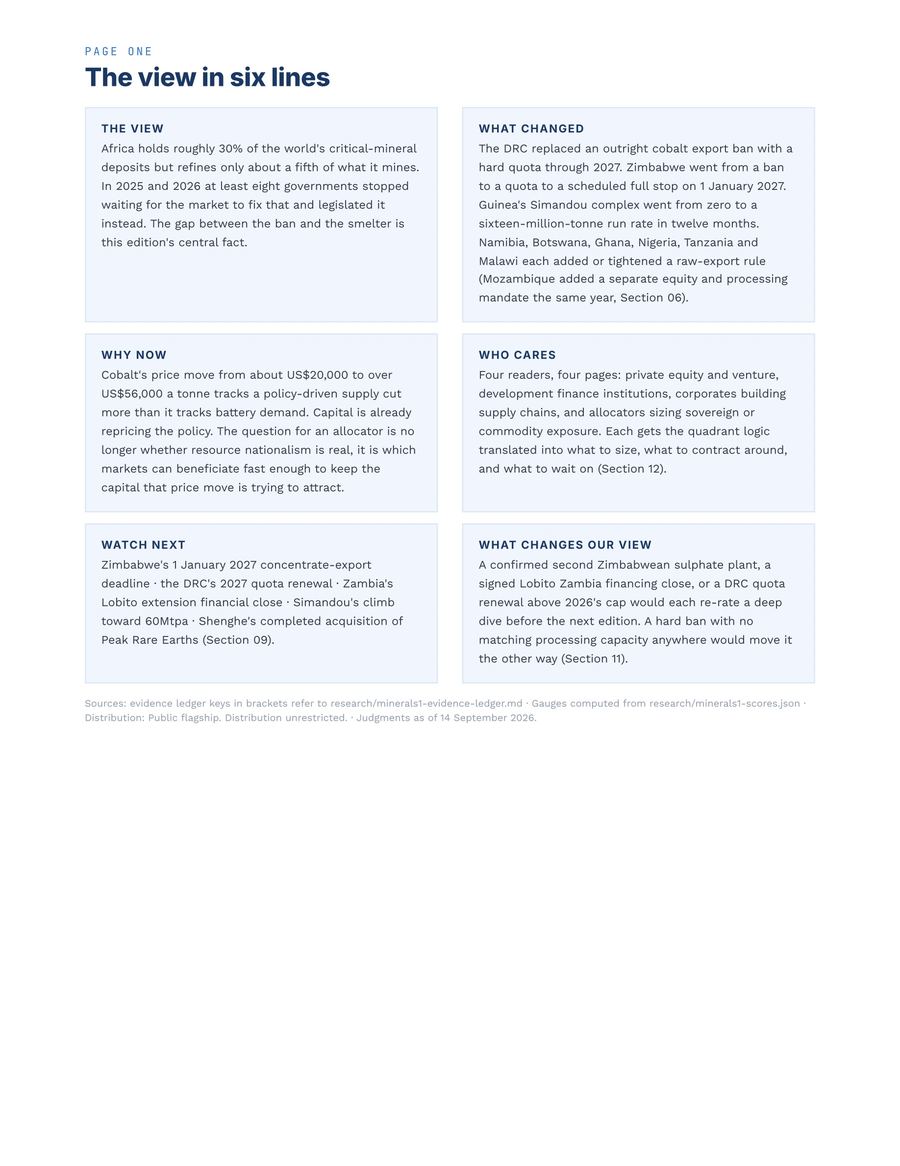
Resource nationalism became continental policy in 2025 and 2026. The DRC capped cobalt exports, Zimbabwe moved from a ban to a quota toward a full 2027 stop, and six more markets now restrict raw mineral exports or require local processing. This edition screens all 54 markets on where Africa's mineral endowment actually sits, scores ten on two published gauges, and asks, separately, where the window to capture more of its value is open right now.
Series editor Hinsley Njila, Founder & CEO · Prepared by the Kilwa Research team
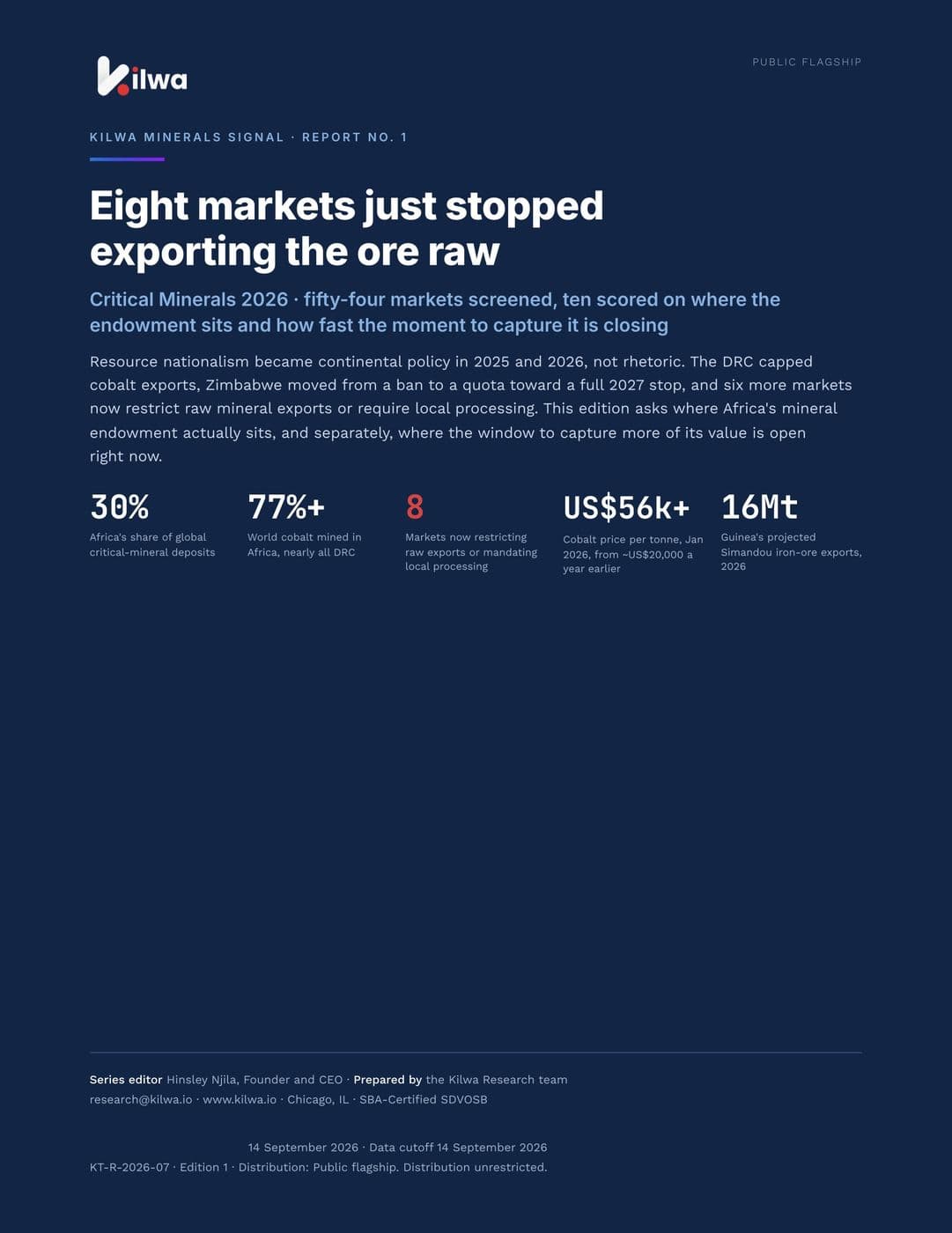
markets that now restrict raw mineral exports or require local processing, most of it legislated in the past three years: DRC, Zimbabwe, Namibia, Botswana, Ghana, Nigeria, Tanzania and Malawi
Key takeaways
- 01
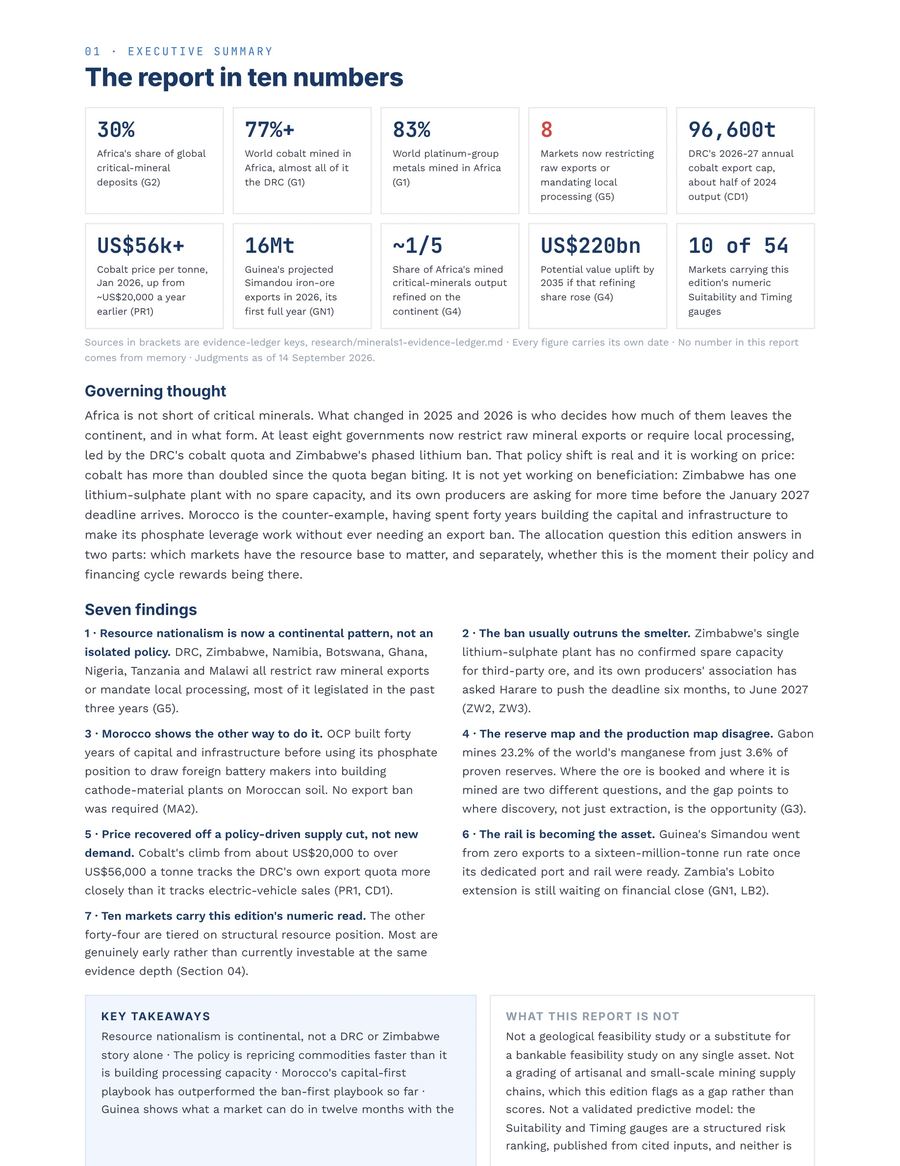
Resource nationalism is now a continental pattern, not an isolated policy. DRC, Zimbabwe, Namibia, Botswana, Ghana, Nigeria, Tanzania and Malawi all restrict raw mineral exports or mandate local processing, most of it legislated in the past three years.
- 02
The ban usually outruns the smelter. Zimbabwe's single lithium-sulphate plant has no confirmed spare capacity for third-party ore, and its own producers' association has asked Harare to push the January 2027 deadline six months.
- 03
Morocco shows the other way to do it. OCP built forty years of capital and infrastructure before using a roughly 70% share of world phosphate reserves to draw foreign battery makers into building cathode plants on Moroccan soil. No export ban was required.
- 04
The reserve map and the production map disagree. Gabon mines 23.2% of the world's manganese from 3.6% of proven reserves; where the ore is booked and where it is mined are different questions, and the gap points to where discovery, not just extraction, is the opportunity.
- 05
The price recovered off a policy-driven supply cut, not new demand. Cobalt's climb from about US$20,000 to over US$56,000 a tonne tracks the DRC's own export quota more closely than electric-vehicle sales.
- 06
The rail is becoming the asset. Guinea's Simandou went from zero exports to a sixteen-million-tonne run rate once its dedicated port and rail were ready; Zambia's Lobito extension is still waiting on financial close.
The call
Africa is not short of critical minerals. What changed in 2025 and 2026 is who decides how much of them leaves the continent, and in what form. The policy shift is real and it is working on price; it is not yet working on beneficiation. Size on where the endowment and the processing position actually sit, time entry on the catalyst and policy calendar, and underwrite the named plant, corridor or quota rather than the country. Morocco and Guinea, which built the leverage before they used it, are the benchmark; Zimbabwe, where the ban arrived before the smelter, is the live test of the other playbook.
Two gauges: where the endowment sits, and whether now is the moment
Kilwa's operating manual separates structural suitability from entry timing and forbids blending them into one opaque score. The Suitability gauge asks where a market's resource base, industrial scale, processing position and infrastructure access sit today, on a three-year horizon. The Timing gauge asks whether the next six to eighteen months reward being there: catalyst density, policy trajectory, financing momentum and where the relevant commodity sits in its own price cycle. Every factor is scored 0 to 100, every input carries a verified or estimate flag, and every weight is published.
Quadrants split at the ten-market medians, 59.3 on Suitability and 61.4 on Timing, so they describe a market's position relative to this cohort in September 2026, not an absolute grade. Only ten markets carry a numeric gauge, chosen for segment and regional breadth across battery metals, rare earths and ferro-alloys, and bulk minerals, because publishing a number on evidence Kilwa has not retrieved would be worse than not publishing one. The other forty-four are tiered on structural resource position alone: six Advantaged, seventeen Forming, twelve Watch and nineteen Screened, with Western Sahara unscored.
“The gap between the ban and the smelter is this edition's central fact.”
The policy moved first. The processing capacity has not caught up
The IEA's 2026 review of energy-transition minerals marks 2025 as the year export-control risk moved from a theoretical vulnerability to a material one. The DRC lifted its cobalt export ban in October 2025 only to replace it with a quota that caps 2026 and 2027 exports at roughly half of 2024 production, about 96,600 tonnes a year, and actual shipments are running at a third to a half of even that cap on logistics bottlenecks. Zimbabwe suspended lithium-concentrate exports outright in February 2026, eased that into a quota-plus-tax regime in April, and has a full concentrate-export ban scheduled for 1 January 2027. Namibia, Botswana, Ghana, Nigeria, Tanzania and Malawi each carry a version of the same rule.
The market has already repriced the policy. What has not moved as fast is the processing side of the trade. Zimbabwe has exactly one operating lithium-sulphate plant, running its own concentrate at full tilt, and its producers are asking for a six-month extension before the 2027 deadline lands. Morocco is the instructive counter-case: OCP never needed an export ban, because it spent four decades building the capital base, the integrated chemical hubs at Jorf Lasfar and Safi, and the reserve position that let it dictate terms instead of restricting volume. Ban first or build the leverage first is this edition's organising tension.
Ten markets, four quadrants, and the corridors racing the mines
Three markets clear both gauges. Morocco leads on both, with the downstream position already built rather than promised. Guinea earns high conviction on Simandou, an eight-billion-tonne, roughly 65%-iron deposit that went from zero exports to a sixteen-million-tonne run rate on more than US$20bn of newly built dedicated rail and port, with the government holding 15% of both the mining and the infrastructure joint ventures. Zambia earns it on a record 890,346 tonnes of copper in 2025 and the Lobito extension, whose Millennium Challenge Corporation grant widened to US$491m in June 2026 while its financial-close date still disagrees across sources by up to a year.
The DRC screens Advantaged on the coarsest continental read, with close to 70% of world cobalt reserves and the world's second-largest copper output, yet sits in the structurally-attractive, poor-timing quadrant, because a dominant reserve base and a well-timed entry are not the same fact: the quota, the logistics discount to it, and China's roughly 80% share of both cobalt and copper output all sit between the two. South Africa holds 88 to 90% of global platinum-group reserves and the thinnest 2026 catalyst calendar in the cohort. Namibia and Tanzania are the opposite problem, real catalysts and almost no production yet. Zimbabwe, Madagascar and Mozambique carry the lithium, nickel and graphite side, and all three are running well under either their nameplate capacity or their policy ambition.
“Size DRC cobalt and copper exposure to the quota, not to the reserve. A position that assumes 2024-level export volumes will be wrong twice over.”
The dissenting read
Kilwa's central narrative treats resource nationalism as a rational, if unevenly executed, attempt to capture more value onshore. The dissenting reading is worth stating plainly: an export ban or beneficiation mandate that assumes processing capacity will materialise on a legislated deadline, rather than funding it first, risks a period where ore simply cannot move at all, at a cost to producers, workers and treasury revenue that a slower, capital-first approach would have avoided. The corridor story carries a matching caveat: Lobito's actual 2026 throughput is under two million tonnes against a 4.6-million-tonne rail design, with a single-track vulnerability that an Angolan flooding event proved out with a two-month outage. The variant view does not dispute that resource nationalism is happening. It disputes that it is working yet, anywhere except Morocco.
The least-covered risk is responsible sourcing. This edition scores resource position and timing; it does not score responsible-sourcing risk, and that gap matters most in exactly the markets scoring highest. Artisanal and small-scale mining supplies a material share of DRC cobalt outside the industrial quota system entirely, and eastern DRC's tin, tantalum, tungsten and gold trade carries a longstanding conflict-mineral overlay that the report deliberately does not quantify. The report says so, and treats it as the next roadmap item rather than as covered.
Four paths to Minerals Signal No. 2
Probabilities are Kilwa's subjective judgments as of the publication date, not measured frequencies and not forecasts of returns. Each range is anchored to a cited 2025 to 2026 precedent and labelled as a Kilwa assumption, with cobalt as the shared reference point.
- 01Base · quota-and-corridor equilibrium · 55%The DRC quota holds near its 87,000 to 97,000-tonne band through 2027, Zimbabwe's deadline slips about six months on industry pressure, and the Lobito Zambia extension reaches financial close in 2027. Cobalt reference US$45,000 to 60,000 a tonne.
- 02Upside · beneficiation accelerates · 20%G7-aligned capital crowds in faster than expected, a second Zimbabwean sulphate line reaches a final investment decision, and Lobito throughput doubles ahead of schedule, on the precedent of Simandou's own zero-to-sixteen-million-tonne ramp in twelve months. Cobalt reference US$40,000 to 50,000.
- 03Downside · policy whiplash · 20%Quota enforcement gaps widen further, with exports already running at a third to a half of the DRC cap, and Zimbabwe enforces its hard ban on schedule with still only one plant, triggering a genuine volume shock. Cobalt reference above US$70,000.
- 04Stress · fragmentation · 5%A major producer renegotiates or nationalises terms mid-contract, on the precedent of Glencore's 39% year-on-year first-quarter 2026 DRC output drop, and the Lobito and TAZARA corridors harden into competing blocs that both underperform design capacity at once. A multi-mineral shock, with an escalation clock from day 0 to day 180 published alongside.
What would change our view
Ten signposts, in the order they should move: the DRC's quarterly quota utilisation against the 96,600-tonne cap; the cobalt price; Zimbabwe's sulphate-plant commissioning count; a single confirmed financial-close date for the Lobito Zambia extension; Port of Lobito throughput against the 4.6-million-tonne design; Simandou's monthly export tonnage toward a 60-million-tonne 2028 target; the Shenghe–Peak Rare Earths transaction close; whether the announced US$12bn US critical-minerals stockpile programme becomes actual offtake; any eleventh or twelfth market joining the export-control wave; and evidence that Mozambique's and Zimbabwe's new equity and processing rules are actually applied. Every one is graded in public in Minerals Signal No. 2, stating which moved as expected, which did not, and why.
A confirmed second Zimbabwean sulphate plant, a signed Lobito Zambia financing close, or a DRC quota renewal above 2026's cap would each re-rate a deep dive before the next edition. A hard ban with no matching processing capacity anywhere would move it the other way. DR Congo and Tanzania sit closest to the median lines, at 57.0% and 57.9% quadrant retention against an 87.5% average, so a modest evidence revision could move either.
What this report is not
Not a geological feasibility study or a substitute for a bankable feasibility study on any single asset. Not a grading of artisanal and small-scale mining supply chains, which the edition flags as a gap rather than scores. Not a validated predictive model: the Suitability and Timing gauges are a structured risk ranking, published from cited inputs, and neither is ISI or METI. Not a downstream battery or EV manufacturing cost model. Frameworks for sizing conversations, not recommendations, tailored to no recipient or portfolio. The report notes Kilwa's standing sovereign-AI relationship with the Government of Rwanda, which has no bearing on Rwanda's Forming tier in the continental screen.
The numbers
- 30%
- of the world's critical-mineral deposits are in Africa, which refines only about a fifth of what it mines
- US$56k+
- a tonne for cobalt in January 2026, from about US$20,000 a year earlier: a move that tracks the DRC's export quota more closely than electric-vehicle demand
- 3 of 10
- scored markets clear both gauges today, Morocco, Guinea and Zambia, and three clear neither
- 87.5%
- of quadrant assignments survive Monte Carlo perturbation of every estimated input, over 1,000 draws
The model, in one table
The four quadrants
| Quadrant | Markets | What it means for capital |
|---|---|---|
| High conviction | Morocco (90.5 · 79.5), Guinea (68.0 · 75.5), Zambia (63.8 · 73.3) | Both gauges above the median. Morocco's downstream position is built, not promised; Guinea's rail-and-port structure is the template for the next greenfield entry; Zambia's copper does not need Lobito to be valuable, but the multiple it earns does. |
| Structurally attractive, poor timing | South Africa (73.3 · 50.3), DR Congo (63.0 · 60.8) | The patient book. Treat South Africa's platinum-group position as the three-year trade, timed to price troughs rather than a news event. Size DRC exposure to the quota, not the reserve, and diligence quota-compliant offtake ahead of the 2027 renewal. |
| Improving but early | Namibia (55.5 · 64.0), Tanzania (34.3 · 62.0) | The option book. Enter early and small against named project milestones, Etango-8, Lofdal, Ngualla, not against the country story. Real catalysts, almost no production yet. |
| Weak structure, weak timing | Zimbabwe (51.8 · 47.0), Madagascar (47.8 · 59.0), Mozambique (36.8 · 41.5) | Needs a specific reason to be present today. Underwrite the named plant, the reopened permit regime or the new 15% state-equity step, not the sector. |
Two published gauges, 0 to 100, higher is better, split at the ten-market medians of 59.3 on Suitability and 61.4 on Timing as of 14 September 2026. A structured risk ranking from cited inputs, 41 of 80 factor cells verified — not a validated predictive model — and neither gauge is ISI or METI, which remain in independent validation. The figures in brackets are the Suitability and Timing reads.
Series editor: Hinsley Njila, Founder & CEO. Prepared by the Kilwa Research team. research@kilwa.io
This report is research and analysis. It is not investment, legal or tax advice. Kilwa scores are structured risk rankings, not validated predictive models, except where explicitly stated otherwise. It is prepared for general circulation on a published schedule and is not tailored to any recipient.
Conflicts of interest. Kilwa does not hold, trade or take positions in the securities, currencies or instruments of the markets it scores, and receives no compensation from any government, issuer or institution in exchange for a score, a rating or favourable coverage. Where a research programme is funded by a named partner, that funding is disclosed in the report.