

Services · Market entry & growth
Market Entry & Growth Strategy
Which market fits your strategy, in what sequence, and when the entry window becomes attractive.
A company entering Africa must choose more than a country. It must choose the sequence, the city, the corridor, the partner, the channel, the regulatory route and the moment. A weak choice becomes a working-capital problem, an FX loss or a stranded investment. Kilwa compares the markets on one transparent frame, identifies which fits the strategy, reads when the window opens, and keeps watching the assumptions after the launch.
- 0.13%
- real 2025 growth of Africa's exports to the EU27 in euros, against a 4.54% dollar headline. Volume, not translation, decides a case
- Kilwa Atlas No. 2, August 2026
- 1.3bn
- people in the AfCFTA market across 55 countries, with combined GDP of about US$3.4tn — and border processes, currency conditions and regulation that still differ sharply by market
- World Bank, AfCFTA assessment
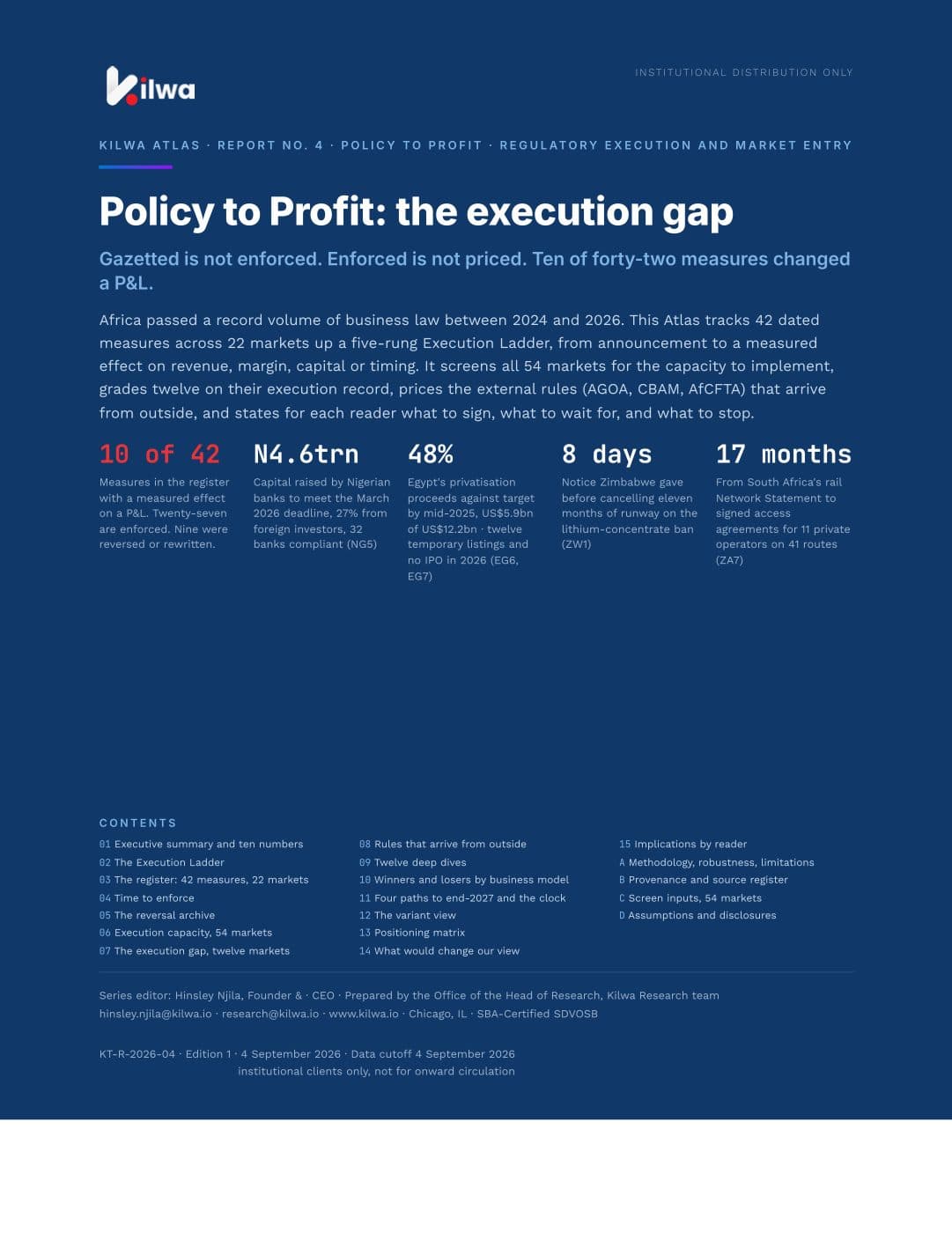
- 10 of 42
- tracked business measures that changed a P&L; 27 are enforced and nine were reversed or rewritten
- Kilwa Atlas No. 4, September 2026
- 97h
- of export border compliance in Sub-Saharan Africa against 13 in the OECD, paid in working capital on every unit
- World Bank Doing Business, cited in One Market, Fifty-Four Borders
The decision you are facing
What the committee actually asks.
- 01Which country, and which city or corridor within it?
- 02In what sequence, and what has to be true before the second market?
- 03How large is the demand we can actually address, in local currency, after border friction?
- 04Which regulatory and licensing route is enforced, as opposed to announced?
- 05Which partners, distributors or targets survive diligence?
- 06When does the entry window open, and what would tell us it has closed?
What we deliver
The offerings, grouped by the question they answer.
Where
- Country and city selection
- Market-entry sequencing
- Addressable-market and demand assessment
- Competitor and pricing intelligence
How
- Regulatory and licensing pathway
- Partner, distributor and acquisition-target screening
- Route-to-market design
- Site and trade-corridor selection
When, and after
- FX-adjusted unit economics
- Entry-trigger monitoring
- Post-entry growth and expansion reviews
Sector focus for deep advisory: Energy and renewables, Technology and fintech, Infrastructure, logistics and real estate, Financial services and investment. Other sectors are screened on the platform and delivered with sector partners.
The Execution Ladder
Buy the enforced rule, not the announced one.
From Kilwa Atlas No. 4: a measure earns a price only at the rung it has reached. The entry plan is built on the rung, not the press release.
How Kilwa answers it differently
Not another country report.
Not a static ranking
Traditional market-entry reports rank markets once. Kilwa reads suitability and timing separately, shows the factors behind both, and re-reads them as the policy calendar moves.
Enforced, not announced
Of 42 dated business measures tracked across 22 markets since 2024, ten reached a measured effect on a profit and loss account. The entry plan is built on the rung a rule has actually reached.
The frame is shared with the capital
The same gauges investors use to read a market are the ones the entry plan rests on, so the strategy and its financing speak the same language.
How we engage
3 formats. One path.
Scoped to the mandate rather than a tier list, so the fee follows the decision, the markets and the horizon.
Single-market entry assessment
One market read in full: demand, capability, permission, cash and execution, with the stop conditions stated.
Multi-market prioritisation
A sequenced portfolio of markets on one frame, with the trigger that opens each window.
Entry strategy with implementation support
The strategy plus the regulatory pathway, partner screening and the monitoring that follows the launch.
1Scope
The decision, the mandate, the markets and the horizon, agreed in writing before any evidence is assembled.
2Evidence
Inputs gathered from the source registry and the client, each flagged verified or estimated, with provenance recorded.
3Read
Structure and timing read separately on the published gauges, with the factors behind each shown.
4Decide
A decision pack for the committee, board or ministry: the call, the confidence, the trail and the condition that would prove it wrong.
5Monitor
Assumptions become dated signposts, watched between editions and graded in public, misses included.
Named solutions
Delivered inside the engagement.
Four products serve four points in the same decision cycle. This service delivers two of them.
- Discover and compareKilwa Africa Factbook
- MonitorZawadi Briefing Engine
- Underwrite and approveKilwa Deal Room
- Prove what happenedKilwa ImpactOS
Kilwa Africa Factbook
Africa's living, source-linked reference.
Country and sector comparison on consistent definitions, with the freshness and confidence of every figure shown, for the selection stage.
Zawadi Briefing Engine
Where and when to act, with proof, exposure and an owner.
Entry-trigger monitoring after the plan is agreed: the policy calendar, the FX conditions and the licensing milestones that open or close the window.
Boundaries
What this service is not.
- Not legal, tax or licensing advice: regulatory pathways are evidence and sequencing, to be confirmed with local counsel.
- Partner and target screening is diligence support, not a recommendation to transact, and makes no allegation about any named firm.
- Agriculture, healthcare, manufacturing and tourism entries draw on sector partners where operational depth is required; Kilwa says so rather than pretending to it.
Kilwa Technologies LLC is not a registered investment adviser, broker-dealer, credit rating agency or law firm. Its services are market, policy and country intelligence and decision support, provided under a written engagement. They are not investment, legal, tax or accounting advice, and nothing on this site is an offer or solicitation.
Before the first call
The questions buyers ask.
- What is different from a market-entry report?
- A report ranks markets once. Kilwa reads suitability and timing separately, shows the factors behind both, and keeps reading them after launch, so the sequence and the window are decisions with dates rather than a chapter.
- Which sectors are covered in depth?
- Energy and renewables; technology and fintech; infrastructure, logistics and real estate; financial services and investment. Other sectors are screened on the platform and delivered with sector partners, which Kilwa says rather than pretends otherwise.
- Does Kilwa recommend partners or acquisition targets?
- It screens them for diligence, on the evidence, and makes no allegation about any named firm. A recommendation to transact, and the legal, tax and licensing work, stay with the institution's advisers.
- How long does a single-market assessment take?
- Scope sets it. The five gates, demand, capability, permission, cash and execution, are worked in sequence, and one hard failure stops the case early, which is often the most valuable outcome.
Research for this service
All insights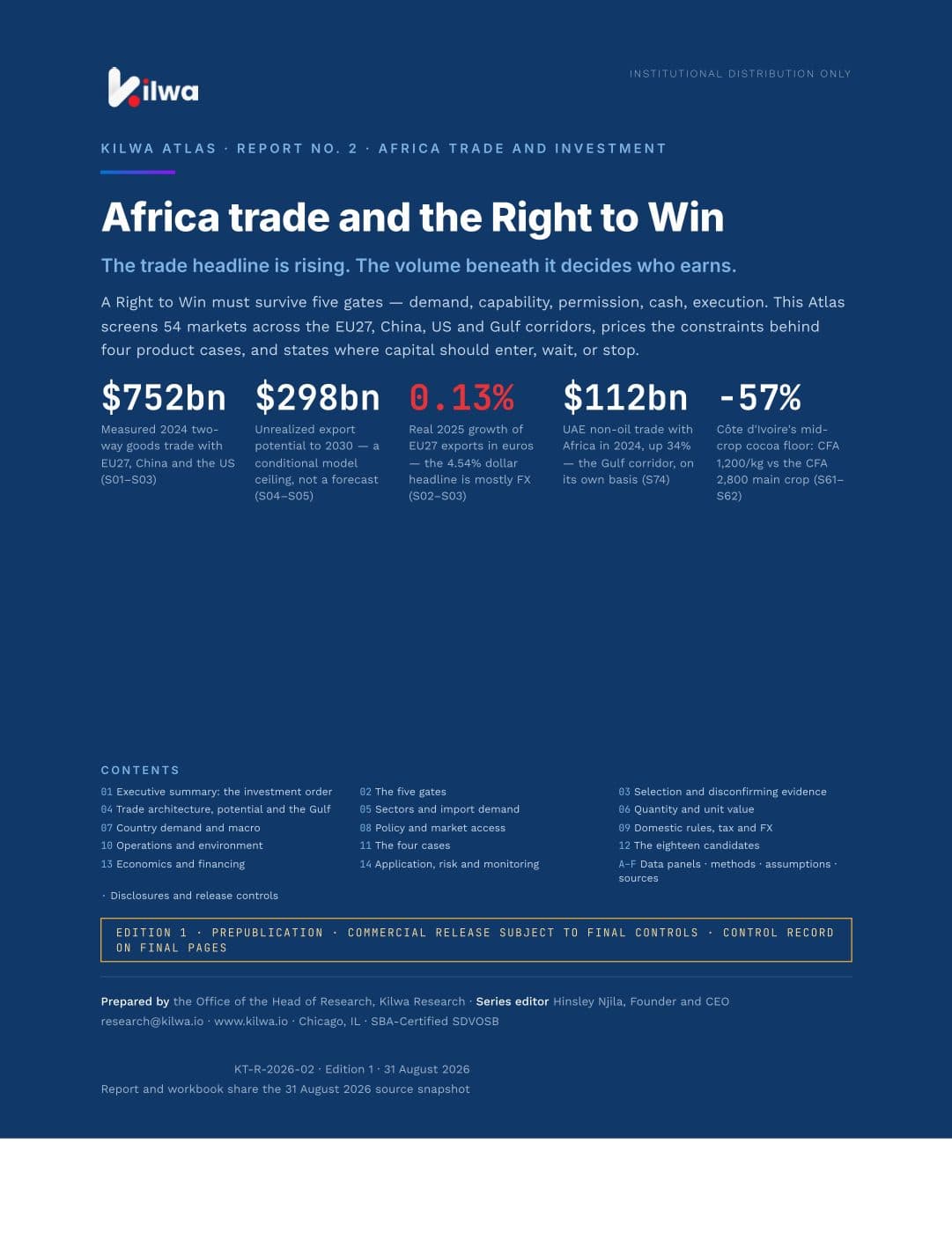
Built for: Multinational Corporations · Private Equity & Venture Capital. Other services: Capital allocation & deals · Risk & regulatory intelligence · Sovereign capital & investment promotion · Sovereign AI.
Scope an engagement
Tell us the decision. We will tell you what evidence it needs.
One conversation to agree the mandate, the markets and the horizon. A reply within one business day, from a person.