

Services · Capital allocation & deals
Capital Allocation, Deal & Portfolio Intelligence
Which markets fit the mandate, when to move, and what the exit is worth before you underwrite it.
An investment committee does not need another country report. It needs to know which markets and sectors fit the mandate, what has changed since the original thesis, whether the timing is favourable, which risks could break the case, whether the currency exposure can be hedged and which exit routes actually exist. Kilwa answers those questions on one transparent frame, and records how the answer was reached.
- −0.05
- correlation between the structural read and the timing read across 54 markets: where to invest and when to enter are independent questions
- Kilwa Atlas No. 5, September 2026
- US$5.1bn
- of private capital deployed across Africa in 2025, over 530 deals and 81 exits — active enough to reward better evidence, fragmented enough to need it
- AVCA, 2025 activity report
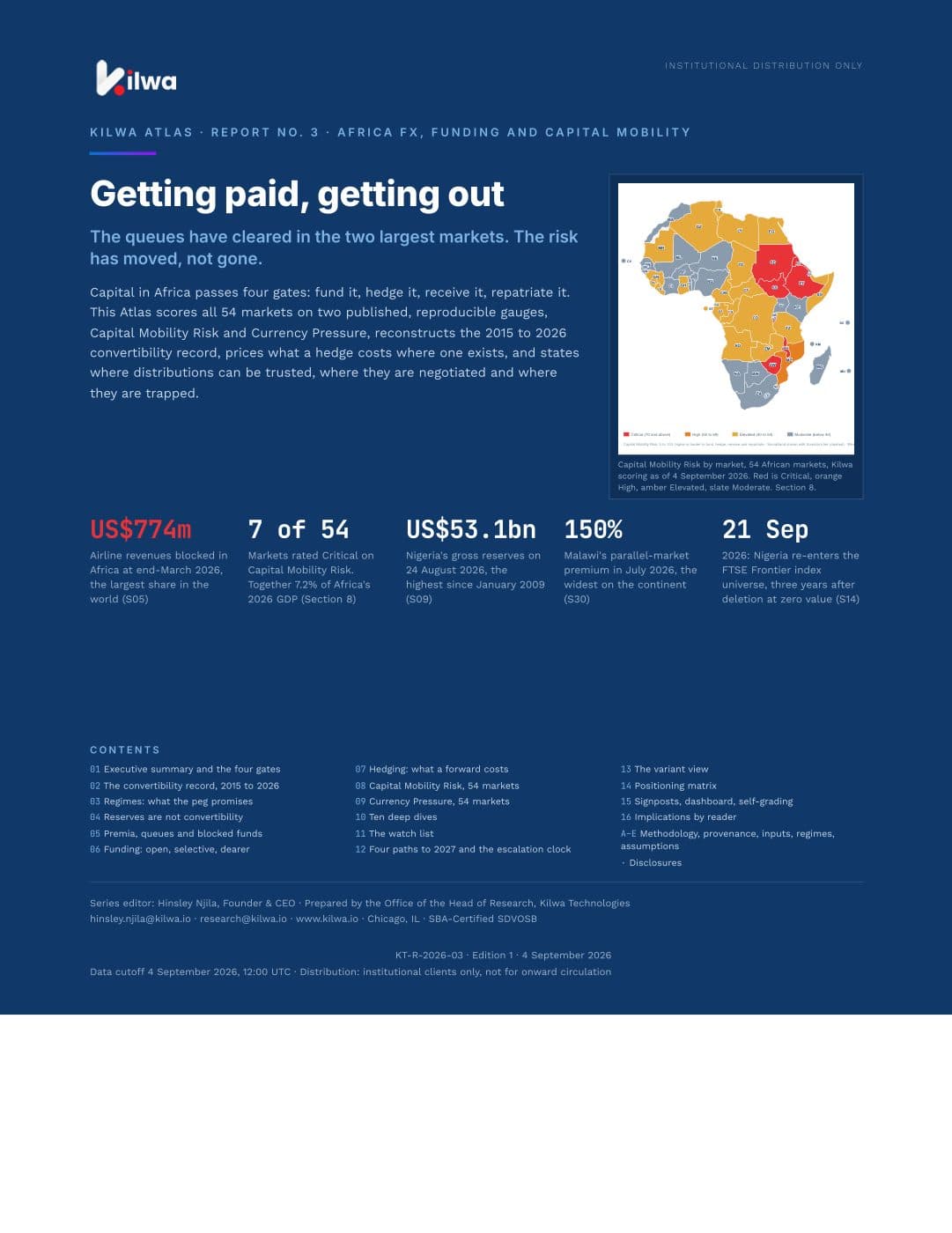
- 29 of 54
- markets where the binding constraint on a distribution is not return but repatriation friction
- Kilwa Atlas No. 3, September 2026
- +75%
- growth in East African investment activity in 2025, to US$1.2bn
- AVCA, 2025 activity report
The decision you are facing
What the committee actually asks.
- 01Which markets and sectors fit our mandate, on evidence rather than a league table?
- 02What has changed since the original thesis, and does it matter to this position?
- 03Is the timing favourable, and what would tell us it has turned?
- 04Which risks could break the investment case, and how would we see them coming?
- 05Can the currency exposure be hedged, at what cost, and for how long?
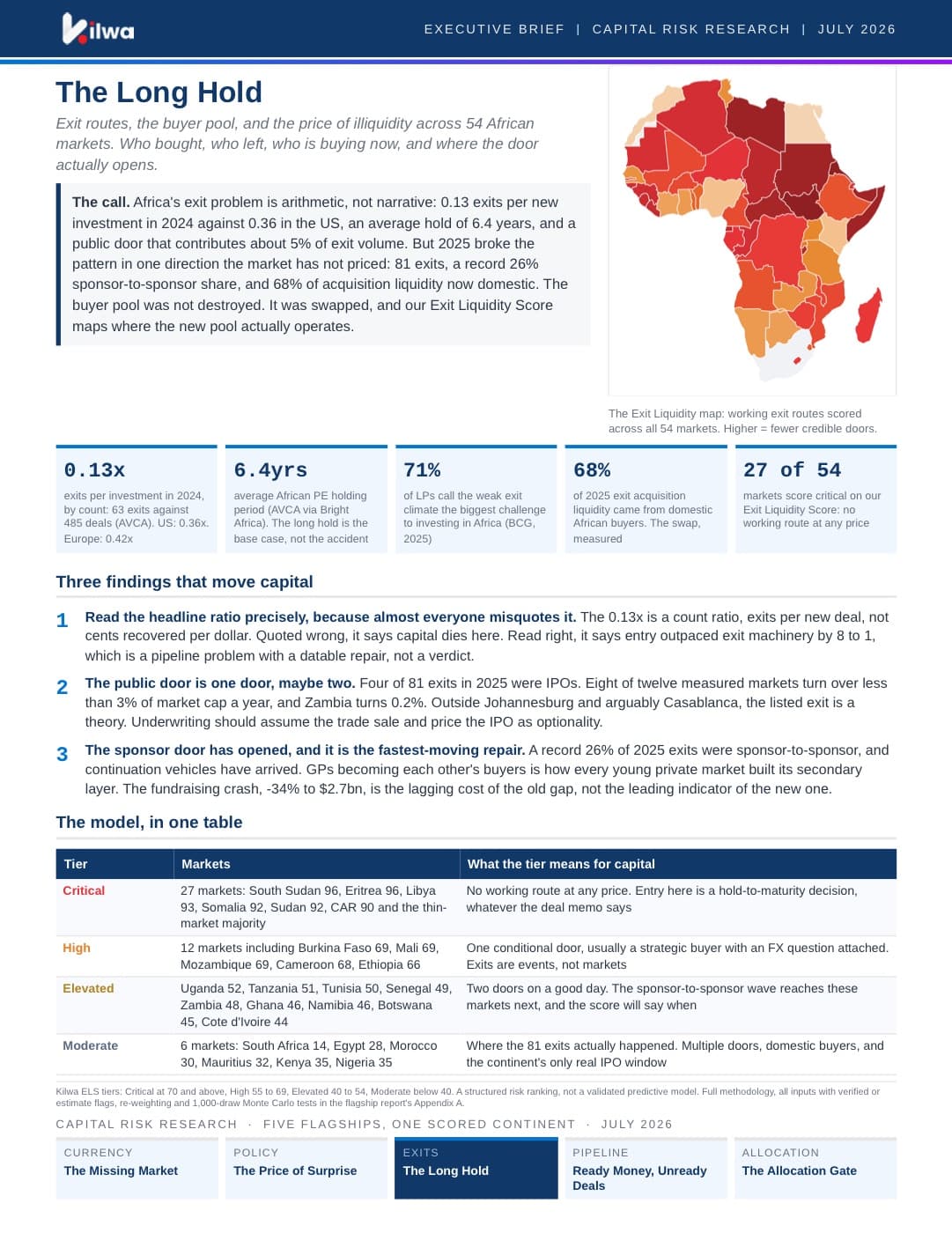
- 06Which exit routes exist in this market, and what does the door cost the day everyone uses it?
- 07Which markets in the portfolio need attention now, and why?
What we deliver
The offerings, grouped by the question they answer.
Screening and prioritisation
- Mandate-to-market screening across all 54 markets
- Country and sector prioritisation on the structural and timing reads
- Pre-investment market intelligence
Diligence
- Commercial and country-risk due diligence
- FX, convertibility, capital-mobility and exit assessment
- Market thesis construction and red-team review
Decision and monitoring
- Committee-ready evidence packs with the source trail attached
- Portfolio exposure monitoring with observable triggers
- Entry and exit conditions, market by market
- Kilwa Deal Room implementation
Two gauges, kept apart
Where and when are different questions.
Every one of the 54 markets on the structural read and the timing read from Kilwa Atlas No. 5. The two are uncorrelated (r = −0.05), which is why a single composite score misleads.
- High conviction (13)
- Structure, poor timing (14)
- Improving but early (14)
- Weak, weak (13)
Source: Kilwa Atlas No. 5, Exhibits 5 and 7, gauges as of 4 September 2026. Structured rankings, not validated predictive models; neither read is ISI or METI, which remain in independent validation.
| Market | Structure | Timing | Quadrant |
|---|---|---|---|
| South Africa | 77.1 | 59.9 | High conviction |
| Morocco | 71.9 | 66.2 | High conviction |
| Egypt | 70.0 | 61.6 | High conviction |
| Mauritius | 66.5 | 47.9 | Structure, poor timing |
| Côte d'Ivoire | 64.3 | 51.8 | Structure, poor timing |
| Kenya | 62.0 | 44.5 | Structure, poor timing |
| Senegal | 61.9 | 17.1 | Structure, poor timing |
| Botswana | 61.5 | 55.1 | Structure, poor timing |
| Cabo Verde | 60.9 | 55.7 | High conviction |
| Namibia | 59.9 | 43.9 | Structure, poor timing |
| Algeria | 58.5 | 67.2 | High conviction |
| Benin | 56.1 | 55.2 | High conviction |
| Ghana | 54.5 | 65.6 | High conviction |
| Uganda | 54.4 | 62.9 | High conviction |
| Nigeria | 53.1 | 83.1 | High conviction |
| Seychelles | 52.8 | 34.1 | Structure, poor timing |
| Djibouti | 52.0 | 59.1 | High conviction |
| Rwanda | 51.9 | 46.8 | Structure, poor timing |
| Gabon | 51.7 | 45.9 | Structure, poor timing |
| Tanzania | 51.5 | 40.7 | Structure, poor timing |
| Tunisia | 50.8 | 47.3 | Structure, poor timing |
| Niger | 49.8 | 68.0 | High conviction |
| Burkina Faso | 49.6 | 57.4 | High conviction |
| Mauritania | 49.5 | 48.2 | Structure, poor timing |
| Mali | 49.5 | 54.4 | Structure, poor timing |
| Togo | 49.3 | 49.4 | Structure, poor timing |
| Zambia | 48.7 | 69.4 | High conviction |
| Guinea | 48.2 | 52.2 | Weak structure, weak timing |
| Angola | 46.8 | 90.7 | Improving but early |
| Ethiopia | 46.4 | 80.8 | Improving but early |
| Libya | 46.1 | 51.7 | Weak structure, weak timing |
| DR Congo | 46.0 | 67.6 | Improving but early |
| Cameroon | 45.9 | 43.9 | Weak structure, weak timing |
| Equatorial Guinea | 45.7 | 64.6 | Improving but early |
| Eswatini | 45.3 | 57.2 | Improving but early |
| Comoros | 42.6 | 52.4 | Weak structure, weak timing |
| The Gambia | 42.5 | 59.6 | Improving but early |
| Chad | 40.5 | 77.5 | Improving but early |
| Lesotho | 40.4 | 60.4 | Improving but early |
| Guinea-Bissau | 39.6 | 47.9 | Weak structure, weak timing |
| Republic of the Congo | 38.8 | 60.6 | Improving but early |
| Madagascar | 38.4 | 44.3 | Weak structure, weak timing |
| Mozambique | 37.4 | 28.4 | Weak structure, weak timing |
| São Tomé and Príncipe | 37.4 | 53.5 | Weak structure, weak timing |
| Somalia | 35.6 | 34.5 | Weak structure, weak timing |
| Zimbabwe | 35.4 | 72.5 | Improving but early |
| Liberia | 35.3 | 65.1 | Improving but early |
| Eritrea | 34.8 | 52.8 | Weak structure, weak timing |
| Sierra Leone | 32.0 | 70.1 | Improving but early |
| Sudan | 21.0 | 61.9 | Improving but early |
| Central African Republic | 20.4 | 43.1 | Weak structure, weak timing |
| Burundi | 18.9 | 50.7 | Weak structure, weak timing |
| Malawi | 18.6 | 46.2 | Weak structure, weak timing |
| South Sudan | 11.7 | 72.9 | Improving but early |
How Kilwa answers it differently
Not another country report.
Two gauges, kept apart
Structural suitability and entry timing are modelled separately and published together. Across 54 markets the two reads are uncorrelated, which is exactly why a single composite score misleads: it lets one gauge do the other's job.
The exit is priced before the entry
Capital mobility, currency pressure and the convertibility record are scored market by market, so repatriation friction sits in the underwriting model rather than the risk section of the committee paper.
A trail a risk committee can interrogate
Every input carries a verified-or-estimate flag, every score decomposes into the indicators that drove it, and every call names the condition that would prove it wrong. The judgment behind the pack is the founder's twenty years in institutional risk; the evidence behind the judgment is on the page.
How we engage
4 formats. One path.
Scoped to the mandate rather than a tier list, so the fee follows the decision, the markets and the horizon.
Institutional intelligence subscription
Continuous access to the scored frame, the research programme and the analyst desk for a team with a standing Africa mandate.
Deal-specific diligence
A scoped read of the market behind one opportunity: country, sector, currency, exit conditions and the policy calendar, delivered as a committee-ready evidence pack. The merits of the asset itself stay with the institution's own diligence.
Portfolio intelligence mandate
Exposure monitoring across an existing book, with assumptions converted into triggers and a briefing cadence agreed with the risk function.
Enterprise integration
Signals, evidence and monitoring delivered into the institution's own systems, with governance and security documentation for vendor onboarding.
1Scope
The decision, the mandate, the markets and the horizon, agreed in writing before any evidence is assembled.
2Evidence
Inputs gathered from the source registry and the client, each flagged verified or estimated, with provenance recorded.
3Read
Structure and timing read separately on the published gauges, with the factors behind each shown.
4Decide
A decision pack for the committee, board or ministry: the call, the confidence, the trail and the condition that would prove it wrong.
5Monitor
Assumptions become dated signposts, watched between editions and graded in public, misses included.
Named solutions
Delivered inside the engagement.
Four products serve four points in the same decision cycle. This service delivers two of them.
- Discover and compareKilwa Africa Factbook
- MonitorZawadi Briefing Engine
- Underwrite and approveKilwa Deal Room
- Prove what happenedKilwa ImpactOS
Kilwa Deal Room
The system of record for how an institution reached an investment judgment.
Carries an opportunity from mandate intake through evidence, underwriting, challenge, committee and monitoring, so the decision can be reconstructed and its assumptions become triggers. The institution's own reviewers make the decision; the system records how.
Kilwa Africa Factbook
Africa's living, source-linked reference.
Country, regional and sector profiles with confidence and freshness on every figure, for the discovery and comparison stage.
Boundaries
What this service is not.
- Kilwa does not advise on the value of, or the advisability of investing in, any security, fund or company. Its analysis is of markets, sectors, currencies, policy and institutions; the investment decision, and any advice about specific securities, stay with the institution and its registered advisers.
- Decision support, not regulated investment advice: Kilwa does not execute trades, recommend specific securities or promise outcomes.
- Not a substitute for legal, tax, financial-statement, sanctions or technical diligence, which stay with the institution's advisers.
- Verified facts, estimates and analyst judgments remain visibly distinct in every deliverable, and human reviewers retain fiduciary responsibility.
Kilwa Technologies LLC is not a registered investment adviser, broker-dealer, credit rating agency or law firm. Its services are market, policy and country intelligence and decision support, provided under a written engagement. They are not investment, legal, tax or accounting advice, and nothing on this site is an offer or solicitation.
Before the first call
The questions buyers ask.
- Is this investment advice?
- No. Kilwa analyses markets, sectors, currencies, policy and institutions and records how a decision was reached. It does not advise on the value of any security, fund or company and it is not a registered investment adviser. The investment decision stays with the institution and its registered advisers.
- How is an engagement priced?
- To the mandate, the markets and the horizon: a subscription, a scoped project or a retainer, agreed in writing before work starts. No fee is published because no two mandates are the same. Flagship reports are the exception and carry a licence price.
- How quickly can a market read for one opportunity be delivered?
- The scoping conversation sets the timeline. The read draws on gauges Kilwa already publishes for all 54 markets, so the clock runs on the client-specific evidence rather than on building the frame.
- Which markets does it cover?
- All 54 African markets on the platform gauges, with deep advisory coverage in twelve: Rwanda, Kenya, Tanzania, Uganda, Ethiopia, Nigeria, Ghana, Côte d'Ivoire, South Africa, Morocco, Egypt and Zambia.
Research for this service
All insights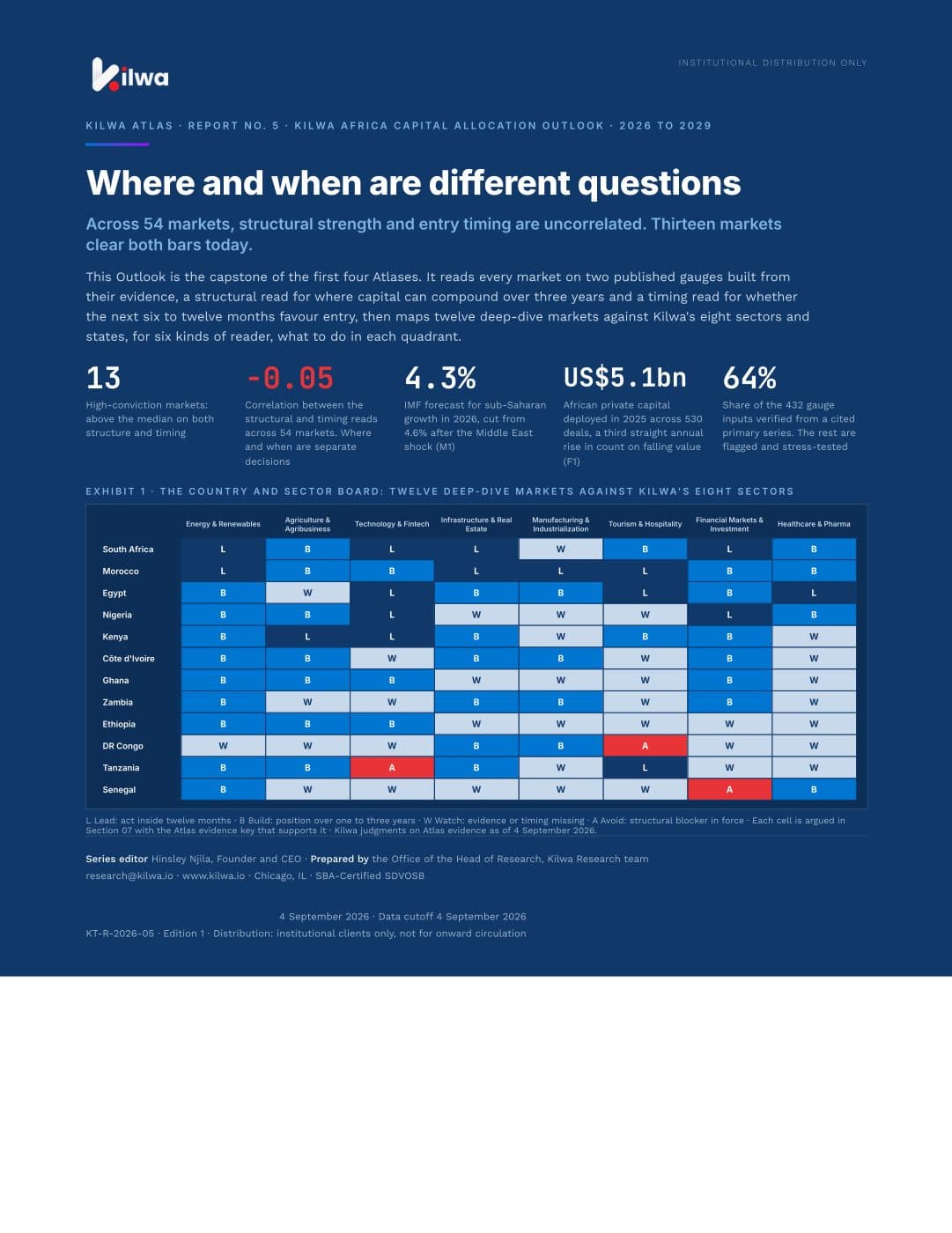
Built for: Development Finance Institutions · Private Equity & Venture Capital · Sovereign Wealth Funds. Other services: Risk & regulatory intelligence · Market entry & growth · Sovereign capital & investment promotion · Sovereign AI.
Scope an engagement
Tell us the decision. We will tell you what evidence it needs.
One conversation to agree the mandate, the markets and the horizon. A reply within one business day, from a person.