Kilwa Atlas · No. 6
Kilwa Atlas No. 6: Five Gates — Private Credit in Africa
Where a private loan in Africa gets repaid, where it stops, and which gate is shut in each of twenty markets.
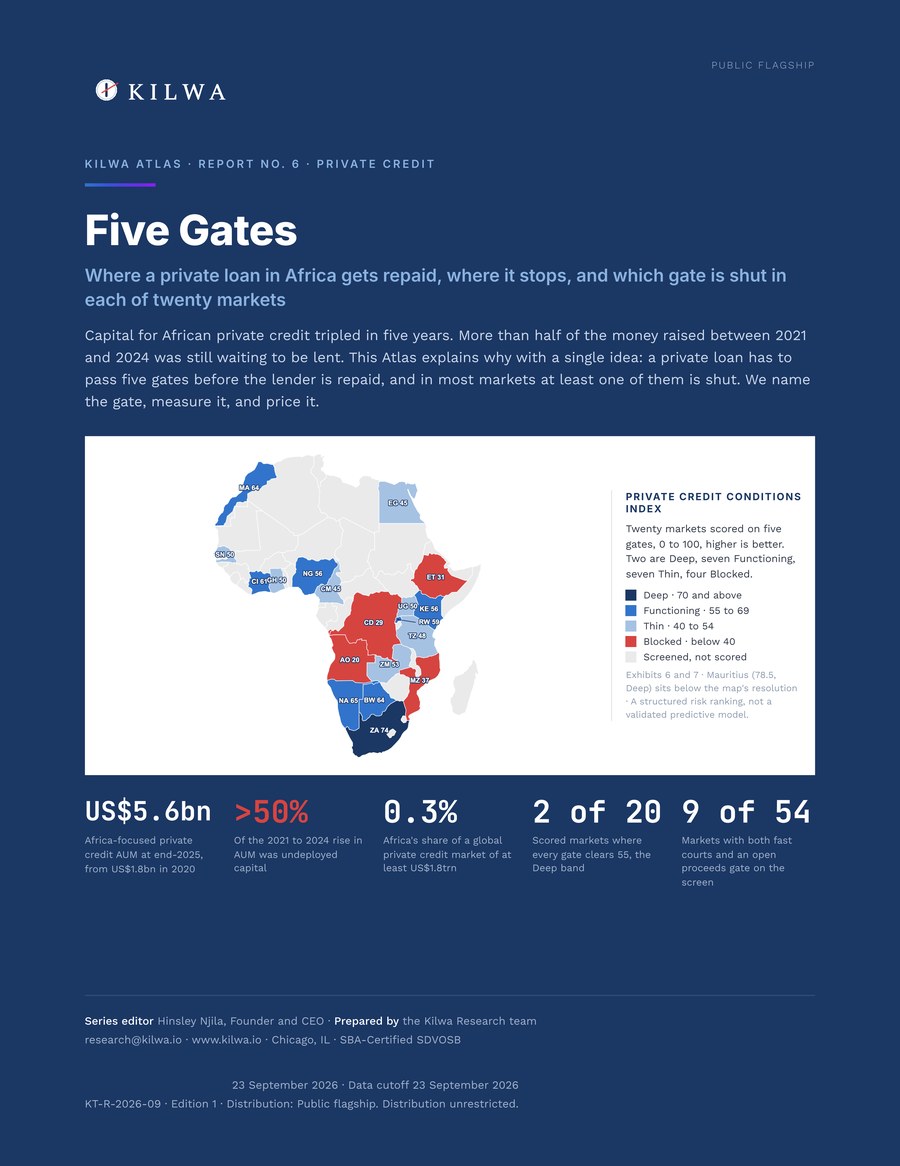
Capital for African private credit tripled in five years, and more than half of the money raised between 2021 and 2024 was still waiting to be lent. This Atlas explains why with one idea: a private loan has to pass five gates before the lender is repaid, and in most markets at least one is shut. The Private Credit Conditions Index scores each gate from 0 to 100 in twenty markets, a screen puts all 54 into four lanes on court speed and the proceeds gate, and five enforcement precedents show what lenders actually got back and how long it took.
Series editor Hinsley Njila, Founder & CEO · Prepared by the Kilwa Research team
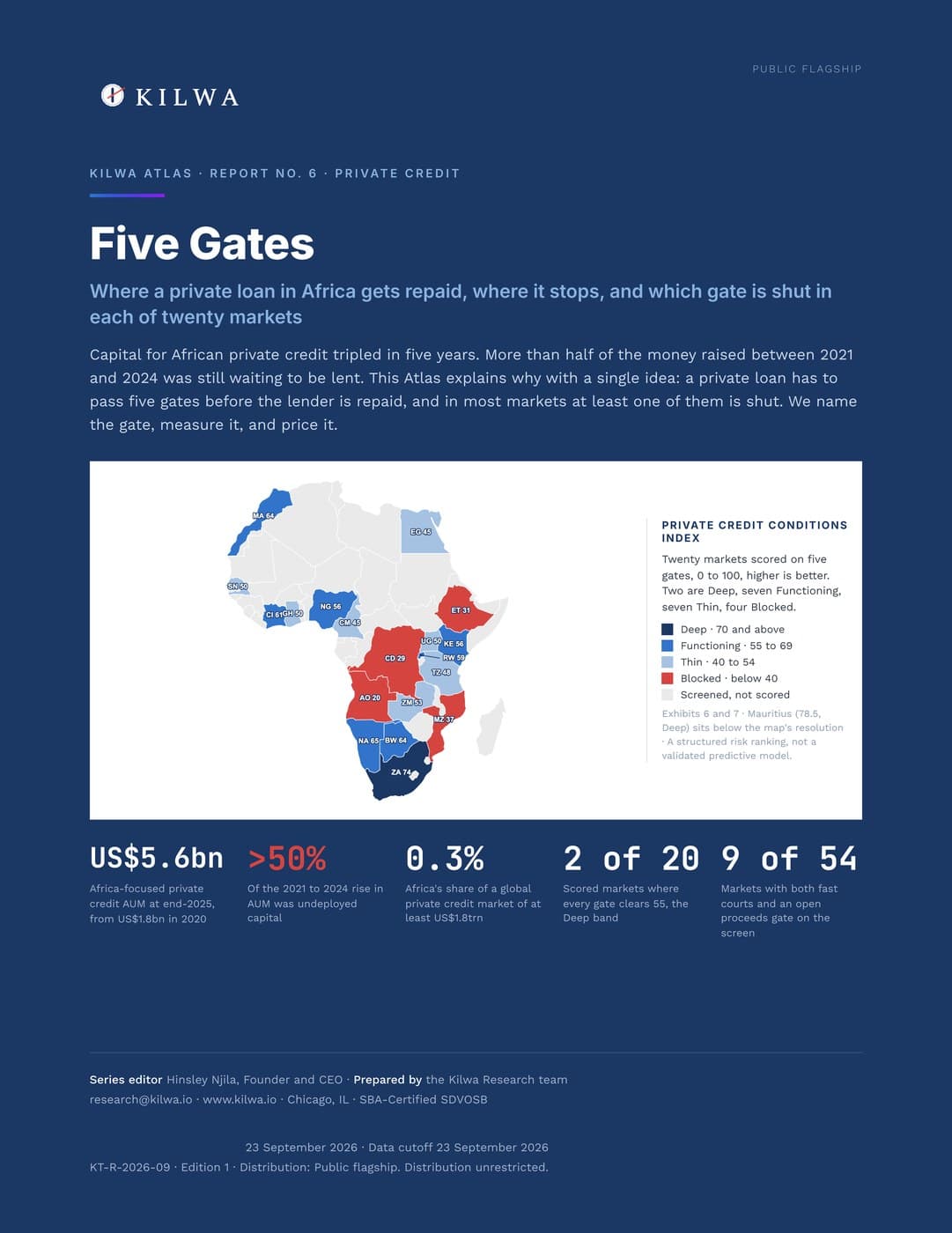
scored markets where every gate clears 55, the Deep band: Mauritius at 78.5 and South Africa at 73.7 on the Private Credit Conditions Index
Key takeaways
- 01
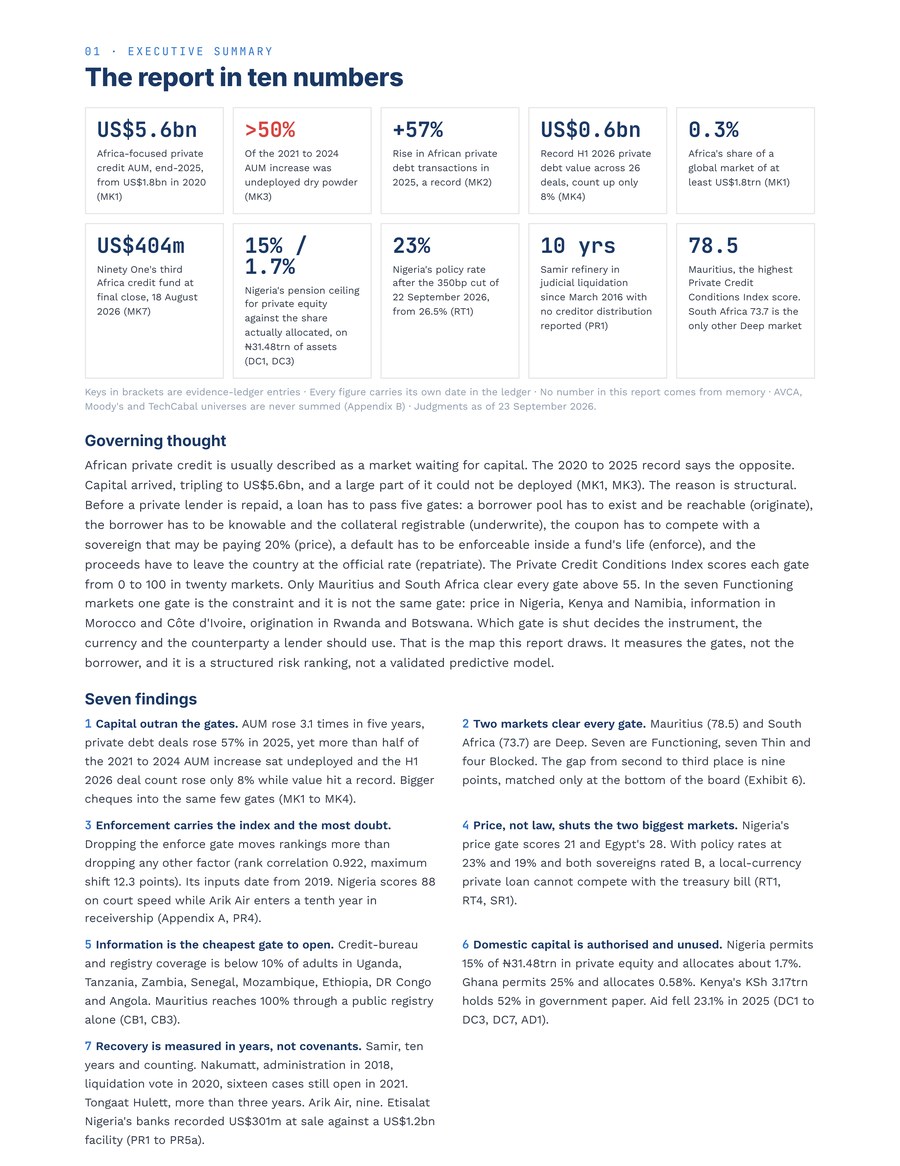
Capital outran the gates. AUM rose 3.1 times in five years and private debt deals rose 57% in 2025, yet more than half of the 2021 to 2024 AUM increase sat undeployed, and the first-half 2026 deal count rose only 8% while value hit a record.
- 02
Two markets clear every gate. Mauritius (78.5) and South Africa (73.7) are Deep; seven markets are Functioning, seven Thin and four Blocked, and the gap from second to third place is nine points.
- 03
Enforcement carries the index and the most doubt. Dropping the enforce gate moves rankings more than any other factor, its inputs date from 2019, and Nigeria scores 88 on court speed while Arik Air's receivership enters a tenth year.
- 04
Price, not law, shuts the two biggest markets. Nigeria's price gate scores 21 and Egypt's 28: with policy rates at 23% and 19% and both sovereigns rated B, a local-currency private loan cannot compete with the treasury bill.
- 05
Information is the cheapest gate to open. Bureau and registry coverage is below 10% of adults in eight of the twenty markets; Mauritius reaches 100% through a public registry alone.
- 06
Domestic capital is authorised and unused. Nigeria permits 15% of ₦31.48trn in private equity and allocates about 1.7%, Ghana permits 25% and allocates 0.58%, and Kenya's funds hold 52% in government paper.
- 07
Recovery is measured in years, not covenants. Samir, ten years and counting; Nakumatt, two years to a liquidation vote; Tongaat Hulett, more than three; Arik Air, nine; 9mobile's banks recorded US$301m at sale against a US$1.2bn facility.
The report, in brief
What it is, who it is for, and what you get.
Where a private loan in Africa gets repaid: five gates scored in 20 markets, all 54 screened into four lanes.
Written for
Credit and infrastructure funds
Which gate is shut in each of twenty markets, and what that makes of the instrument, the currency and the counterparty: hard-currency exporter loans where price is the gate, offshore security where the courts are.
Africa-focused GPs and global LPs
Whether a manager's workout record matches the enforce gate that carries a quarter of the index, against five court cases and what they actually returned to lenders.
DFIs and multilaterals
How the first-loss share of a pooled vehicle compares with the courts of its underlying markets rather than the sovereign rating: a pool of Nigerian, Kenyan and Ghanaian loans has three court clocks.
Banks, insurers and corporate strategy teams
Where bureau and registry coverage is below one adult in ten, and what that makes of the payment histories banks and suppliers already hold.
What you get
- The Private Credit Conditions Index for twenty markets: five gate scores each, every input flagged verified or estimate, and the shut gate named
- The 54-market screen, Open lane, Slow lane, Gated or Shut, on court speed and the Atlas No. 3 proceeds gate
- Five enforcement precedents with what lenders got and how long it took, from Samir to 9mobile, and a workout clock from day 0 to beyond 180
- Public pricing anchors, from sovereign Eurobonds to US direct lending, with the two gaps no primary source can fill stated rather than filled
- Three scenarios to 2028, four named assumptions and ten dated indicators that Kilwa grades in public in the second edition
- 39 pages as a PDF, delivered the moment payment clears
The call
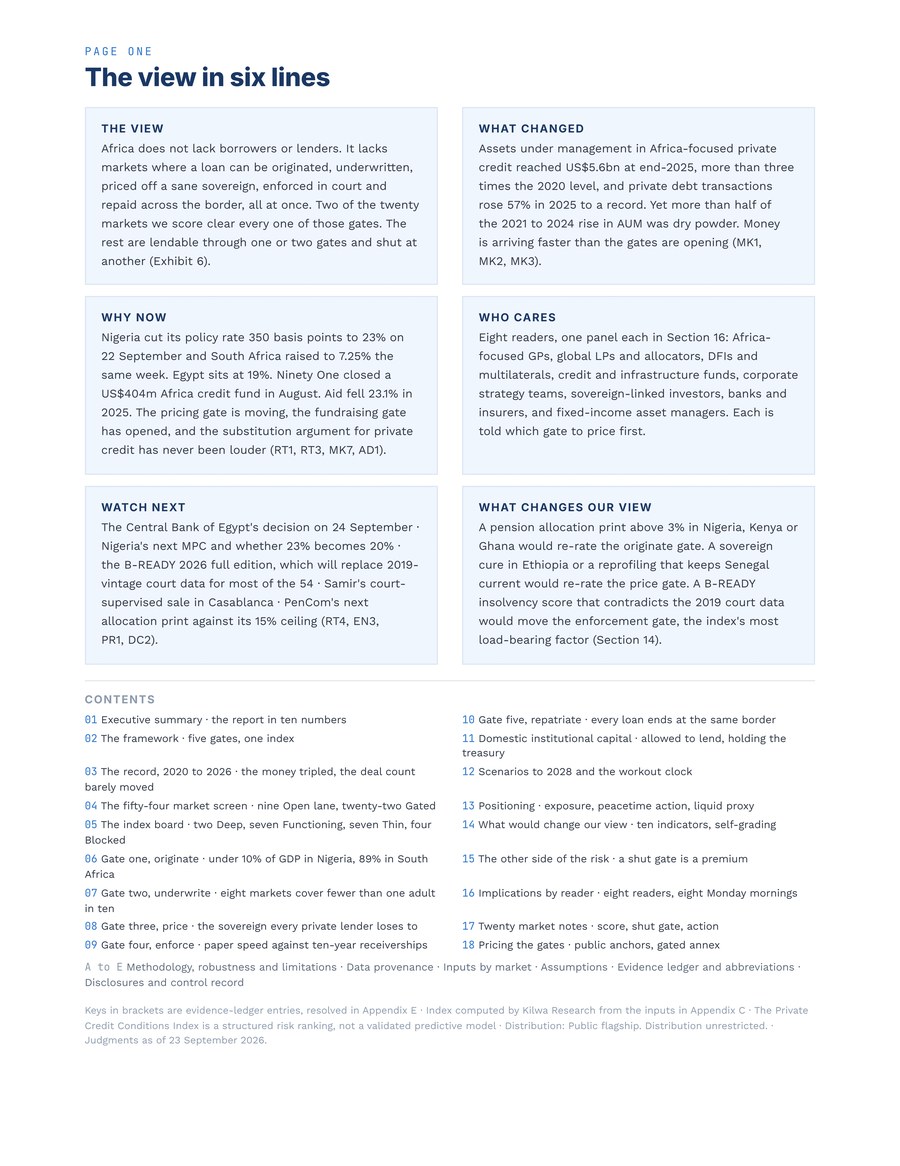
Africa does not lack borrowers or lenders. It lacks markets where a loan can be originated, underwritten, priced off a sane sovereign, enforced in court and repaid across the border, all at once. Two of the twenty markets scored clear every one of those gates. The rest are lendable through one or two and shut at another, and which gate is shut decides the instrument, the currency and the counterparty: price in Nigeria, Kenya and Namibia, information in Morocco and Côte d'Ivoire, origination in Rwanda and Botswana. Enforcement carries a quarter of the index and most of its doubt, because in four of the five precedents the court was where the time was lost and in the fifth a regulator kept the case out of court. The index measures the gates, not the borrower, and it is a structured risk ranking, not a validated predictive model.
Five gates, one index, and a polarity that runs the other way
The Private Credit Conditions Index follows a loan from the day it is originated to the day the proceeds land in the lender's account. A borrower pool has to exist and be reachable (originate), the borrower has to be knowable and the collateral registrable (underwrite), the coupon has to compete with a sovereign that may be paying 20% (price), a default has to be enforceable inside a fund's life (enforce), and the proceeds have to leave the country at the official rate (repatriate). Each gate is scored 0 to 100 from published inputs, higher is better for the lender, and the five are combined with fixed weights of 20, 15, 20, 25 and 20. The heaviest weight goes to enforcement because in four of the five precedents the court was where the time was lost, and in the fifth a regulator kept the case out of court.
Bands are Deep at 70 and above, Functioning 55 to 69, Thin 40 to 54 and Blocked below 40, the same polarity as the Exit Liquidity Index of Liquidity Signal No. 1 and the opposite of Kilwa's risk tiers, so an index band is never compared with a risk tier. The index measures the conditions a lender faces, not the quality of any borrower: a borrower's credit decides whether a loan defaults, and the five gates decide what the lender gets back when it does, and how long that takes. Its court-speed inputs are the 2019 Doing Business survey, the only enforcement series that covers all twenty markets, and the report says so at every exhibit.
“Which gate is shut decides the instrument, the currency and the counterparty a lender should use.”
The money tripled. The deal count barely moved.
Three series tell the story and must be kept apart, because they measure different universes. Moody's counts assets under management of Africa-focused private credit funds: US$5.6bn at end-2025, from US$1.8bn in 2020, 3.1 times in five years and still about 0.3% of a global market it puts at more than US$1.8trn. AVCA counts announced deals: private debt transactions rose 57% in 2025 to a record, and in the first half of 2026 private debt value hit a record US$0.6bn on 26 deals, a count up only 8%. More than half of the 2021 to 2024 rise in AUM was undeployed capital. Money is arriving faster than the gates are opening.
Moody's set one condition for scale: managers must show returns that compensate for foreign-exchange, liquidity and frontier risk, against the mixed record of Africa-focused private funds. Every one of those three risks is a gate in this index. FX is the repatriate gate; liquidity is the enforce gate, because an illiquid loan is one you cannot exit by court or by sale; frontier risk is the price gate. Moody's proposed remedy, DFI first-loss under pooled senior tranches sold to pensions and insurers, is a way of passing gates a single lender cannot pass alone, and the report tests whether the pensions are there to buy.
Nine markets have fast courts and an open door. Twenty-two have a queue at the border.
The screen puts every African Union member on two measured facts and nothing else: court speed from the 2019 survey, fast where insolvency resolves in 2.5 years or less and a contract is enforced in 700 days or fewer, and the proceeds gate as the Atlas No. 3 Capital Mobility Risk tier. Four lanes result. Open lane, fast courts and a Moderate mobility tier: nine markets, Botswana, Côte d'Ivoire, Djibouti, Mauritius, Namibia, Nigeria, Rwanda, South Africa and Uganda. Slow lane, slow courts behind an open border: sixteen, among them Kenya, Morocco and Senegal. Gated, an Elevated or High mobility tier whatever the courts do: twenty-two, among them Egypt, Ghana, Tanzania and Zambia. Shut, a Critical tier: seven.
The map shows where the plumbing works, not where the borrowers are. Nigeria, Rwanda and Uganda are Open lane on 2019 court data that the enforcement section questions; Zambia is Gated by the border, not the court; Egypt, Ghana and Tanzania are Gated by both. Central Africa has no Open-lane market and eight of its nine are Gated. Twenty of the 54 are then scored on the index. The other 34 are screened, not scored, and are never given a number.
Two Deep, seven Functioning, seven Thin, four Blocked. The gap after second place is nine points.
Mauritius leads at 78.5 on a public registry that covers every adult, a 1.7-year insolvency process and an open capital account. South Africa follows at 73.7 with the deepest borrower pool on the continent, private credit at 89% of GDP, and the only established business rescue practice in the panel. Then the ranking drops nine points to Namibia at 64.7, and the seven Functioning markets are bunched between 64.7 and 55.9. Each of them is held back by a different gate, which is the most useful fact in the exhibit: price in Nigeria, Kenya and Namibia, information in Morocco and Côte d'Ivoire, origination in Rwanda and Botswana.
Nigeria ranks ninth at 55.9, nine-tenths of a point above Thin, with the best enforcement score in the sample built on 2019 court data and one of the three lowest price scores; if a reader replaced the 2019 reading with the Arik Air duration, Nigeria would be Thin, and its band retention in the Monte Carlo is 72.3%, the lowest in the sample. Kenya ranks eighth at 56.4 with the joint-strongest collateral law and a 4.5-year insolvency clock. Egypt is Thin at 44.5 because it fails two gates at once, a 19% policy rate and 1,010 days to enforce a contract. Mauritius is scored as a structuring hub: its borrower pool is small, and a lender booking Mauritius exposure is usually lending through it, not to it. The factor detail is published so that any reader can re-score it.
Gate by gate: what the twenty markets show
Each gate has one headline fact, and together they explain why the same market can be lendable through one gate and shut at another.
- 01OriginateDomestic credit to the private sector runs from 89% of GDP in South Africa and 78% in Morocco to under 10% in Nigeria, Ghana and Angola. A ratio under 10% is a market for private lenders rather than a warning against one, provided the other gates open: Nigeria's manufacturers put the maximum bank lending rate at 35.6% in May 2026.
- 02UnderwriteIn eight of the twenty markets a lender can check the history of fewer than one adult in ten: Uganda, Tanzania, Zambia, Senegal, Mozambique, Ethiopia, DR Congo and Angola. Mauritius covers 100% through a public registry, and Cameroon's BEAC registry reaches 40% with no private bureau. Information is the only gate a regulator can open in a budget cycle.
- 03PriceA private loan in local currency is priced above the government's own paper, and when the policy rate is 23% in Nigeria or 19% in Egypt the coupon a mid-market borrower would have to pay is one it cannot carry. Morocco, Botswana, Mauritius and Côte d'Ivoire lead the gate by pairing a sound anchor with a single-digit rate; Ethiopia, in selective default, and Senegal at CC are the two where the anchor itself is broken.
- 04EnforceOn 2019 readings Nigeria (2.0 years, 399 days), Zambia, Mauritius and Rwanda work out fastest, and Egypt, DR Congo, Angola and Kenya trail. Three post-2019 statutes earn a five-point overlay: Nigeria's CAMA 2020 and Insolvency Regulations 2022, Ghana's Act 1015 of 2020 and Ethiopia's 2021 Commercial Code. The gate carries a quarter of the index and the largest share of its uncertainty.
- 05RepatriateA repaid loan is not a distribution until the currency converts and leaves. The gate is read across from Atlas No. 3 rather than re-derived, so the two publications cannot disagree. South Africa, Mauritius, Morocco, Botswana and Côte d'Ivoire sit above 74; Ethiopia at 26 and Mozambique at 35 are Blocked overall largely because of this gate.
The record in court: five precedents, what lenders got and how long it took
The precedents are the check on the paper. None of the five resolved inside the standardised time, and the two that returned cash to lenders did so through a sale of the claims or the company, not through the court's own process. Samir, Morocco: judicial liquidation ordered in March 2016 on about EUR 4.12bn of claims, fifteen takeover offers failed since 2017, no creditor distribution reported by September 2026. Nakumatt, Kenya: administration in January 2018, a liquidation vote in January 2020, sixteen court cases still open in 2021. Tongaat Hulett, South Africa: business rescue from 2022, more than three years, with lenders exiting by selling their claims. Arik Air, Nigeria: a receivership opened in February 2017 and now in its tenth year. Etisalat Nigeria: a regulator-brokered sale that returned about 25 cents on the dollar in recorded cash, eighteen months after default, the fastest outcome in the panel.
That is the structural finding for a private lender, and the reason the enforce gate carries 25% of the index: the judgment is the slow part. Amounts are as reported by each source and are not restated, allegations concerning live proceedings are attributed to the body making them, and no motive is asserted for any named company, shareholder or officer.
The pensions are allowed to lend at home. They hold the government's paper instead.
Moody's remedy for scale is a pooled structure in which DFIs take the first loss and domestic pensions and insurers buy the senior tranche. The pensions exist: Nigeria's contributory scheme held ₦31.48trn (US$22.80bn) in July 2026, up 51% in two years; Kenya's retirement industry passed KSh 3.167trn in June 2026; South Africa's is about R5.76trn. The ceilings exist too: PenCom allows 15% in private equity, Ghana's NPRA 25% in alternatives, Kenya's RBA 10%, South Africa 15%. What does not exist is the allocation. Nigeria's funds hold about 1.7% in private equity, South Africa's 0.8%, Kenya's 0.7%, Ghana's 0.58%, and Kenya's funds hold 52% in government securities. One percent of the South African and Nigerian pools alone is about US$3.6bn, nearly two-thirds of Africa-focused private credit AUM at end-2025.
Aid from OECD donors fell 23.1% in 2025 and bilateral aid to sub-Saharan Africa fell 26.3%. It is tempting to say domestic pensions can replace it. They cannot at current allocations, and they should not be asked to replace grants with loans to unbankable projects. What they can do is buy the senior tranche of a pooled credit vehicle whose first loss a DFI has taken, in local currency, at a yield above the treasury bill. That is a product design problem, and the report prices it against the public anchors.
Three paths to 2028, and a clock for the day a borrower stops paying
Probabilities are Kilwa's subjective judgments as of 23 September 2026, not measured frequencies and not forecasts of returns, and each path is anchored to a precedent already in the evidence ledger rather than to a model.
- 01Gates open one at a time · 55%Nigeria and Egypt ease toward mid-teens by 2028, B-READY 2026 replaces the 2019 court data and confirms the middle of the board, and pooled DFI-first-loss vehicles reach pensions in Nigeria, Kenya and Ghana. Nigeria and Kenya consolidate Functioning, Ghana and Zambia cross into Functioning on price, and two Deep markets stay two.
- 02Local capital shows up · 20%A pension allocation print above 3% in one of Nigeria, Kenya or Ghana. In Nigeria 3% of ₦31.48trn is about ₦944bn, roughly US$680m at the source's rate, a sum larger than Ninety One's US$404m close, the largest in the ledger. Originate scores rise in the market concerned and local-currency senior credit becomes the product.
- 03Rates stay above 20 and courts stay slow · 25%The US tightening of September 2026 holds African rates up, Nigeria's policy rate stays above 20% and Egypt's above 17%, and a 2022 to 2024 vintage hard-currency loan defaults into a court that takes the Samir or Arik path. Nigeria drops to Thin on price, Egypt stays Thin, and Blocked stays four.
The other side of the risk: a shut gate is a premium for the one lender who can pass it
Every gate in the report is also a moat. Where information coverage is below 10%, a lender that has built its own borrower files earns a spread nobody else can underwrite. Where courts take a decade, a lender with an offshore share pledge and a pre-agreed sale route recovers while others wait. Where the sovereign pays 20%, a lender that can borrow in local currency from pensions at the treasury rate and lend at a margin above it has a business the foreign fund cannot copy. US direct lending earns about 500 basis points over SOFR for senior secured risk in a market with 60% to 75% recoveries, and the African premium over that is the price of the gates. The premium is widest in Thin-band markets where the border is not the shut gate, Zambia, Uganda, Ghana and Senegal; not worth collecting where the repatriate gate is the shut one, Ethiopia and Mozambique; and disappearing in South Africa and Mauritius, where every gate is open and the competition is the bank and the JSE.
What would change our view
Four assumptions are named so they can be disproved: that 2019 court speed still describes 2026 courts, load-bearing for a quarter of the index and already partly disproved by the precedent panel; that the sovereign anchor is the binding price; that dry powder is a gate problem rather than a manager problem; and that the Atlas No. 3 mobility read still holds. Ten dated indicators follow in the order they would move, from the Central Bank of Egypt's decision of 24 September 2026 and whether Nigeria's 23% becomes 20%, through PenCom's next allocation print against its 15% ceiling and Kenya's RBA government-securities share, to the B-READY 2026 full edition, a completed Samir sale, a court-approved resolution at Arik, Ethiopia's sovereign status, Senegal's reprofiling and the next Africa credit fund above US$400m. Kilwa will grade every signpost in the second edition, scheduled for the third quarter of 2027, and publish the grades whether or not they flatter the framework.
What this report is not
It is not a credit rating of any sovereign, bank or borrower, and it contains no fund-level performance, no loan-level pricing and no forecast of default rates. Its court-speed inputs come from the discontinued Doing Business project, survey year 2019, used because no other series covers all twenty markets; the World Bank's B-READY 2025 edition covers about ten African economies and is not yet an input. Where a figure is an estimate it is flagged with its basis, and 29% of the two hundred sub-scores are estimates; observed activity and the mobility read-across are wholly estimates, so the index measures conditions, not outcomes. Instruments, funds and companies are named as evidence or as liquid proxies for the exposures described, not as recommendations, and the frameworks are for sizing conversations, tailored to no recipient or portfolio.
The numbers
- US$5.6bn
- Africa-focused private credit AUM at end-2025, from US$1.8bn in 2020: 3.1 times in five years, and still about 0.3% of a global market of at least US$1.8trn
- >50%
- of the 2021 to 2024 rise in AUM was undeployed capital, while private debt deals rose 57% in 2025 and first-half 2026 value hit a record US$0.6bn on only 26 deals
- 23%
- Nigeria's policy rate after the 350bp cut of 22 September 2026: with the sovereign rated B, a local-currency private loan cannot compete with the treasury bill
- 15% · 1.7%
- Nigeria's pension ceiling for private equity against the share actually allocated, on ₦31.48trn of assets; Ghana permits 25% and allocates 0.58%
- 10 yrs
- Samir refinery in judicial liquidation since March 2016 with no creditor distribution reported: the longest of the five precedents that set the enforce gate's weight at a quarter of the index
- 9 of 54
- markets in the Open lane of the screen, with fast courts and an open proceeds gate; twenty-two are Gated at the border and seven are Shut
The model, in one table
The Private Credit Conditions Index, twenty markets
| Band | Markets | What it means for a lender |
|---|---|---|
| Deep | Mauritius 78.5, South Africa 73.7 | Every gate clears 55. Mauritius scores as a structuring hub with full registry coverage and a small borrower pool, so exposure booked there is usually lent through it rather than to it; South Africa has the deepest borrower pool on the continent and the only established business rescue practice in the panel. |
| Functioning | Namibia 64.7, Morocco 64.1, Botswana 63.9, Côte d'Ivoire 61.1, Rwanda 59.1, Kenya 56.4, Nigeria 55.9 | One gate is the constraint and it is not the same gate: price in Nigeria, Kenya and Namibia, information in Morocco and Côte d'Ivoire, origination in Rwanda and Botswana. Nigeria sits nine-tenths of a point above Thin on 2019 court data, with the lowest band retention in the sample. |
| Thin | Zambia 53.1, Uganda 50.3, Ghana 50.0, Senegal 50.0, Tanzania 48.2, Cameroon 45.0, Egypt 44.5 | Two gates shut, or one shut hard. Egypt fails price and enforcement at once, a 19% policy rate and 1,010 days to enforce a contract; Zambia pairs the second-best enforcement reading in the sample with a CCC+ sovereign at 13.25%. |
| Blocked | Mozambique 36.8, Ethiopia 31.4, DR Congo 29.2, Angola 20.2 | The border or the court shuts the loan. Ethiopia is in selective default with 0.4% bureau coverage and a Critical mobility read; Angola has no recorded insolvency practice and 1,296 days to enforce a contract, the lowest score in the sample. |
The Private Credit Conditions Index runs 0 to 100 and higher is better for a lender, the same polarity as the Exit Liquidity Index and the opposite of Kilwa's risk tiers, so its bands are never compared with a risk-tier band: Deep 70 and above, Functioning 55 to 69, Thin 40 to 54, Blocked below 40. Five weighted gates (originate 20%, underwrite 15%, price 20%, enforce 25%, repatriate 20%), each scored 0 to 100 from published inputs, with 29% of the two hundred sub-scores flagged as estimates. Rank order survives every alternative weight set at a rank correlation of 0.96 or better, and in 1,000 Monte Carlo draws every market stays within one band of the published one. A structured risk ranking, not a validated predictive model, and not a credit rating of any sovereign, bank or borrower.
By market
Markets this report tiers.
- Algeria
- Angola
- Benin
- Botswana
- Burkina Faso
- Burundi
- Cabo Verde
- Cameroon
- Central African Republic
- Chad
- Comoros
- Côte d'Ivoire
- Djibouti
- DR Congo
- Egypt
- Equatorial Guinea
- Eritrea
- Eswatini
- Ethiopia
- Gabon
- Ghana
- Guinea
- Guinea-Bissau
- Kenya
- Lesotho
- Liberia
- Libya
- Madagascar
- Malawi
- Mali
- Mauritania
- Mauritius
- Morocco
- Mozambique
- Namibia
- Niger
- Nigeria
- Republic of the Congo
- Rwanda
- São Tomé and Príncipe
- Senegal
- Seychelles
- Sierra Leone
- Somalia
- South Africa
- South Sudan
- Sudan
- Tanzania
- The Gambia
- Togo
- Tunisia
- Uganda
- Zambia
- Zimbabwe
Each market page gathers every tier the published reports print for that market, dated and linked to its source.
Series editor: Hinsley Njila, Founder & CEO. Prepared by the Kilwa Research team. research@kilwa.io
This report is research and analysis. It is not investment, legal or tax advice. Kilwa scores are structured risk rankings, not validated predictive models, except where explicitly stated otherwise. It is prepared for general circulation on a published schedule and is not tailored to any recipient.
Conflicts of interest. Kilwa does not hold, trade or take positions in the securities, currencies or instruments of the markets it scores, and receives no compensation from any government, issuer or institution in exchange for a score, a rating or favourable coverage. Where a research programme is funded by a named partner, that funding is disclosed in the report.